The HoloCoder’s Resume

agile

In an ideal world, the resume is an advertisement for our capabilities and the interview process is an audit of those claims. Many factors have contributed to complicating what should be a simple process.


ihaventreadyourresume

The first is the rise of professional IT recruiters and the automation of the resume process. Recruiters bring a lot to the game, offering a wider selection of IT job candidates to hiring companies, on the one hand, and providing a wider selection of jobs to job hunters, on the other. Automation requires standardization, however, and this has led to an overuse of key search terms when matching candidates to positions. The process begins with job specs from the hiring company — which parenthetically often have little to do with the actual job itself and highlights the frequent disconnect between IT departments and HR departments. A naive job hunter would try to describe their actual experience, which typically will not match the job spec as written by HR. At this point the recruiter helps the job hunter modify the details of her resume to match the template provided by the hiring company by injecting and prioritizing key buzzwords into the resume. “I’m sorry but Lolita, Inc will never hire you unless you have synesthesia listed in your job history. You do have experience with synesthesia, don’t you?”


clusteredindex

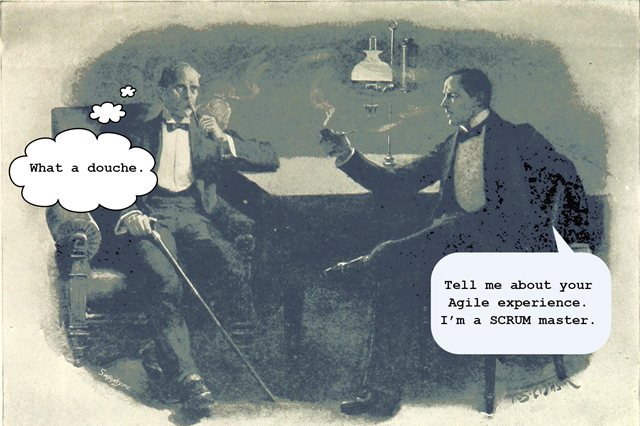
All of this gerrymandering is required in order to get to the next step, the job interview. Unfortunately, the people doing the job interview have little confidence in the resume as a vehicle for accurately describing a candidate’s actually abilities. First of all, they know that recruiters have already gone over it to eliminate useful information and replace it with keywords instead. Next, the interviewers typically haven’t actually seen the HR job specs and do not understand what kind of role they are hiring for. Finally, none of the interviewers have any particular training in doing job interviews or any particular skill in ascertaining what a candidate knows. In short, the interviewer doesn’t know what he’s looking for and wouldn’t know how to get it if he did.

greatestweakness

A savvy interviewer will probably realize that he is looking for the sort of generalist that Joel Spolsky describes as “smart and gets things done,” but how do you interview for that? The tools the interviewer is provided with are not generic but instead highly specific technology skills. At some point, this impedance mismatch between technology specific interview questions on the one had and a desire to hire generalists on the other (technology, after all, simply changes too quickly to look for only one skillset) lead to an increased reliance on behavioral questions and eventually Google-style language games. Neither of these, it turns, out, particularly help in hiring good candidates.

polymorphism

Once we historically severed any attempt to match interview questions to actual skills, the IT interview process was allowed to become a free floating hermeneutic exercise. Abstruse but non-specific questions involving principles and design patterns have taken over the process. This has led to two strange outcomes. On the one hand, job applicants are now required to be fluent in technical information they will never actually use in their jobs. Literary awareness of ten year old blog posts by Martin Fowler are more important than actually knowing how to get things done. And if the job interviewer exhibits any self-awareness when he turns down a candidate for not being clear on the justified uses of the CQRS pattern (there are none), it will not be because the candidate didn’t know something important for the job but rather because the candidate was unwilling to play the software architecture language game, and anyone unwilling to play the game is likely going to be a poor cultural fit.

The other consequence of an increased reliance on abstruse and non-essential IT knowledge has been the rise of the Architect across the industry. The IT industry has created a class of software developers who cannot actually develop software but instead specialize in telling other people what is wrong with their code. The architect is a specialization that probably indicates a deviant phase in the software industry – but at the same time it is a natural outcome of our IT job spec – resume – interview process. The skills of a modern software architect – knowledge of abstruse information and jargon often combined with an inability to get things done – is what we currently look for through our IT cargo cult hiring rituals.

whencanyoustart

This distinction between the ritual of IT hiring and the actual goals of IT hiring become most apparent when we look for specific as opposed to generalist skills. We hire generalists to be on staff over a long period. We hire specialists to perform difficult but real tasks that can eventually be handed over to our generalists – when we need to get something specific done.

Which gets us to the point of this post. What are the skills we should look for when hiring for a HoloLens developer? And what are the skills a HoloLens developer should be highlighting on her resume?

At this point in time, when there is still no SDK generally available for the HoloLens and all HoloLens coders are working for Microsoft and under various NDAs, it is hard to say. Fortunately, important clues have been provided by the recent announcement of the first consulting agency dedicated to the HoloLens and co-founded by someone who has been working on HoloLens applications for Microsoft over the past year. The company Object Theory was just started by Michael Hoffman and Raven Zachary and they threw up a website to advertise this new venture.

Among the tasks involved in creating this sort of extremely specialized website is explaining what capabilities you offer. First, they offer experience since Hoffman has worked on several of the demos that Microsoft has been exhibiting at conferences and in promotional videos. But is this enough of a differentiator? What skills do they have to offer to a company looking to build a HoloLens application?

This is part of the fascination of their “Work” page. It cannot describe any actual work since the company just started and hasn’t technically done any technical work. Instead, it provides a list of capabilities that look amazingly like resume keywords – but different from any keywords you may have come across:


          • Entirely new Natural User Interfaces (NUI)
          • Surface reconstruction and object persistence
          • 3D Spatial HRTF audio
          • Mesh reduction, culling and optimization
          • Baked shadows and ambient occlusion
          • UV mapping
          • Optimized render shaders
          • Efficient WiFi connectivity to back-end services
          • Unity and DirectX
          • Windows 10 APIs


These, in fact, are probably the sorts of skills you should be putting on your resume – or learning about in order to put on your resume – if getting a job programming HoloLens is your goal.

The verso side of this coin is that the list can also be turned into a great set of interview questions for someone thinking of hiring for HoloLens development, for instance:

Explain the concept of NUI to me.

Tell me about your experience with surface reconstruction and object persistence.

What is 3D spatial HRTF audio and why is it important for engineering HoloLens apps?

What are mesh reduction, mesh culling and mesh optimization?

Do you know anything about baked shadows and ambient occlusion?

Describe how you would go about performing UV mapping.

What are optimized render shaders and when would you need them?

How does the HoloLens communicate with external services such as a database?

What are the advantages and disadvantages of developing in Unity vs DirectX?

Describe the Windows 10 APIs that are used in HoloLens application development.


Then again, maybe these questions are a bit too abstruse?

HoloLens App Development with Unity

A few months ago I wrote a speculative piece about how HoloLens might work with XAML frameworks based on the sample applications Microsoft had been showing.

Even though Microsoft has still released scant information about integration with 3D platforms, I believe I can provide a fairly accurate walkthrough of how HoloLens development will occur for Unity3D. In fact, assuming I am correct, you can begin developing games and applications today and be in a position to release a HoloLens experience shortly after the hardware becomes available.

To be clear, though, this is just speculative and I have no insider information about the final product that I can talk about. This is just what makes sense based on publicly available information regarding HoloLens.

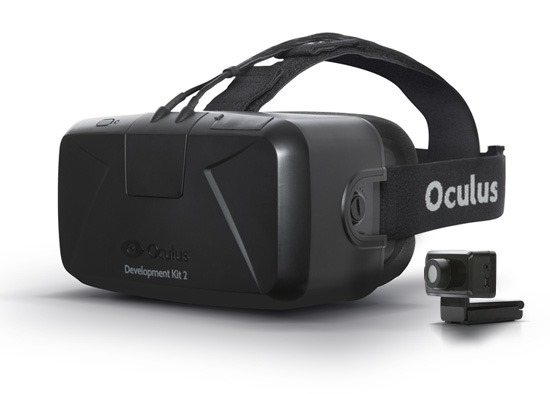
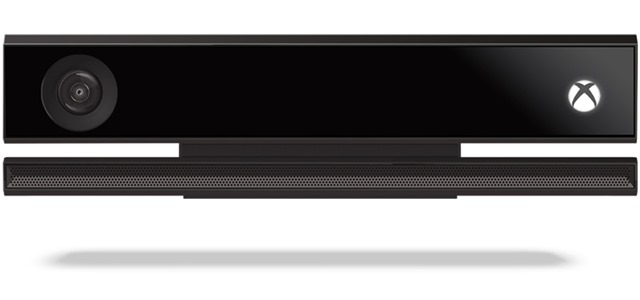
Unity3D integration with third party tools such as Kinect and Oculus Rift occurs through plugins. The Kinect 2 plugin can be somewhat complex as it introduces components that are unique to the Kinect’s capabilities.

The eventual HoloLens plugin, on the other hand, will likely be relatively simple since it will almost certainly be based on a pre-existing component called the FPSController (in Unity 5.1 which is currently the latest).

To prepare for HoloLens, you should start by building your experience with Unity 5.1 and the FPSController component. Here’s a quick rundown of how to do this.

Start by installing the totally free Unity 5.1 tools: http://unity3d.com/get-unity/download?ref=personal

newproject

Next, create a new project and select 3D for the project type.

newprojectcharacters

Click the button for adding asset packages and select Characters. This will give you access to the FPSController. Click done and continue. The IDE will now open with an practically empty project.

assetstore

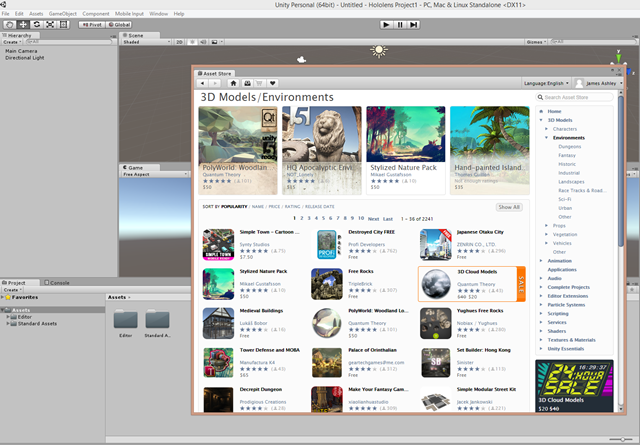
At this point, a good Unity3D tutorial will typically show you how to create an environment. We’re going to take a shortcut, however, and just get a free one from the Asset Store. Hit Ctrl+9 to open the Asset Store from inside your IDE. You may need to sign in with your Unity account. Select the 3D Models | Environments menu option on the right and pick a pre-built environment to download. There are plenty of great free ones to choose from. For this walkthrough, I’m going to use the Japanese Otaku City by Zenrin Co, Ltd.

import

After downloading is complete, you will be presented with an import dialog box. By default, all assets are selected. Click on Import.

hierarchy_window

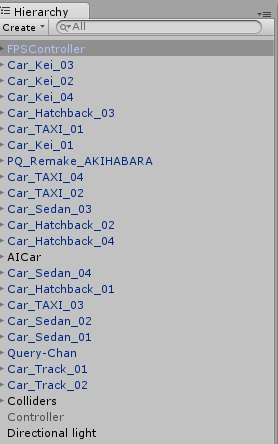
Now that the environment you selected has been imported, go the the scenes folder in your project window and select a sample scene from the downloaded environment. This will open up the city or dungeon or forest or whatever environment you chose. It will also make all the different assets and components associated with the scene show up in your Hierarchy window. At this point, we want to add the first-person shooter controller into the scene. You do this by selecting the FPSController from the project window under Assets/Standard Assets/Characters/FirstPersonCharacter/Prefabs and dragging the FPSController into your Hierarchy pane.

fpscontroller

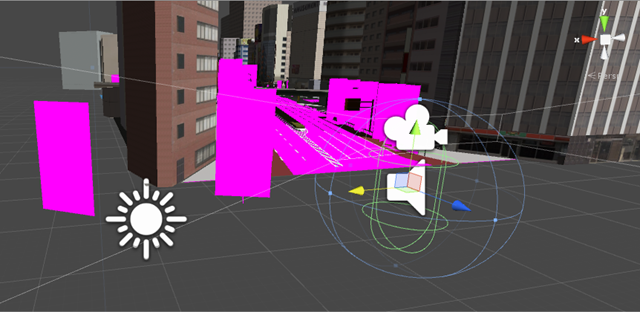
This puts a visual representation of the FPS controller into your scene. Select the controller with your mouse and hit “F” to zoom in on it. You can see from the visual representation that the FPS controller is basically a collision field that can be moved with a keyboard or gamepad that additionally has a directional camera component and a sound component attached. The direction the camera faces ultimately become the view that players see when you start the game.

dungeon

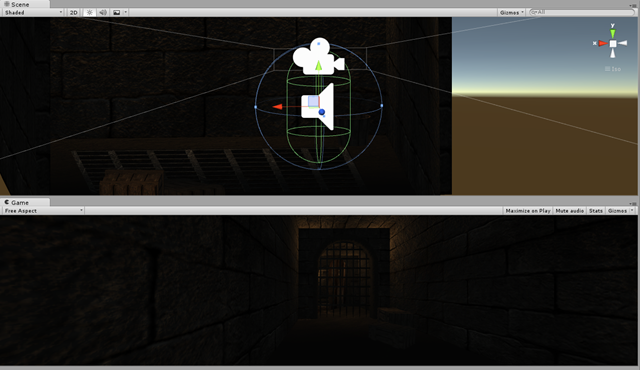
Here is another scene that uses the Decrepit Dungeon environment package by Prodigious Creations and the FPS controller. The top pane shows a design view while the bottom pane shows the gamer’s first-person view.

buttons

You can even start walking through the scene inside the IDE by simply selecting the blue play button at the top center of the IDE.

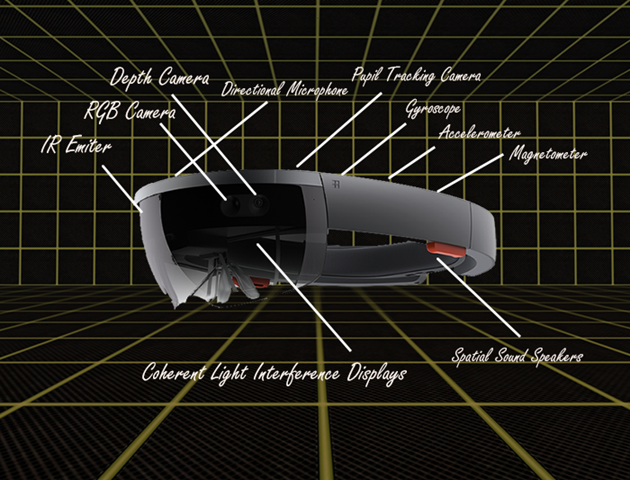
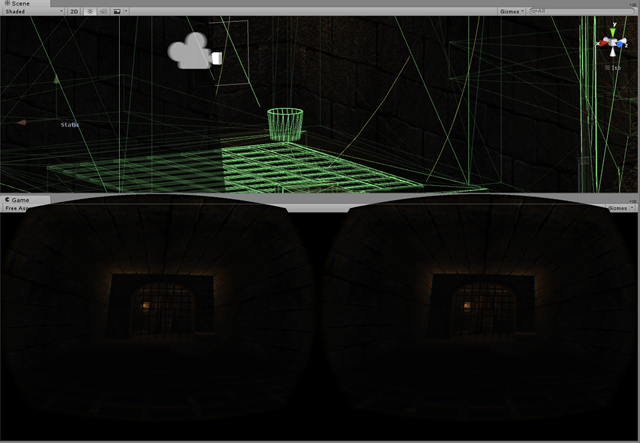
The way I imagine the HoloLens integration to work is that another version of FPS controller will be provided that replaces mouse controller input with gyroscope/magnetometer input as the player rotates her head. Additionally, the single camera view will be replaced with a two camera rig that sends two different, side-by-side feeds back to the HoloLens device. Finally, you should be able to see how all of this works directly in the IDE like so:

stereoscope

There is very good evidence that the HoloLens plugin will work something like I have outlined and will be approximately this easy. The training sessions at the Holographic Academy during /Build pretty much demonstrated this sort of toolchain. Moreover, this is how Unity3D currently integrates with virtual reality devices like Gear VR and Oculus Rift. In fact, the screen cap of the Unity IDE above is from an Oculus game I’ve been working on.

So what are you waiting for? You pretty much have everything you already need to start building complex HoloLens experiences. The integration itself, when it is ready, should be fairly trivial and much of the difficult programming will be taken care of for you.

I’m looking forward to seeing all the amazing experiences people are building for the HoloLens launch day. Together, we’ll change the future of personal computing!

Marshall McLuhan and Understanding Digital Reality

Understanding McLuhan

While slumming on the internet looking for new content about digital media I came across this promising article entitled Virtual Reality, Augmented Reality and Application Development. I was feeling hopeful about it until I came across this peculiar statement:

“Of the two technologies, augmented reality has so far been seen as the more viable choice…”

What a strange thing to write. Would we ever ask whether the keyboard or the mouse is the more viable choice? The knife or the fork? Paper or plastic? It should be clear by now that this is a false choice and not a case of having your cake or eating it, too. We all know that the cake is a lie.

But this corporate blog post was admittedly not unique in creating a false choice between virtual reality and augmented reality. I’ve come across this before and it occurred to me that this might be an instance of a category mistake. A category mistake is itself a category of philosophical error identified by the philosopher Gilbert Ryle to tackle the sticky problem of Cartesian dualism. He pointed out that even though it is generally accepted in the modern world that mind is not truly a separate substance from mind but is in fact a formation that emerges in some fashion out of the structure of our brains, we nevertheless continue to divide the things of the world, almost as if by accident, into two categories: mental stuff and material stuff.

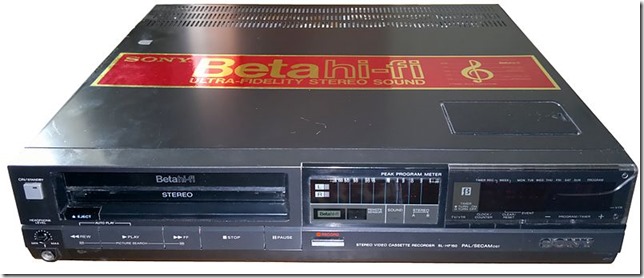
sony betamax

There are certainly cases of competing technologies where one eventually dies off. The most commonly cited example is the Betamax and VHS. Of course, they both ultimately died off and it is meaningless today to claim that either one really succeeded. There are many many more examples of apparently technological duels in which neither party ultimately falls or concedes defeat. PC versus Mac. IE vs Chrome. NHibernate vs EF. etc.

The rare case is when one technology completely dominates a product category. The few cases where this has happened, however, have so captured our imaginations that we forget it is the exception and not the rule. This is the case with category busters like the iPhone and the iPad – brands that are so powerful it has taken years for competitors to even come up with viable alternatives.

What this highlights is that, typically, technology is not a zero sum game. The norm in technology is that competition is good and leads to improvements across the board. Competition can grow an entire product category. The underlying lie, however, is perhaps that each competitor tells itself that they are in a fight to the death and that they are the next iPhone. This is rarely the case. The lie beneath that lie is that each competitor is hoping to be bought out by another larger company for billions of dollars and has to look competitive up until that happens. A case of having your cake and eating it, too.

stop_staring

There is, however, a category in which one set of products regularly displace another set of products. This happens in the fashion world.

Each season, each year, we change out our cuts, our colors and accessories. We put away last year’s fashions and wouldn’t be caught dead in them. We don’t understand how these fashion changes occur or what rules they obey but the fashion houses all seem to conform to these unwritten rules of the season and bring us similar new things at the proper time.

This is the category mistake that people make when they ask things such as which is more viable: augmented reality or virtual reality? Such questions belong to the category of fashion (which is in season: earth tones or pastels?) and not to technology. In the few unusual cases where this does happen, then the category mistake is clearly in the opposite direction. The iPhone and iPad are not technologies: they are fashion statements.

Virtual reality and augmented reality are not fashion statements. They aren’t even technologies in the way we commonly talk about technology today – they are not software platforms (though they require SDKs), they are not hardware (though they are useless without hardware), they are not development tools (you need 3D modeling tools and game engines for this). In fact, they have more in common with books, radio, movies and television than they do to software. They are new media.

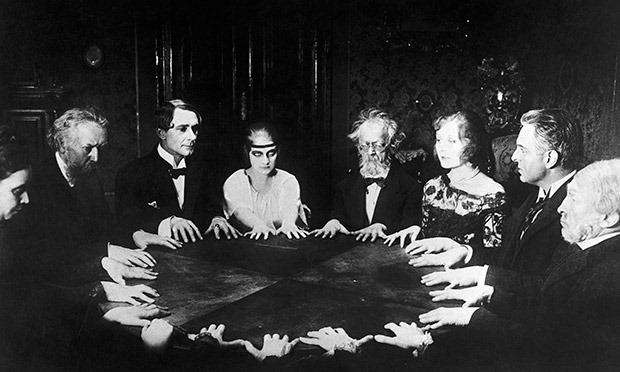
Dr Mabuse

A medium, etymologically speaking, is the thing in the middle. It is a conduit from a source to a receiver – from one world to another. A medium lets us see or hear things we would otherwise not have access to. Books allow us to hear the words of people long dead. Radio transmits words over vast distances. Movies and television let us see things that other people want us to see and we pay for the right to see those things. Augmented reality and virtual reality, similarly, are conduits for new content. They allow us to see and hear things in ways we haven’t experienced content before.

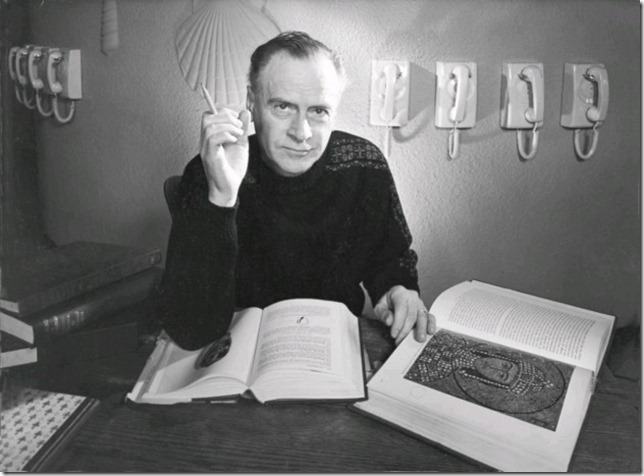
The moment we cross over from talking about technology and realize we are talking about media, we automatically invoke the spirit of Marshall McLuhan, the author of Understanding Media: The Extensions of Man. McLuhan thought deeply about the function of media in culture and many of his ideas and aphorisms, such as “the medium is the message,” have become mainstays of contemporary discourse. Other concepts that were central to McLuhan’s thought still elude us and continue to be debated. Among these are his two media categories: hot and cold.

understanding media

McLuhan claimed that any media is either hot or cold, warm or cool. Cool mostly means what we think it means metaphorically; for instance, James Dean is cool in exactly the way McLuhan meant. Hot media, in turn, is in most ways what you would think it is: kinetic with a tendency to overwhelm the senses. To illustrate what he meant by hot and cold, McLuhan often provides contrasting examples. Movies are a hot medium. Television is a cold medium. Jazz is a hot medium. The twist is a cool medium. Cool media leave gaps that the observer must fill in. It is highly participatory. Hot media is a wall of sensation that does not require any filling in: McLuhan characterizes it as “high definition.”

I think it is pretty clear, between virtual reality and augmented reality, which falls into the category of a cool medium and which a hot one.

To help you come to your own conclusions about how to categorize augmented reality glasses and the virtual reality goggles, though, I’ll provide a few clues from Understanding Media:

“In terms of the theme of media hot and cold, backward countries are cool, and we are hot. The ‘city slicker’ is hot, and the rustic is cool. But in terms of the reversal of procedures and values in the electric age, the past mechanical time was hot, and we of the the TV age are cool. The waltz was hot, fast mechanical dance suited to the industrial time in its moods of pomp and circumstance.”


“Any hot medium allows of less participation than a cool one, as a lecture makes for less participation than a seminar, and a book for less than dialogue. With print many earlier forms were excluded from life and art, and many were given strange new intensity. But our own time is crowded with examples of the principle that the hot form excludes, and the cool one includes.”


“The principle that distinguishes hot and cold media is perfectly embodied in the folk wisdom: ‘Men seldom make passes at girls who wear glasses.’ Glasses intensify the outward-going vision, and fill in the feminine image exceedingly, Marion the Librarian notwithstanding. Dark glasses, on the other hand, create the inscrutable and inaccessible image that invites a great deal of participation and completion.”


audrey hepburn glasses

Minecraft in Virtual Reality and Augmented Reality

minecraft_ar_godview

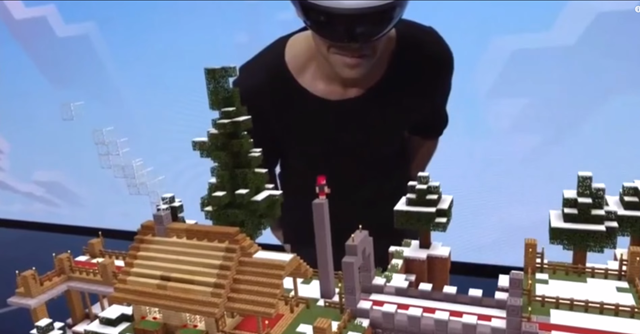
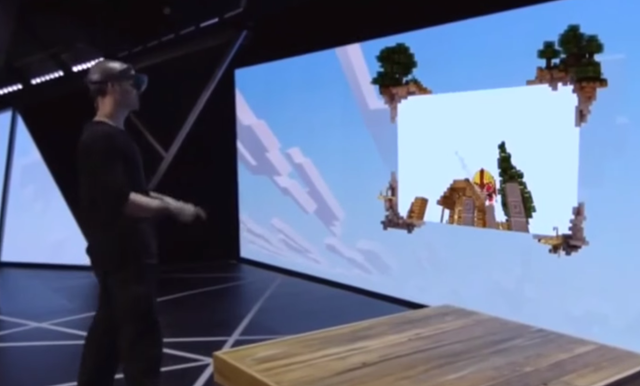
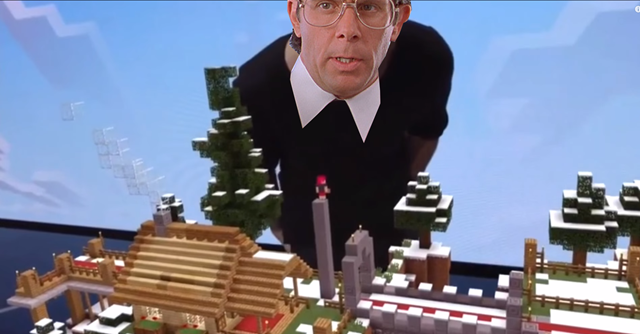
Microsoft recently created possibly the best demo they have ever done on stage for E3. Microsoft employees played Minecraft in a way no one has ever seen it before, on a table top as if it was a set of legos. Many people speculated on social media that this may be the killer app that HoloLens has been looking for.

What is particularly exciting about the way the demo captured people’s imaginations is that they can start envisioning what AR might actually be used for. People are even getting a firm grip on the differences between Virtual Reality, which creates an immersive experience, and augmented reality which creates a mixed experience overlapping digital objects with real world objects.

Nevertheless, there is still a tendency to see virtual reality exemplified by the Oculus Rift and augmented reality exemplified by HoloLens and Magic Leap as competing solutions. In fact they are complementary solutions. They don’t compete with one another any more than your mouse and your keyboard do.

Bill Buxton has famously said that everything is best for something and worst for something else. By contrasting the Minecraft experience for Oculus and HoloLens, we can better see what each technology is best at.


minecraft_vr

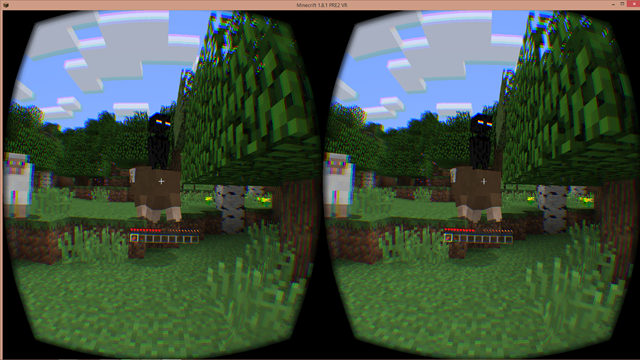
The Virtual Reality experience for Oculus is made possible by a free hacking effort called Minecrift. It highlights the core UX flavor of almost all VR experiences – they are first person, with the player fully present in a 3D virtual world. VR is great for playing Minecraft in adventure or survival mode.

minecraft_ar_wall

Adventure mode with HoloLens is roughly equivalent to the adventure mode we get today on a PC or XBOX console with the added benefit that the display can be projected on any wall. It isn’t actually 3D, though, as far as we can tell from the demo, despite the capability of displaying stereoscopic scenes with HoloLens.

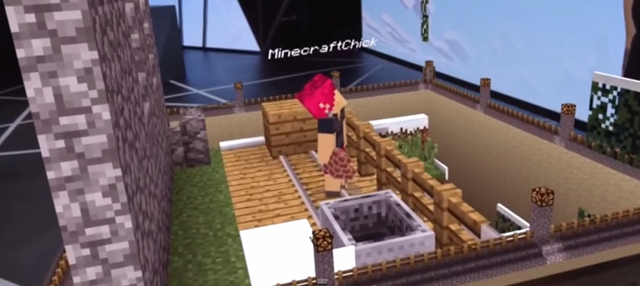
What does work well, however, is Minecraft in creation mode. This is basically the god view we have become familiar with from various strategy and resource games over the years.

minecraft_ar_closeup

God View vs First Person View

In a fairly straightforward way, it makes sense to say that AR is best for a god-centric view while VR is best for a first-person view. For instance, if we wanted to create a simulation that allows users to fly a drone or manipulate an undersea robot, virtual reality seems like the best tool for the job. When we need to create a synoptic view of a building or even a city, on the other hand, then augmented reality may be the best UX. Would it be fair to say that all new UX experiences fall into one of these two categories?


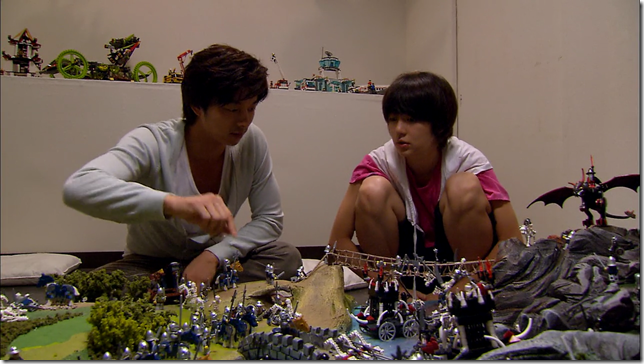
Most of our metaphors for building software, building businesses and building every other kind of buildable thing, after all, are based on the lego building block and it’s precursors the Lincoln log and erector sets. We play games as children in order, in part, to prepare ourselves for thinking as adults. Minecraft was built similarly on the idea of creating a simulation of a lego block world that we could not only build but also virtually play in on the computer.

lego_astronaut

The playful world of Lego blocks is built on two things: the blocks themselves formed into buildings and scenes and the characters that we identify with who live inside the world of blocks. In other words the god-view and the first-person view.

coffee prince

It should come as no surprise, then, that these two core modes of our imaginative lives should stay with us through our childhoods and into our adult approaches to the world. We have both an interpersonal side and an abstract, calculating side. The best leaders have a bit of both.

minecraft_ar_limburgh 

You apparently didn’t put one of the new coversheets on your TPS report

The god-view in business tends to be the synoptic view demanded by corporate executives and provided in the form of dashboards or crystal reports. It would be a shame if AR ended up falling into that use-case when it can provide so much more and in more interesting ways. As both VR and AR mature over the next five years, we all have a responsibility to keep them anchored in the games of our childhood and avoid letting them become the faults and misdemeanors of the corporate adult world.

Update 6/20

A recent arstechnica article indicates that the wall-projected HoloLens version of Minecraft in adventure mode can be played in true 3D:

One other impressive feature of the HoloLens-powered virtual screen was the ability to activate a three-dimensional image, so that the scene seemed to recede into the wall like a window box. Unlike a standard 3D monitor, this 3D image actually changed perspective based on the viewing angle. If I went up near the wall and looked at the screen from the left, I could see parts of the world that would usually be behind the right side of the wall, as if the screen was simply a window into another world.

Jon Snow Lives (and how he would do it)


unjon

Those watching Game of Thrones on TV just got the last of George R. R. Martin’s big whammies. Book readers have known about this since around 2011. They also have had almost four years to come up with rescue plans for one of their favorite characters. Here are a few that have been worked out over the years. For a series that is famous for killing characters off, there are a surprising number of ways to bring people back in Westeros. Remember, in the game of thrones, you win or you die or you somehow get resurrected. People always forget that last part.

1. Julius Ceasar Jon — dead is dead. Got to throw this out there even though no one really believes it.
2. Jesus Christ Jon — As the Azor Ahai Jon somehow resurrects himself. The best scenario I saw is that they attempt to burn his body but he rises from the ashes.

dondarrion
3. UnJon — Melisandre does some blood magic to bring Jon back like Thoros brings back Beric Dondarrion. Mel and Thoros worship the same god and use similar magic.
4. Sherlock Holmes Jon — Jon fakes his own death in order to leave the wall.
5. J.R. Ewing Jon — the antecedents are Arya at the twins and Theon’s fake out with Bran’s and Rickon’s bodies at Winterfell — Jon isn’t dead at all and survives his cuts. The narrative and screen cuts just makes us think he’s dead.
6. General Hospital Jon — in a coma.
7. Jon Cleese — just a flesh wound.

8. Do Over Jon — Mel or Wildling medicine restores Jon with no lasting effects. No better or worse than before.
9. Cold Hands Jon — there are good wights, too, after all. In the books, there is a character referred to as Cold Hands who has all the characteristics of a white walker but is helpful.

wight 
10. Other Jon (aka Darth Jon) — and then again, there are bad wights (most of them, in fact). This would be the graying of Jon Snow’s character if he goes over to the dark side, per prophecy and fan theory.
11. Alter-Jon — like the Mace/Rattleshirt switcheroo in the books, someone else has been glamored to look like Jon. The faceless men have this magic, so we know it exists.

Bran 
12. Targ Warg Jon — warging runs in the Stark blood. This opens up additional variations:

12a. Ghost Jon — Jon lives out the next season in his wolf Ghost.
12b. Ice Jon — He goes to Ghost but comes back into his own body which is preserved in a frozen state under the Wall.
12c. Wun Wun Jon — From Ghost to a nice new strong body with a simple mind (a book specific theory).
12d. Stannis Jon — From Ghost to Stannis — if Stannis is dead, he won’t be needing his body. Plus this would allow Jon to prosecute his war against the Lannisters, taking up from his brother Rob.
12e. Dragon Jon — Jon goes to Ghost and then into one of Dany’s dragons (or maybe another dragon under the Wall or under Winterfell). Makes him literally the third head of the dragon (you followers of ancient Westeros prophecies know what I’m talkin’ about – yeah you do).

13. Kentucky Fried Jon — like Victarion’s arm (old book history), a healing magic to sustain life through burning.

clegane

14. Frankenstein’s Monster Jon – Qyburn, we discover in the season finally, has basically brought Gregor Clegane back to life (Gregorstein) through some kind of laboratory science. If Jon is put on ice, Qyburn may eventually do the same for Jon. Or mix and match the two, who knows.

Emgu, Kinect and Computer Vision

monalisacv

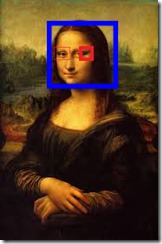
Last week saw the announcement of the long awaited OpenCV 3.0 release, the open source computer vision library originally developed by Intel that allows hackers and artists to analyze images in fun, fascinating and sometimes useful ways. It is an amazing library when combined with a sophisticated camera like the Kinect 2.0 sensor. The one downside is that you typically need to know how to work in C++ to make it work for you.

This is where EmguCV comes in. Emgu is a .NET wrapper library for OpenCV that allows you to use some of the power of OpenCV on .NET platforms like WPF and WinForms. Furthermore, all it takes to make it work with the Kinect is a few conversion functions that I will show you in the post.

Emgu gotchas

The first trick is just doing all the correct things to get Emgu working for you. Because it is a wrapper around C++ classes, there are some not so straightforward things you need to remember to do.

1. First of all, Emgu downloads as an executable that extracts all its files to your C: drive. This is actually convenient since it makes sharing code and writing instructions immensely easier.

2. Any CPU isn’t going to cut it when setting up your project. You will need to specify your target CPU architecture since C++ isn’t as flexible about this as .NET is. Also, remember where your project’s executable is being compiled to. For instance, an x64 debug build gets compiled to the folder bin/x64/Debug, etc.

3. You need to grab the correct OpenCV C++ library files and drop them in the appropriate target project file for your project. Basically, when you run a program using Emgu, your executable expects to find the OpenCV libraries in its root directory. There are lots of ways to do this such as setting up pre-compile directives to copy the necessary files. The easiest way, though, is to just go to the right folder, e.g. C:\Emgu\emgucv-windows-universal-cuda 2.4.10.1940\bin\x64, copy everything in there and paste it into the correct project folder, e.g. bin/x64/Debug. If you do a straightforward copy/paste, just remember not to Clean your project or Rebuild your project since either action will delete all the content from the target folder.

4. Last step is the easiest. Reference the necessary Emgu libraries. The two base ones are Emgu.CV.dll and Emgu.Util.dll. I like to copy these files into a project subdirectory called libs and use relative paths for referencing the dlls, but you probably have your own preferred way, too.

WPF and Kinect SDK 2.0

I’m going to show you how to work with Emgu and Kinect in a WPF project. The main difficulty is simply converting between image types that Kinect knows and image types that are native to Emgu. I like to do these conversions using extension methods. I provided these extensions in my first book Beginning Kinect Programming about the Kinect 1 and will basically just be stealing from myself here.

I assume you already know the basics of setting up a simple Kinect program in WPF. In MainWindow.xaml, just add an image to the root grid and call it rgb:

<Grid> 
    <Image x:Name="rgb"></Image> 
</Grid> 


Make sure you have a reference to the Microsoft.Kinect 2.0 dll and put your Kinect initialization code in your code behind:

KinectSensor _sensor;
ColorFrameReader _rgbReader;


private void InitKinect()
{
    _sensor = KinectSensor.GetDefault();
    _rgbReader = _sensor.ColorFrameSource.OpenReader();
    _rgbReader.FrameArrived += rgbReader_FrameArrived;
    _sensor.Open();
}

public MainWindow()
{
    InitializeComponent();
    InitKinect();
}


protected override void OnClosing(System.ComponentModel.CancelEventArgs e)
{
    if (_rgbReader != null)
    {
        _rgbReader.Dispose();
        _rgbReader = null;
    }
    if (_sensor != null)
    {
        _sensor.Close();
        _sensor = null;
    }
    base.OnClosing(e);
}


Kinect SDK 2.0 and Emgu


You will now just need the extension methods for converting between Bitmaps, Bitmapsources, and IImages. In order to make this work, your project will additionally need to reference the System.Drawing dll:

static class extensions
{

    [DllImport("gdi32")]
    private static extern int DeleteObject(IntPtr o);


    public static Bitmap ToBitmap(this byte[] data, int width, int height
        , System.Drawing.Imaging.PixelFormat format = System.Drawing.Imaging.PixelFormat.Format32bppRgb)
    {
        var bitmap = new Bitmap(width, height, format);

        var bitmapData = bitmap.LockBits(
            new System.Drawing.Rectangle(0, 0, bitmap.Width, bitmap.Height),
            ImageLockMode.WriteOnly,
            bitmap.PixelFormat);
        Marshal.Copy(data, 0, bitmapData.Scan0, data.Length);
        bitmap.UnlockBits(bitmapData);
        return bitmap;
    }

    public static Bitmap ToBitmap(this ColorFrame frame)
    {
        if (frame == null || frame.FrameDescription.LengthInPixels == 0)
            return null;

        var width = frame.FrameDescription.Width;
        var height = frame.FrameDescription.Height;

        var data = new byte[width * height * PixelFormats.Bgra32.BitsPerPixel / 8];
        frame.CopyConvertedFrameDataToArray(data, ColorImageFormat.Bgra);

        return data.ToBitmap(width, height);
    }

    public static BitmapSource ToBitmapSource(this Bitmap bitmap)
    {
        if (bitmap == null) return null;
        IntPtr ptr = bitmap.GetHbitmap();
        var source = System.Windows.Interop.Imaging.CreateBitmapSourceFromHBitmap(
        ptr,
        IntPtr.Zero,
        Int32Rect.Empty,
        System.Windows.Media.Imaging.BitmapSizeOptions.FromEmptyOptions());
        DeleteObject(ptr);
        return source;
    }

    public static Image<TColor, TDepth> ToOpenCVImage<TColor, TDepth>(this ColorFrame image)
        where TColor : struct, IColor
        where TDepth : new()
        {
            var bitmap = image.ToBitmap();
            return new Image<TColor, TDepth>(bitmap);
        }

    public static Image<TColor, TDepth> ToOpenCVImage<TColor, TDepth>(this Bitmap bitmap)
        where TColor : struct, IColor
        where TDepth : new()
    {
        return new Image<TColor, TDepth>(bitmap);
    }

    public static BitmapSource ToBitmapSource(this IImage image)
    {
        var source = image.Bitmap.ToBitmapSource();
        return source;
    }
   
}

Kinect SDK 2.0 and Computer Vision


Here is some basic code to use these extension methods to extract an Emgu IImage type from the ColorFrame object each time Kinect sends you one and then convert the IImage back into a BitmapSource object:

void rgbReader_FrameArrived(object sender, ColorFrameArrivedEventArgs e)
{
    using (var frame = e.FrameReference.AcquireFrame())
    {
        if (frame != null)
        {
            var format = PixelFormats.Bgra32;
            var width = frame.FrameDescription.Width;
            var height = frame.FrameDescription.Height;
            var bitmap = frame.ToBitmap();
            var image = bitmap.ToOpenCVImage<Bgr,byte>();

            //do something here with the IImage 
            //end doing something


            var source = image.ToBitmapSource();
            this.rgb.Source = source;

        }
    }
}
 

face_capture

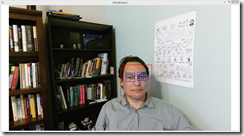
You should now be able to plug in any of the sample code provided with Emgu to get some cool CV going. As an example, in the code below I use the Haarcascade algorithms to identify heads and eyes in the Kinect video stream. I’m sampling the data every 10 frames because the Kinect is sending 30 frames a second while the Haarcascade code can take as long as 80ms to process. Here’s what the code would look like:

int frameCount = 0;
List<System.Drawing.Rectangle> faces;
List<System.Drawing.Rectangle> eyes;

void rgbReader_FrameArrived(object sender, ColorFrameArrivedEventArgs e)
{
    using (var frame = e.FrameReference.AcquireFrame())
    {
        if (frame != null)
        {
            var format = PixelFormats.Bgra32;
            var width = frame.FrameDescription.Width;
            var height = frame.FrameDescription.Height;
            var bitmap = frame.ToBitmap();
            var image = bitmap.ToOpenCVImage<Bgr,byte>();

            //do something here with the IImage 
            int frameSkip = 10;
            //every 10 frames

            if (++frameCount == frameSkip)
            {
                long detectionTime;
                faces = new List<System.Drawing.Rectangle>();
                eyes = new List<System.Drawing.Rectangle>();
                DetectFace.Detect(image, "haarcascade_frontalface_default.xml", "haarcascade_eye.xml", faces, eyes, out detectionTime);
                frameCount = 0;
            }

            if (faces != null)
            {
                foreach (System.Drawing.Rectangle face in faces)
                    image.Draw(face, new Bgr(System.Drawing.Color.Red), 2);
                foreach (System.Drawing.Rectangle eye in eyes)
                    image.Draw(eye, new Bgr(System.Drawing.Color.Blue), 2);
            }
            //end doing something


            var source = image.ToBitmapSource();
            this.rgb.Source = source;

        }
    }
}


Why are the best Augmented Reality Experiences inside of Virtual Reality Experiences?

elite_cockpit

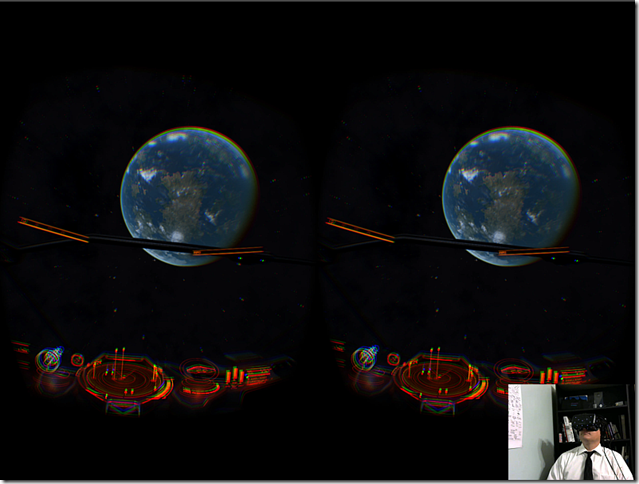
I’ve been playing the Kickstarted space simulation game Elite: Dangerous for the past several weeks with the Oculus Rift DK2. Totally work related, of course.

Basically I’ve had the DK2 since Christmas and had been looking for a really good game to go with my device (rather than the other way around). After shelling out $350 for the goggles, $60 more for a game didn’t seem like such a big deal.

In fact, playing Elite: Dangerous with the Oculus and an XBox One gamepad has been one of the best gaming experiences I have ever had in my life – and I’m someone who played E.T. on the Atari 2600 when it first came out so I know what I’m talking about, yo. It is a fully realized Virtual Reality environment which allows me to fly through a full simulation of the galaxy based on current astronomical data. When I am in the simulation, I objectively know that I am playing a game. However, all of my peripheral awareness and background reactions seem to treat the simulation as if it is real. My sense of space changes and my awareness expands into the virtual space of the simulation. If I don’t mistake the VR experience for reality, I nevertheless do experience a strong suspension of disbelief when I am inside of it.

elite_cockpit2

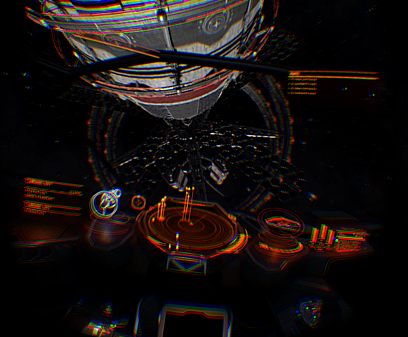
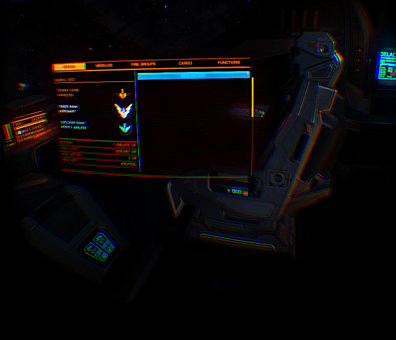
One of the things I’ve found fascinating about this Virtual Reality simulation is that it is full of Augmented Reality objects. For instance, the two menu bars at the top of the screencap above, to the top left and the top right, are full holograms. When I move my head around, parallax effects demonstrate that their positions are anchored to the cockpit rather than to my personal perspective. If the VR goggles allowed me to do it, I would be able to even lean forward and look at the backside of those menus. Interestingly, when the game is played in normal 3D first person mode rather than VR with the Oculus, those menus are rendered as head-up displays and are anchored to my point of view as I use the mouse to look around the cockpit — in much the same way that google glass anchored menus to the viewer instead of the viewed.

The navigation objects on the dashboard in front of me are also AR holograms. Their locations are anchored to the cockpit rather than to me, and when I move around I can see them at different angles. At the same time, they exhibit a combination of glow and transparency that isn’t common to real-world objects and that we have come to recognize, from sci fi movies, as the inherent characteristics of holograms.

I realized at about the 60 hour mark into my gameplay \ research that one of the current opportunities as well as problems with AR devices like the Magic Leap and HoloLens is that not many people know how to develop UX for them. This was actually one of the points of a panel discussion concerning HoloLens at the recent BUILD conference. The field is wide open. At the same time, UX research is clearly already being done inside VR experiences like Elite: Dangerous. The hologram-based control panel at the front of the cockpit is a working example of how to design navigation tools using augmented reality.

elite_cockpit3

Another remarkable feature of the HoloLens is the use of gaze as an input vector for human-computer interactions. Elite: Dangerous, however, has already implemented it. When the player looks at certain areas of the cockpit, complex menus like the one shown in the screencap above pop into existence. When one removes one’s direct gaze, the menu vanishes. If this were a usability test for gaze-based UI, Elite: Dangerous will have already collected hours of excellent data from thousands of players to verify whether this is an effective new interaction (in my experience, it totally is, btw). This is also the exact sort of testing that we know will need to be done over the next few years in order to firm up and conventionalize AR interactions. By happenstance, VR designers are already doing this for AR before AR is even really on the market.

sao1

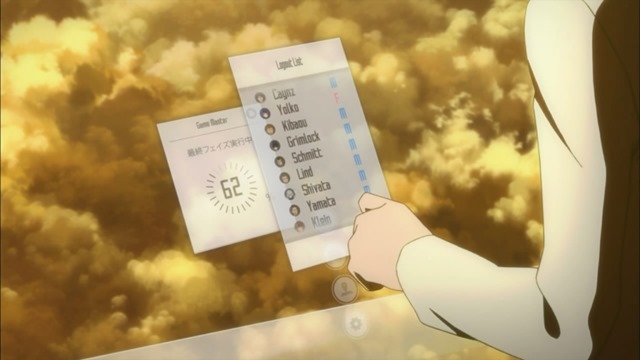
The other place augmented reality interaction design research is being carried out is in Japanese anime. The image above is from a series called Sword Art Online. When I think of VR movies, I think of The Matrix. When I put my children into my Oculus, however, they immediately connected it to SAO. SAO is about a group of beta testers for a new MMORPG that requires virtual reality goggles who become trapped inside the MMORPG due to the evil machinations of one of the game developers. While the setting of the VR world is medieval, players still interact with in-game AR control panels.

sao2

Consider why this makes sense when we ask the hologram versus head-up display question. If the menu is anchored to our POV, it becomes difficult to actually touch menu items. They will move around and jitter as the player looks around. In this case, a hologram anchored to the world rather than to the player makes a lot more sense. The player can process the consistent position of the menu and anticipate where she needs to place her fingers in order to interact with it. Sword Art Online effectively provides what Bill Buxton describes as a UX sketch for interactions of this sort.

On an intellectual level, consider how many overlapping interaction metaphors are involved in the above sketch. We have a 1) GUI-based menu system transposed to 2) touch (no right clicking) interactions, then expressed as 3) an augmented reality experience placed inside of 4) a virtual reality experience (and communicated inside a cartoon).

Why is all of this possible? Why are the best augmented reality experiences inside of virtual reality experiences and cartoons? I think it has to do with cost of execution. Illustrating an augmented reality experience in an anime is not really any more difficult than illustrating a field of grass or a cute yellow gerbil-like character. The labor costs are the same. The difficulty is only in the conceptualization.

Similarly, throwing a hologram into a virtual reality experience is not going to be any more difficult than throwing a tree or a statue into the VR world. You just add some shaders to create the right transparency-glowy-pulsing effect and you have a hologram. No additional work has to be done to marry the stereoscopic convergence of hologram objects and the focal position of real world locations as is required for really good AR. In the VR world, these two things – the hologram world and the VR world – are collapsed into one thing.

There has been a tendency to see virtual reality and mixed reality as opposed technologies. What I have learned from playing with both, however, is that they are actually complementary technologies. While we wait for AR devices to be released by Microsoft, Magic Leap, etc. it makes sense to jump into VR as a way to start understanding how humans will interact with digital objects and how we must design for these interactions. Additionally, because of the simplification involved in creating AR for VR rather than AR for reality, it is likely that VR will continue to hold a place in the design workflow for prototyping our AR experiences even years from now when AR becomes not only a reality but an integral thread in the fabric of reality.

On The Gaze as an input device for Hololens

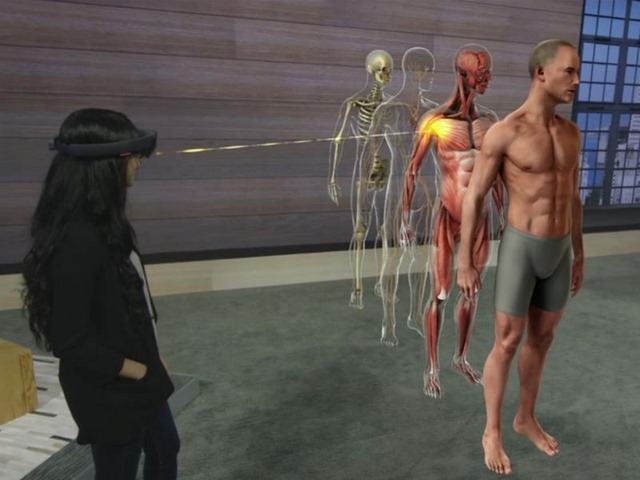
microsoft-hololens-build-anatomy

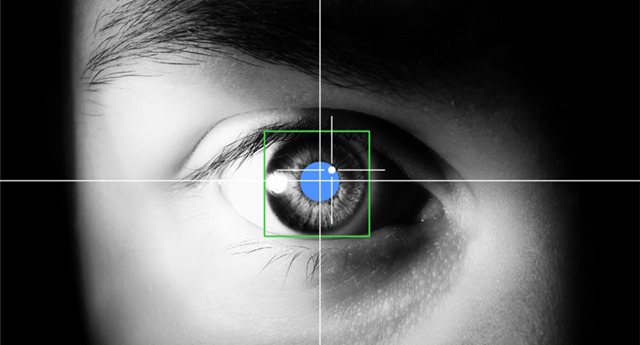
The Kinect sensor and other NUI devices have introduced an array of newish interaction patterns between humans and computers: tap, touch, speech, finger tracking, body gestures. The hololens provides us with a new method of interaction that hasn’t been covered extensively from a UX perspective before: The Gaze. Hololens performs eye tracking in order to aid users of the AR device to activate menus.

Questions immediately arise as to the role this will play in surveillance culture, and even more in the surveillance of surveillance culture. While sensors track our gaze, will they similarly inform us about the gaze of others? Will we one day receive notifications that someone is checking us out? Quis custodiet ipsos custodes? To the eternal question who watches the watchers, we finally have an answer. HoloLens does.

lacan gaze

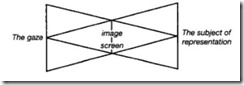
Even though The Gaze has not been analyzed deeply from a UX perspective, it has been the object of profound study from a phenomenological and a structuralist point of view. In this post I want to introduce you to five philosophical treatments of The Gaze covering the psychological, the social, the cinematic, the ethical and the romantic. To start, the diagram above is not from an HCI book as one might reasonably assume but rather from a monograph by the psychoanalyst Jacques Lacan.

the_ambassadors

A distinction is often drawn between Lacan’s early studies of The Gaze and his later conclusions about it. The early work relates it to a “mirror stage” of self-awareness and concerns the gaze when directed to ourselves rather than to others:

“This event can take place … from the age of six months on; its repetition has often given me pause to reflect upon the striking spectacle of a nursling in front of a mirror who has not yet mastered walking or even standing, but who … overcomes, in a flutter of jubilant activity, the constraints of his prop in order to adopt a slightly leaning-forward position and take in an instantaneous view of the image in order to fix it in his mind.”

This notion flowered in the later work The Split Between the Eye and the Gaze into a theory of narcissism in which the subject sees himself/herself as an objet petit a (a technical term for an object of desire) through the distancing effect of the gaze. Through this distancing, the subject also become alienated from itself. What is probably essential for us in this work – as students of emerging technologies –  is the notion that the human gaze is emotionally distancing. This observation was later taken up in post-colonial theory as the “Imperial Gaze” and in feminist theory as “objectification.”

eye-tracking

Michel Foucault achieved fame as a champion of the constructivist interpretation of truth but it is often forgotten that he was also an historian of science. A major theme in his work is the way in which the gaze of the other affects and shapes us – in particular the “scientific gaze.” Being watched causes us discomfort and we change our behavior – sometimes even our perception of who we are – in response to it. The grand image Foucault raises to encapsulate this notion is Jeremy Bentham’s Panopticon, a circular prison in which everyone is watched by everyone else.

THE HOUSEHOLD OF PHILIP IV or LAS MENINAS by Juan Bautista Martinez del Mazo (c1612-15-1667) after Diego Velazquez (1599 - 1660), at Kingston Lacy, Dorset

Where Lacan concentrates on the self-gaze and Foucault on the way the gaze makes us feel, Slovoj Zizek is concerned with the appearance of The Gaze when we gaze back at it. He writes in an essay called “Why Does the Phaullus Appear” from the collection Enjoy Your Symptom:

Shane Walsh (Jon Bernthal) - The Walking Dead - Season 2, Episode 12 - Photo Credit: Gene Page/AMC

Let us take the ‘phantom of the opera,’ undoubtedly mass culture’s most renowned specter, which has kept the popular imagination occupied from Gaston Leroux’s novel at the turn of the century through a series of movie and television versions up to the recent triumphant musical: in what consists, on a closer look, the repulsive horror of his face? The features which define it are four:

“1) the eyes: ‘his eyes are so deep that you can hardly see the fixed pupils. All you can see is two big black holes, as in a dead man’s skull.’ To a connoisseur of Alfred Hitchcock, this image instantly recalls The Birds, namely the corpse with the pecked-out eyes upon which Mitch’s mother (Jessica Tandy) stumbles in a lonely farmhouse, its sight causing her to emit a silent scream. When, occasionally, we do catch the sparkle of these eyes, they seem like two candles lit deep within the head, perceivable only in the dark: these two lights somehow at odds with the head’s surface, like lanterns burning at night in a lonely, abandoned house, are responsible for the uncanny effect of the ‘living dead.’”

Obviously whatever Zizek says about the phantom of the opera applies equally well to The Walking Dead. What ultimately distinguishes vampires, zombies, demons and ghosts lies in the way they gaze at us.

While Zizek finds in the eyes a locus for inhumanity, the ethicist Emmanual Levinas believes this is where our humanity resides. These two notions actually complement each other, since what Zizek indentifies as disturbing is the inability to project a human mind behind a vacant stare. As Levinas says in a difficult and metaphysical way in his masterpiece Totality and Infinity:

“The presentation of the face, expression, does not disclose an inward world previously closed, adding thus a new region to comprehend or to take over. On the contrary, it calls to me above and beyond the given that speech already puts in common among us…. The third party looks at me in the eyes of the Other – language is justice. It is not that there first would be the face, and then the being it manifests or expresses would concern himself with justice; the epiphany of the face qua face opens humanity…. Like a shunt every social relation leads back to the presentation of the other to the same without the intermediary of any image or sign, solely by the expression of the face.”

The face and the gaze of the other implies a demand upon us. For Levinas, unlike Foucault, this demand isn’t simply a demand to behave according to norms but more broadly posits an existential command. The face of the other asks us implicitly to do the right thing: it demands justice.

new_optics_06

The final aspect of the gaze to be discussed – though probably the first aspect to occur to the reader – is the gaze of love, i.e. love at first sight. This was a particular interest of the scholar Ioan P. Couliano. In his book Eros and Magic in the Renaissance Couliano examines old medical theories about falling in love and cures for infatuation and obsession. He relates this to Renaissance theories about pneuma [spiritus, phantasma], which was believed to be a pervasive fluid that allowed objects to be sensed through apparently empty air and become transmitted to the brain and the heart. In this regard, Couliano raises a question that would only make sense to a true Renaissance man: “How does a woman, who is so big, penetrate the eyes, which are so small?” He quotes the 13th century Bernard of Gordon:

Leopold_von_Sacher-Masoch_with_Fannie

The illness called ‘hereos’ is melancholy anguish caused by love for a woman. The ‘cause’ of this affliction lies in the corruption of the faculty to evaluate, due to a figure and a face that have made a very strong impression. When a man is in love with a woman, he thinks exaggeratedly of her figure, her face, her behavior, believing her to be the most beautiful, the most worthy of respect, the most extraordinary with the best build in body and soul, that there can be. This is why he desires her passionately, forgetting all sense of proportion and common sense, and thinks that, if he could satisfy his desire, he would be happy. To so great an extent is his judgment distorted that he constantly thinks of the woman’s figure and abandons all his activities so that, if someone speaks to him, he hardly hears him.”

And here is Couliano’s gloss of Bernard’s text:

RokebyVenus

“If we closely examine Bernard of Gordon’s long description of ‘amor hereos,’ we observe that it deals with a phantasmic infection finding expression in the subject’s melancholic wasting away, except for the eyes. Why are the eyes excepted? Because the very image of the woman has entered the spirit through the eyes and, through the optic nerve, has been transmitted to the sensory spirit that forms common sense…. If the eyes do not partake of the organism’s general decay, it is because the spirit uses those corporeal apertures to try to reestablish contact with the object that was converted into the obsessing phantasm: the woman.”


[As an apology and a warning, I want to draw your attention to the use of ocular vocabulary such as “perspective,” “point of view,” “in this regard,” etc. Ocular phrases are so pervasive in the English language that it is nearly impossible to avoid them and it would be more awkward to try to do so than it is to use them without comment. If you intend to speak about visual imagery, take my advice and pun proudly and without apology – for you will see that you have no real choice in the matter.]

HoloCoding resources from Build 2015

darren! 

The Hololens team has stayed extremely quiet over the past 100 days in order to have a greater impact at Build. Alex Kipman was the cleanup batter on the first day keynote at Build with an amazing overview of realistic Hololens scenarios. This was followed by Hololens demos as well as private tutorials on using Hololens with a version of Unity 3D. Finally there were sessions on Hololens and a pre-recorded session on using the Kinect with the brand new RoomAlive Toolkit.

darren?

Here are some useful links:


There were two things I found particularly interesting in Alex Kipman’s first day keynote presentation.

microsoft-hololens-build-anatomy

The first was the ability of the onstage video to actually capture what was being shown through the hololens but from a different perspective. The third person view of what the person wearing the hololens even worked when the camera moved around the room. Was this just brilliant After Effects work perfectly synced to the action onstage? Or were we seeing a hololens-enabled camera at work? If the latter – this might be even more impressive than the hololens itself.

mission_impossible_five

Second, when demonstrating the ability to pin movies to the wall using Hololens gestures, why was the new Mission Impossible trailer used for the example? Wouldn’t something from, say, The Matrix been much more appropriate.

Perhaps it was just a licensing issue, but I like to think there was a subtle nod to the inexplicable and indirect role Tom Cruise has played in the advancement of Microsoft’s holo-technologies. Minority Report and the image of Cruise wearing biking gloves with his arms raised in the air, conductor-like, was the single most powerful image invoked with Microsoft first introduced the Kinect sensor. As most people know by now, Alex Kipman was the man responsible not only for carrying the Kinect nee Natal Project to success, but now for guiding the development of the Hololens. Perhaps showing Tom Cruise onstage at Build was a subtle nod to this implicit relationship.

The HoloCoder’s Bookshelf

WP_20150430_06_43_49_Pro

Professions are held together by touchstones such as as a common jargon that both excludes outsiders and reinforces the sense of inclusion among insiders based on mastery of the jargon. On this level, software development has managed to surpass more traditional practices such as medicine, law or business in its ability to generate new vocabulary and maintain a sense that those who lack competence in using the jargon simply lack competence. Perhaps it is part and parcel with new fields such as software development that even practitioners of the common jargon do not always understand each other or agree on what the terms of their profession mean. Stack Overflow, in many cases, serves merely as a giant professional dictionary in progress as developers argue over what they mean by de-coupling, separation of concerns, pragmatism, architecture, elegance, and code smell.

Cultures, unlike professions, are held together not only by jargon but also by shared ideas and philosophies that delineate what is important to the tribe and what is not. Between a profession and a culture, the members of a professional culture, in turn, share a common imaginative world that allows them to discuss shared concepts in the same way that other people might discuss their favorite TV shows.

This post is an experiment to see what the shared library of augmented reality and virtual reality developers might one day look like. Digital reality development is a profession that currently does not really exist but which is already being predicted to be a multi-billion dollar industry by 2020.

HoloCoding, in other words, is a profession that exists only virtually for now. As a profession, it will envelop concerns much greater than those considered by today’s software developers. Whereas contemporary software development is mostly about collecting data, reporting on data and moving data from point A to points B and C, spatial software development will be more concerned with environments and will have to draw on complex mathematics as well as design and experiential psychology. The bookshelf of a holocoder will look remarkably different from that of a modern data coder. Here are a few ideas regarding what I would expect to find on a future developer’s bookshelf in five to ten years.


1. Understanding Media by Marshall McLuhan – written in the 60’s and responsible for concepts such as ‘the global village’ and hot versus cool media, McLuhan pioneered the field of media theory.  Because AR and VR are essentially new media, this book is required reading for understanding how these technologies stand side-by-side with or perhaps will supplant older media.

2. Illuminations by Walter Benjamin – while the whole work is great, the essay ‘The Work of Art in the Age of Mechanical Reproduction’ is a must read for discussing how traditional notions about creativity fit into the modern world of print and now digital reproduction (which Benjamin did not even know about). It also deals at an advanced level with how human interactions work on stage versus film and the strange effect this creates.

3. Sketching User Experiences by Bill Buxton – this classic was quickly adopted by web designers when it came out. What is sometimes forgotten is that the book largely covers the design of products and not websites or print media – products like those that can be built with HoloLens, Magic Leap and Oculus Rift. Full of insights, Buxton helps his readers to see the importance of lived experience when we design and build technology.

4. Bergsonism by Gilles Deleuze – though Deleuze is probably most famous for his collaborations with Felix Guattari, this work on the philosophical meaning of the term ‘’virtual reality’, not as a technology but rather as a way of approaching the world, is a gem.

5. Passwords by Jean Baudrillard – what Deleuze does for virtual reality, Baudrillard does for other artifacts of technological language in order to show their place in our mental cosmology. He also discusses virtual reality along the way, though not as thoroughly.

6. Mathematics for 3D Game Programming and Computer Graphics by Eric Lengeyl – this is hardcore math. You will need this. You can buy it used online for about $6. Go do that now.

7. Linear Algebra and Matrix Theory by Robert Stoll – this is a really hard book. Read the Lengeyl before trying this. This book will hurt you, by the way. After struggling with a page of this book, some people end up buying the Manga Guide to Matrix Theory thinking that there is a fun way to learn matrix math. Unfortunately, there isn’t and they always come back to this one.

8. Phenomenology of Perception by Maurice Merleau-Ponty – when it first came out, this work was often seen as an imitation of Heiddeger’s Being and Time. It may be the case that it can only be truly appreciated today when it has become much clearer, thanks to years of psychological research, that the mind reconstructs not only the visual world for us but even the physical world and our perception of 3D spaces. Merleau-Ponty pointed this out decades ago and moreover provides a phenomenology of our physical relationship to the world around us that will become vitally important to anyone trying to understand what happens when more and more of our external world becomes digitized through virtual and augmented reality technologies.

9. Philosophers Explore the Matrix – just as The Matrix is essential viewing for anyone in this field, this collection of essays is essential reading. This is the best treatment available of a pop theme being explored by real philosophers – actually most of the top American philosophers working on theories of consciousness in the 90s. Did you ever think to yourself that The Matrix raised important questions about reality, identity and consciousness? These professional philosophers agree with you.

10. Snow Crash by Neal Stephenson – sometimes to understand a technology, we must extrapolate and imagine how that technology would affect society if it were culturally pervasive and physically ubiquitous. Fortunately Neal Stephenson did that for virtual reality in this amazing book that combines cultural history, computer theory and a fast paced adventure.