Simulations and Simulacra

In a 2010 piece for The New Yorker called Painkiller Deathstreak , the novelist Nicholson Baker reported on his efforts to enter the world of console video games with forays into triple-A titles such as Call of Duty: World at War, Halo 3: ODST, God of War III, Uncharted 2: Among Thieves, and Red Dead Redemption.

rdr1

“[T]he games can be beautiful. The ‘maps’ or ‘levels’—that is, the three-dimensional physical spaces in which your character moves and acts—are sometimes wonders of explorable specificity. You’ll see an edge-shined, light-bloomed, magic-hour gilded glow on a row of half-wrecked buildings and you’ll want to stop for a few minutes just to take it in. But be careful—that’s when you can get shot by a sniper.”

In his journey through worlds rendered on what was considered high-end graphics a decade ago, Nicholson discovered both the frustrations of playing war games against 13 year olds (currently they would be old enough to be stationed in Afghanistan) as well as the peace to be found in virtual environments like Red Dead Redemption’s Western simulator.

Red-Dead-Redemption

“But after an exhausting day of shooting and skinning and looting and dying comes the real greatness of this game: you stand outside, off the trail, near Hanging Rock, utterly alone, in the cool, insect-chirping enormity of the scrublands, feeling remorse for your many crimes, with a gigantic predawn moon silvering the cacti and a bounty of several hundred dollars on your head. A map says there’s treasure to be found nearby, and that will happen in time, but the best treasure of all is early sunrise. Red Dead Redemption has some of the finest dawns and dusks in all of moving pictures.”

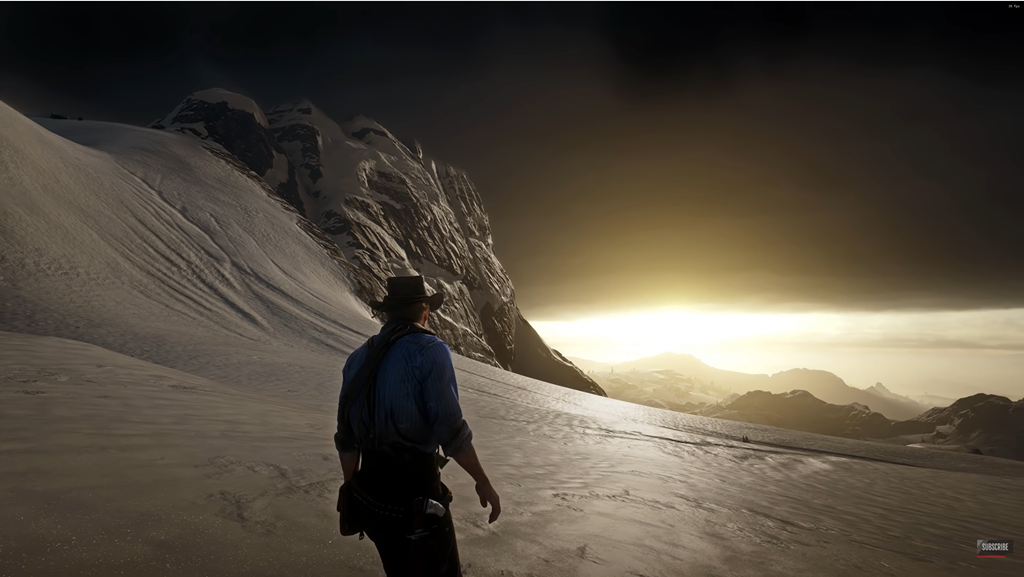
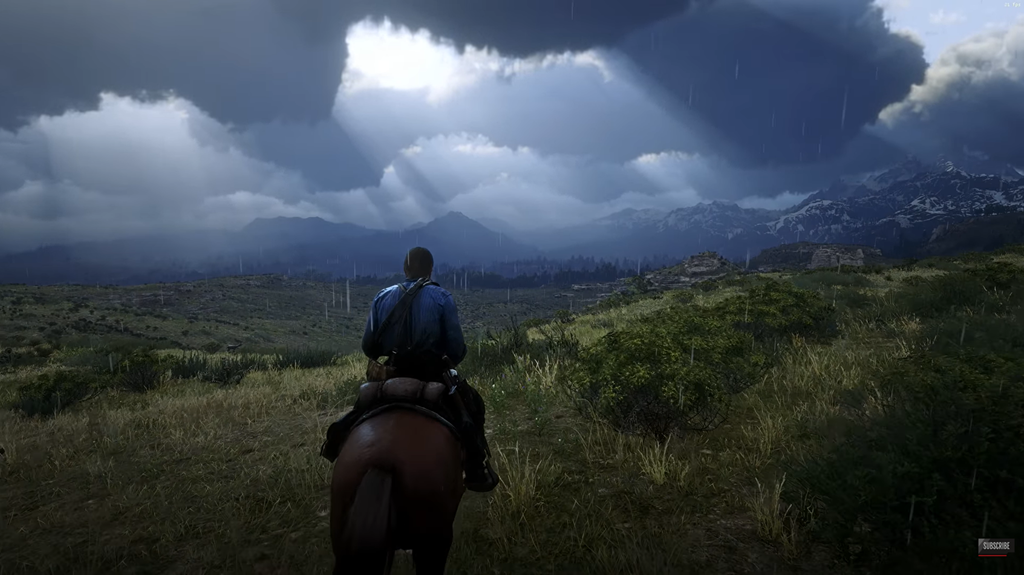
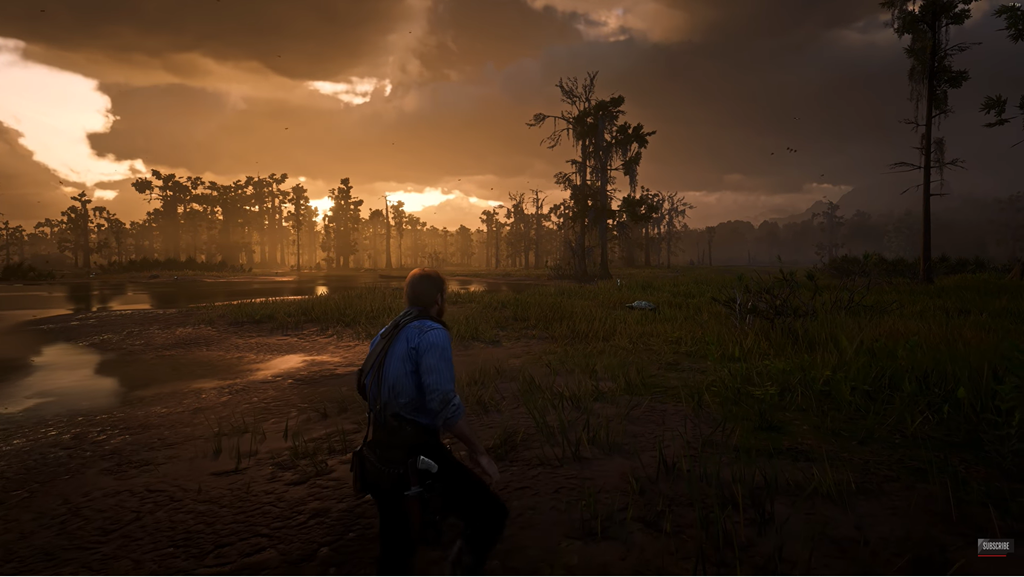
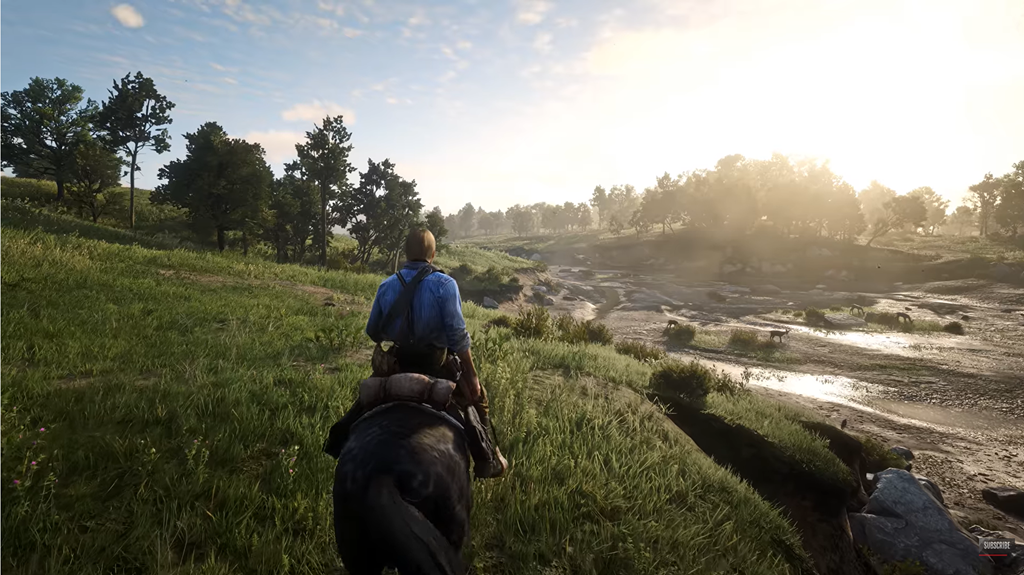
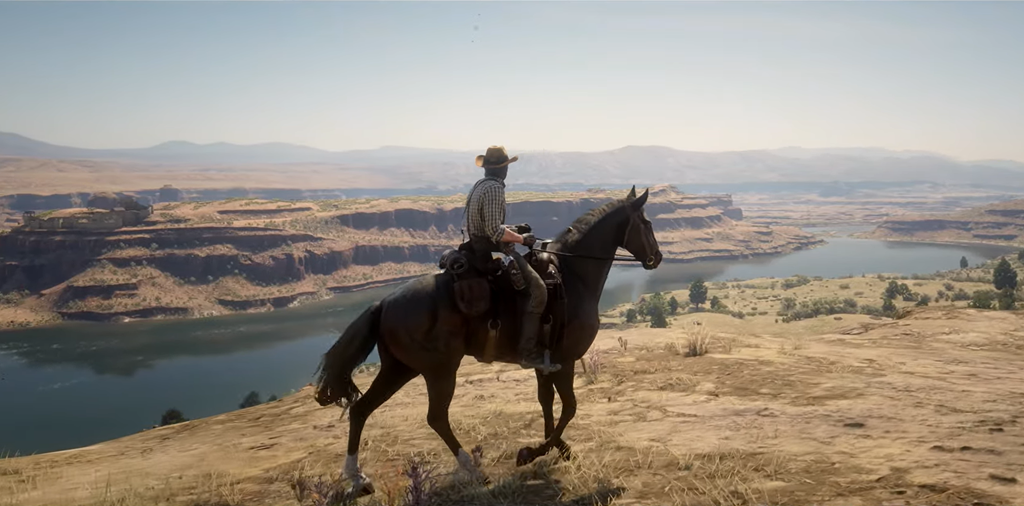
I was reminded of this essay yesterday when Youtube’s algorithms served up  a video of Red Dead Redemption 2 (the sequel to the game Nicholson wrote about) being rendered in 8K on an NVidia 3090 graphics card with raytracing turned on.

The encroachment of simulations upon the real world, to the point that they not only look as good as the real world (real?) but in some aspects even better, has interestingly driven the development of the sorts of AI algorithms that serve these videos up to us on our computers. Simulations require mathematical calculations that cannot be done as accurately or as fast on standard CPUs. This is why hardcore gamers pay upwards of a thousand dollars for bleeding edge graphics cards that are specially designed to perform floating point calculations.

rdr2-4

These types of calculations, interestingly, are also required for working with large data sets for machine learning. The algorithms that steer our online interests, after all, are just simulations themselves, designed to replicate aspects of the real world in order to make predictions about what sorts of videos (based on a predictive model of human behavior honed to our particular tastes) are most likely to increase our dwell time on Youtube.

rdr2-6

Simulations, models and algorithms at this point are all interchangeable terms. The best computer chess programs may or may not understand how chess players think (this is a question for the philosophers). What cannot be denied is that they adequately simulate a master chess player that can beat all the other chess players in the world. Other programs model the stock market and tune them back into the past to see how accurate they are as simulations, then tune them into the future in order to find out what will happen tomorrow – at which point we call them algorithms. Like memory, presence and anticipation for us meatware beings, simulation, model and algorithm make up the false consciousness of AIs.

rdr2_8

Simulacra and Simulation, Jean Baudrillard’s 1981 treatise on virtual reality,  opens with an analysis of the George Luis Borges short story On Exactitude in Science, about imperial cartographers who strive after precision by creating ever larger and larger maps, until the maps eventually achieve a one-to-one scale, becoming exact even as they overtake their intended purpose.

rdr2-5

“The territory no longer precedes the map, nor survives it. Henceforth, it is the map that precedes the territory – precession of simulacra – it is the map that engenders the territory and if we were to revive the fable today, it would be the territory whose shreds are slowly rotting across the map. It is the real, and not the map, whose vestiges subsist here and there, in the deserts which are no longer those of the Empire, but our own. The desert of the real itself.”

I was thinking of Baudrillard and Borges this morning when, by coincidence, Youtube served up a video of comparative map sizes in video games. Even as rendering versimilitude has been one way to gauge the increasing realism of video games, the size of game worlds has been another. A large world provides depth and variety – a simulation of the depth and happenstance we expect in reality – that increases the immersiveness of the game.

rdr2-7

Space exploration games like No Man’s Sky and Elite Dangerous attempt to simulate all of known space as your playing ground, while Microsoft’s Flight Simulator uses data from Bing Maps to allow you to fly over the entire earth. In each case, the increased size is achieved by surrendering on detail. But this setback is temporary, and over time we will be able to match the extent of these simulations with detail, also, until the difference between the real and the model of the real is negligible.

rdr2-9

One of the key difficulties with VR adoption (and to some extent the superiority of AR) is the falling anxiety everyone experiences as they move around in virtual reality. The suspicion that there are hidden objects in the world that the VR experience does not reveal to us prevents us from being fully immersed in the game – except in the case of the highly popular horror genre VR games in which inspiring anxiety is a mark of success. As the movements continue to both increase the detail of our simulations of the real world – to the point of simulating the living room sofa and the kitchen cabinet – and expand the coverage of our simulations across the world so there is no surveillable surface that can escape the increasing exactness of our model, we will eventually overcome VR anxiety. At that point, we will be able to walk around in our VR goggles without ever being afraid of tripping over objects, because there will be a one-to-one correspondence between what we see and what we feel. AR and VR will be indistinguishable at that exacting point, and we will at last be able to tread upon the sands of the desert of the real.

the New XR SDK Pipeline with HoloLens 2: Part 2

In the first part of this series, I provided a detailed walkthrough of setting up a project using new Unity XR SDK pipeline for HoloLens 2 development and how to integrate it with the HoloLens 2 toolchain.

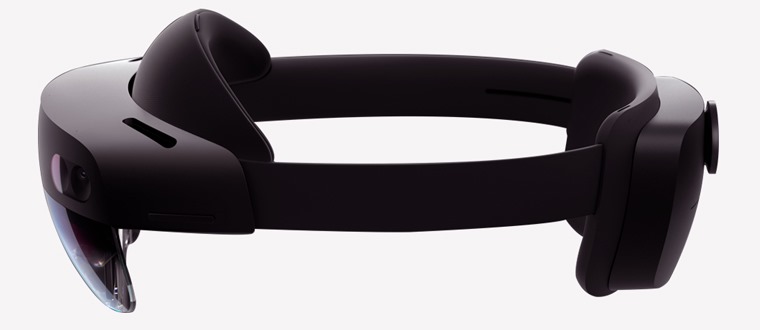
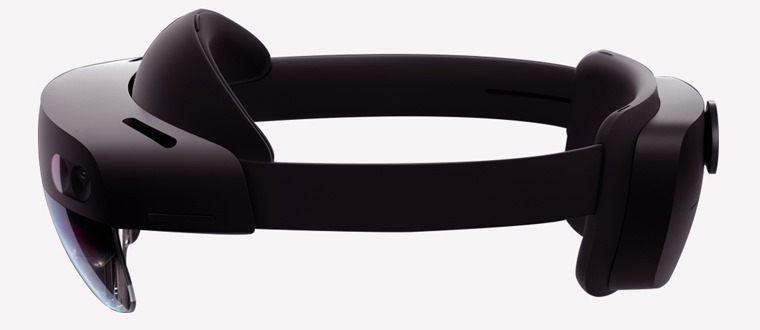
HoloLens2

In this post, I will continue building on that project by showing you how to set up an HoloLens 2 scene in Unity using the Mixed Reality Toolkit. Finally I will show you how to set up and configure one of the MRTK built-in example projects.

Configuring a scene for the HoloLens 2

Use the project from the previous post in which you configured the project settings, player settings, build settings, and imported the MRTK to use with the new XR SDK pipeline.

Setting up a new scene for the HoloLens only takes a few steps.

add_scene

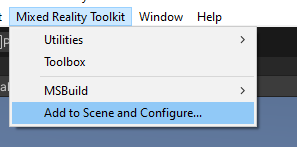
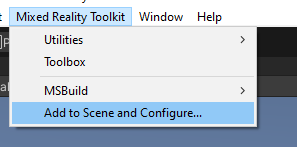
1. From the Mixed Reality Toolkit item in the toolbar, select Add to Scene and Configure.

mrtoolkit

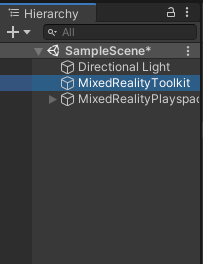
2. This will add the needed MRTK components to your current scene. Verify in the Hierarchy window that your new scene includes the following game objects: Directional Light, MixedReality Toolkit, and Mixed Reality Playspace. Select the MixedReality Toolkit game object.

default_xrsdk

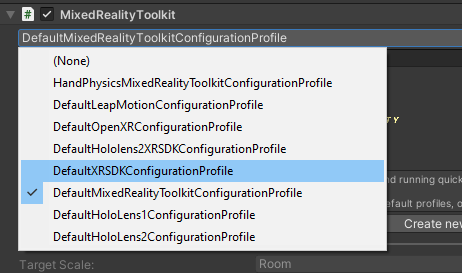
3. In the Inspector pane for the MixedReality Toolkit game object, there is a dropdown of various configuration profiles. The naming of these profiles is confusing. It is extremely important that you switch from the default DefaultMixedRealityToolkitConfigurationProfile to DefaultXRSDKConfigurationProfile. Without making this change, even basic head tracking will not work for you.

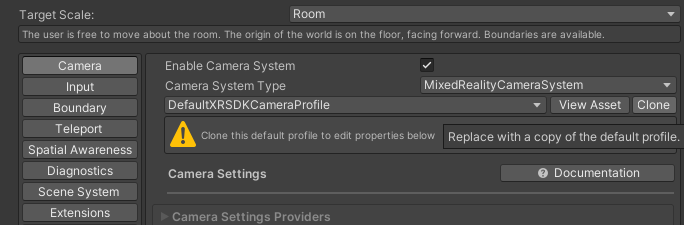
4. Next, click on the Clone button and choose a new pertinent name for your application’s configuration (if  you can’t think of one, then the old standby MyConfigurationProfile will work in a pinch – you can go back and change it later).

cam_clone

5. The MRTK configuration files are set up in a daisy chain fashion, with config files referencing other config files, all of which can be copied and customized. Go ahead and clone the DefaultXRSDKCameraProfile. Rename it to something your can remember (MyCameraProfile will work in a pinch).

6. Save all your changes with Ctrl+S.

Opening an MRTK example project

Being able to test out a working HoloLens 2 application can be instructive. If you followed along with the previous post, you should already have the example scenes imported into your project.

features

If you missed this step, you can open up the Mixed Reality Feature Tool now and import the Mixed Reality Toolkit Examples.

mrtk_examples

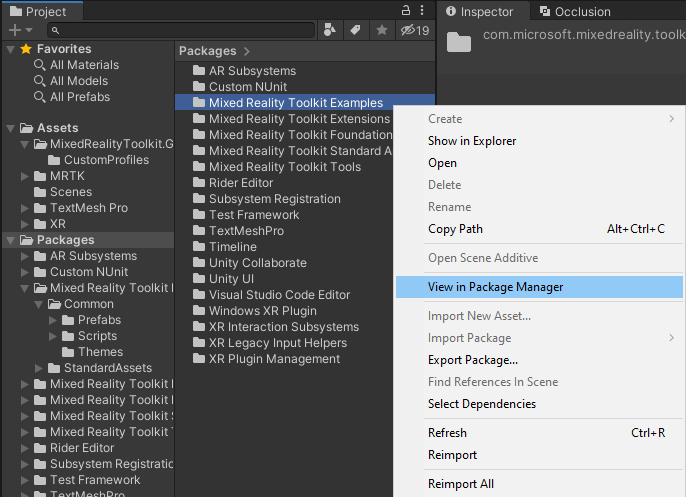
1. After importing, the MRTK examples are still compressed in a package. In the Project pane, navigate to the Packages folder. Then right click on Projects > Mixed Reality Toolkit Examples and click on View in Package Manager in the context menu.

examples_import

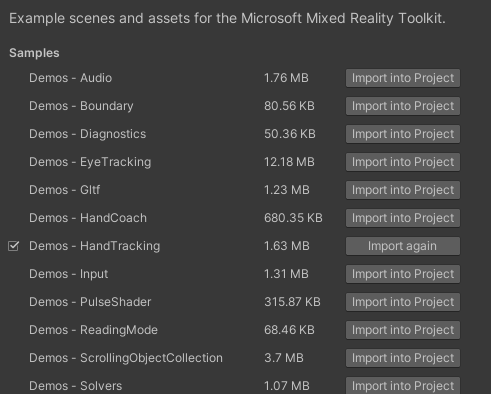
2. In Package Manager, select the Mixed Reality Toolkit Examples package. This will list all of the compressed MRTK demos to the right.

demos_handtracking

3. Click on the Import into Project button next to the Demos – HandTracking sample to decompress it.

hand_inter

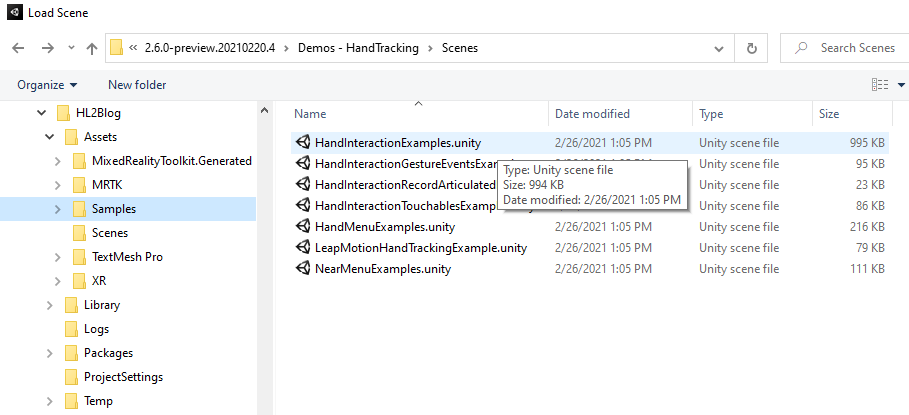
4. There are a few ways to open your scene. I will demonstrate one of them.Type Ctrl+O on your keyboard (this is equivalent to selecting File | Open Scene on the toolbar). A file explorer window will open up. Navigate to the Assets folder for your Unity project. You will find the HandInteractionExample scene under a folder called Samples. Select it.

inter_scene

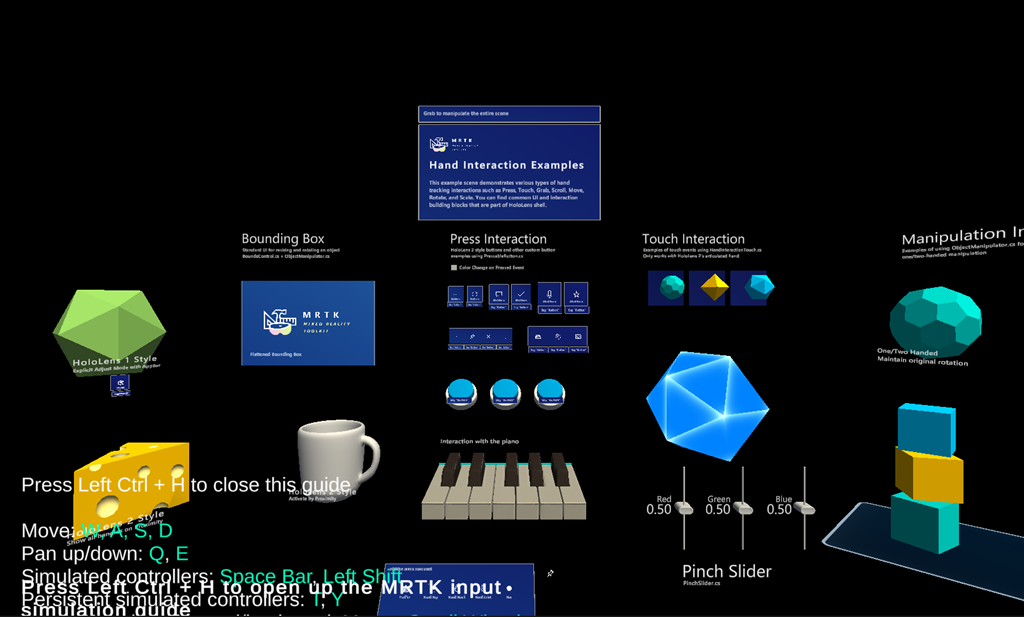
The interaction sample is one of the nicest ways to try out the hand tracking capabilities of the HoloLens 2. It still needs to be configured to work with the new XR SDK pipeline, however.

Configuring an MRTK demo scene

Before deploying this scene to a HoloLens 2, you must first configure the scene to use the XR SDK pipeline.

change_config

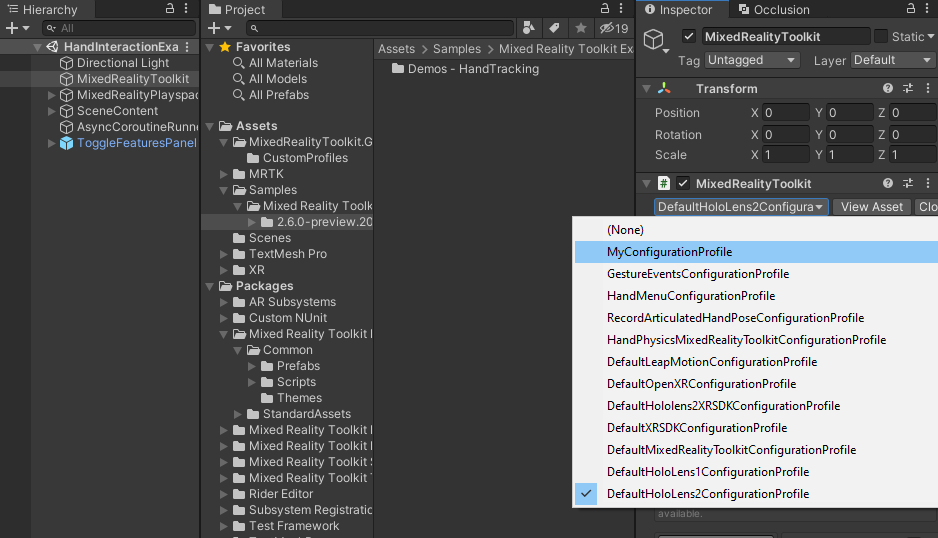
1. Select the MixedRealityToolkit game object in the Hierarchy pane. In the Inspector pane, switch from the default configuration profile to the one you created earlier when you were creating your own scene.

2. Ctrl+S to save your changes.

Preparing the MRTK demo scene for deployment

player_settings

1. Open up the Build Settings window either by typing Ctrl+Shift+B or by selecting File | Build Settings from the project toolbar.

2. Click on the Add Open Scenes button to add the example scene.

3. Ctrl+S to save your build settings.

build_deploy

4. One of the nicest features of the Mixed Reality Toolkit, going back all the way to the original HoloLens Toolkit it developed out of, is the build feature. Building a project for HoloLens has several involved steps which include building a Visual Studio project for UWP, compiling the UWP project into a Windows Store assembly, and finally deploying the appx to either a HoloLens 2 device or to an emulator. The MRTK build window lets you do all of this from inside the Unity IDE.

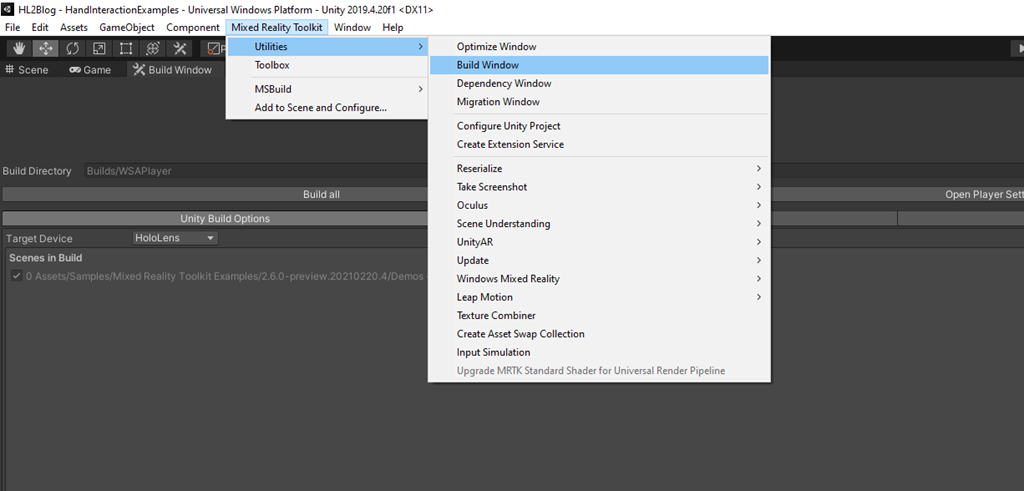
From the Mixed Reality Toolkit menu on the toolbar, select Utilities | Build Window. From here, you can build and deploy your application. Alternatively, you can build your appx file and deploy it from the device portal, which is what I usually do.

Summary

This post completes the walkthrough showing you how to set up and then build a HoloLens 2 application in Unity using the new XR SDK pipeline. It is specifically intended for developers who have developed for the HoloLens before and may have missed a few tool cycles, but should be complete enough to also help developers new to spatial computing get quickly up to speed on the praxis of HoloLens 2 development in Unity.

The New XR SDK Pipeline with HoloLens 2: A Walkthrough

The HoloLens 2 toolchain is under continuous development. In addition, the development of the Mixed Reality Toolkit (MRTK), the developer kit for HoloLens, must be synced with the continuous development of the Unity Game Engine. For these reasons, it is necessary for developers to be careful about using the correct versions of each tool in order to avoid complications.
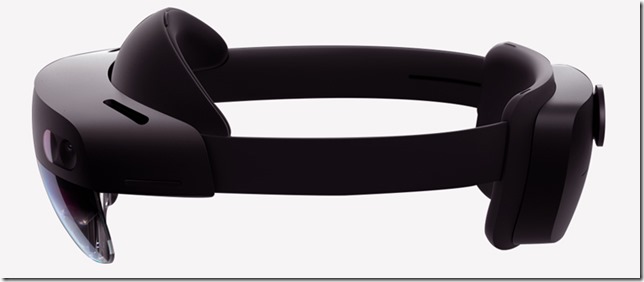
HoloLens2

As of February, 2021, I’m  doing HoloLens development with Visual Studio 2019 v16.5.5, Unity Hub 2.4.2, Unity 2019.4.20f, Mixed Reality Feature Tool 1.0.2102 beta,  MRTK 2.5.4 + MRTK 2.6.0-preview, and Windows 10 Pro 10.0.18363.

MRTK, MR Feature Tool beta,  and the new Unity XR SDK pipeline

The most accurate documentation on getting started with HoloLens 2 development, at this time, is found in the MRTK github repository and on Microsoft’s MR Feature Tool landing page. There are nevertheless some gaps between these two docs that it would be helpful to fill in.

The new Unity XR SDK pipeline is a universal plugin framework that replaces something now known as the legacy Unity XR pipeline. Because of all the moving parts, many people have trouble getting the new pipeline working correctly, especially if they have not kept up with the changes for a while or if they are new to the HoloLens 2.

You will want to download Unity Hub if you don’t have it already.  Unity Hub will help you manage multiple versions of Unity on your development machine. It is fairly common to switch between different versions of Unity if you are working in VR and Mixed Reality as you go back and forth between older versions for maintenance and pursue newer versions for the latest features. As a rule, never upgrade the Unity version of an existing project if things are working well enough.

Create a new unity project

Use the Unity Hub Installs tab to get the latest version of Unity 2019.4, which you will need in order to successfully work with the latest MRTK. Later versions of Unity will not currently work for developing HoloLens 2 applications with the MRTK 2.5.4. Versions earlier than Unity 2018.4 also will not work well.

Some of the documentation mentions using Unity 2020.2 with OpenXR. This is something totally different. Just ignore it.

new_file

Start by creating a new Unity 2019.4 project.

new_2019

When you do this from Unity Hub, you can use the pull down menu to select from any of the versions installed on your development computer.
package_mgr

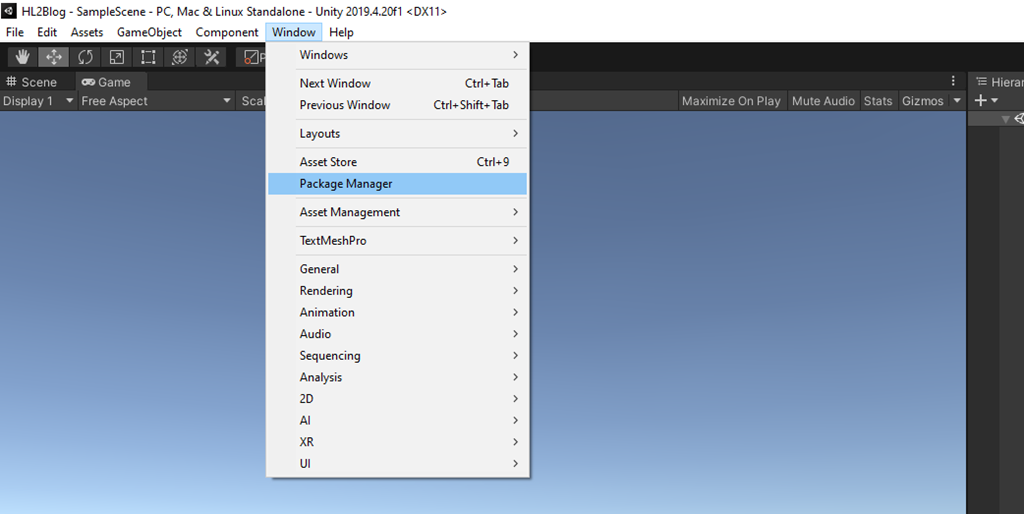
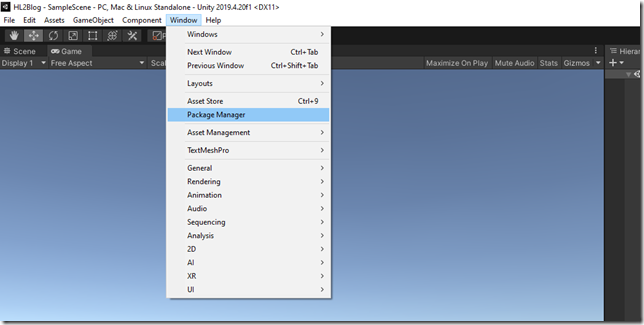
When your Unity app has been created, open the Unity Package Manager from the Windows menu.
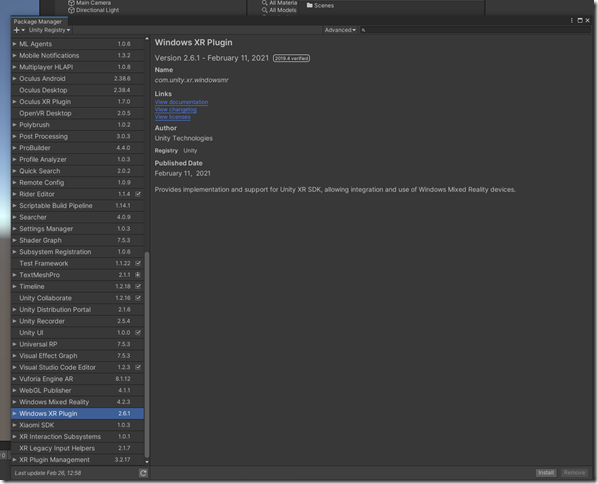
xr_plugin

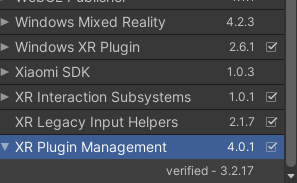
In Package Manager, select the Windows XR Plugin in the left panel. Then click the Install button in the lower left corner of the main panel.
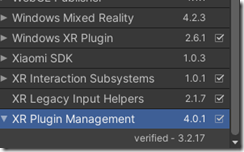
xr_legacy_etc

This will also install the following components automatically: XR Interaction Subsystems, XR Legacy Input Helpers, and XR Plugin Management.

*** Notice that the component called Windows Mixed Reality is not installed. Don’t touch it. This is a left over from the legacy Unity XR pipeline and will eventually be removed from Unity. You will use a different method to get the MRTK into your project. ***

Configure project settings for HoloLens 2

You should now edit your project settings. Open the project settings panel by selecting Edit | Project Settings in the menu bar.

project_settings1

1. Select XR Plug-in Management in the left-hand pane and then, in the main window, check off Windows Mixed Reality to select it as your plug-in provider. This lets the new XR SDK pipeline work with your MRTK libraries (which you will import in the next section).
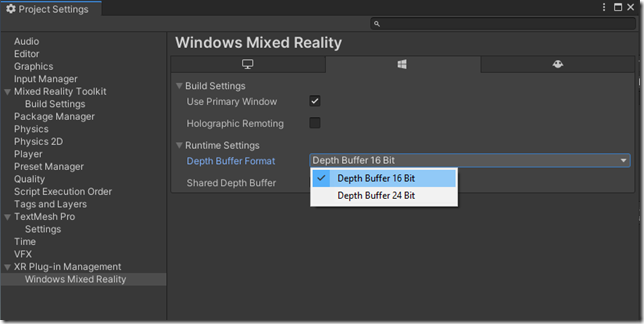
buffer16

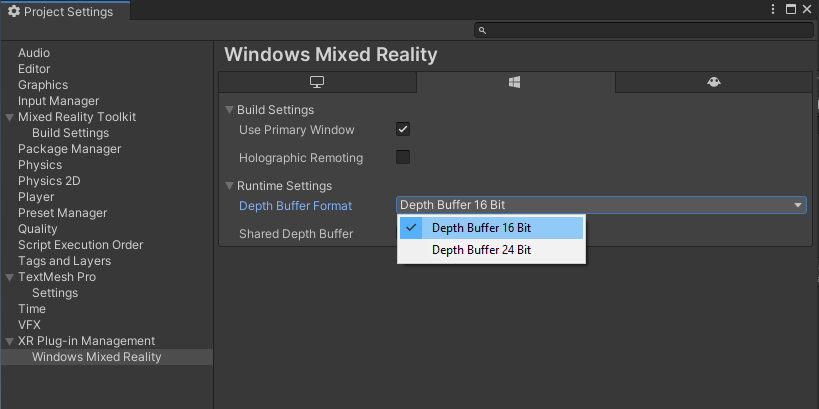
2. Under XR Plug-in Management, select the Windows Mixed Reality entry in the left-hand pane. Make sure Depth Buffer 16 Bit is selected as your Depth Buffer Format and that Shared Depth Buffer is checked off. This will improve the performance of your spatial computing application.
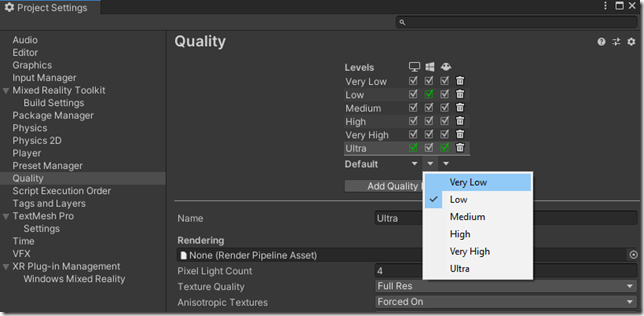
project_settings_qual

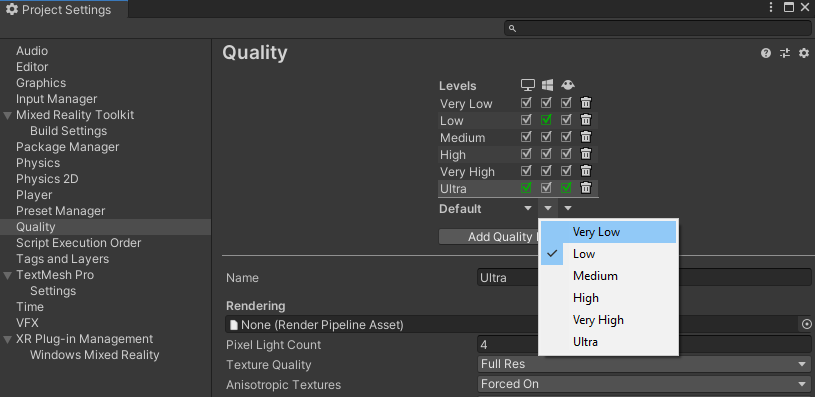
3. Select Quality in the left-hand pane. To improve performance, click the down arrow under the Windows logo to set your default quality setting to Low for your spatial computing application.
tmpro

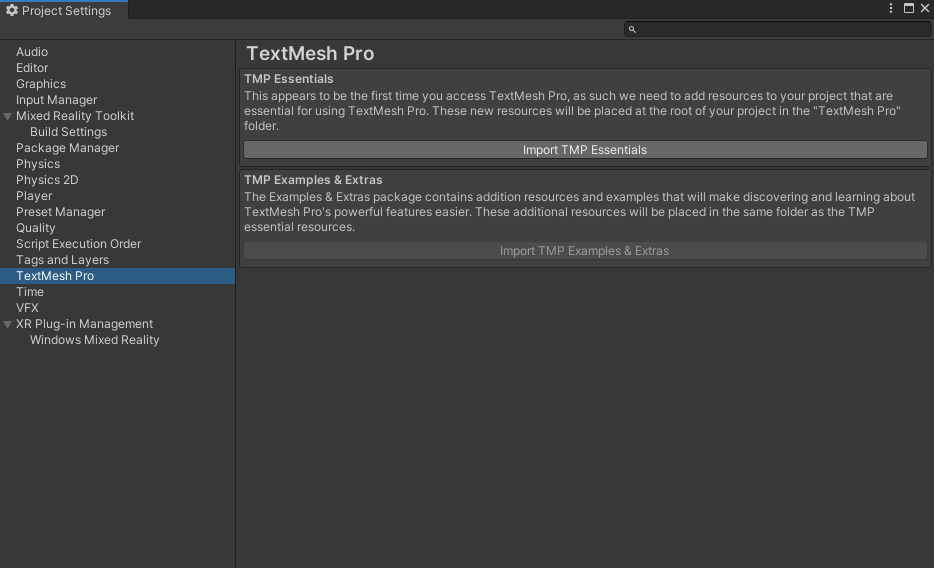
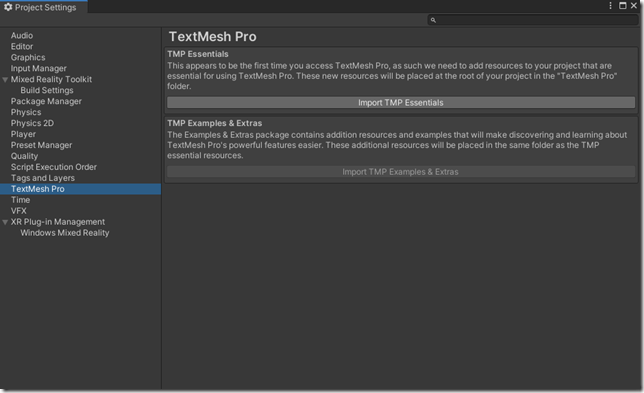
4. While you are configuring your project settings, you might as well also import TextMesh Pro. Select TextMesh Pro in the left-hand pane and click on the Import TMP Essentials button in the main window. TMP will be useful for drawing text objects in your spatial computing application.

player_packagename

5. Select Player  in the right-hand pane to edit your player settings. Change the Package name entry to something relevant for your project. (The project name is how the HoloLens identifies your application. If you are quickly prototyping and deploying projects and forget to change the package name, you will get an obscure message about saying your Template3D package is already installed. This is just the default package name on all new Unity projects.)

You are now ready to import the Mixed Reality Toolkit.

Retrieve MRTK components with MR Feature Tool

The HoloLens team has created a new tool called the Mixed Reality Feature Tool for Unity to help you acquire and deploy the correct version of the MRTK to your project.

feature_tool

1. After downloading the feature tool, you can go into settings and check off the Include preview releases box in order to get the 2.6.0-preview.20210220.4 build of MRTK. Alternatively, you can use MRTK version 2.5.4 if you are uncomfortable with using a preview build.

features

2. Follow the wizard steps to select and download the MRTK features you are interested in. At a minimum, I’d recommend selecting the Toolkit Foundation, Toolkit Extensions, Toolkit Tools, Toolkit Standard Assets, and Toolkit Examples.

fature_path

3. On the Import features screen, select the path to your Unity project. Validate that everything is correct before importing the selected features into your Unity HoloLens 2 project.

4. Click on the Import button.

Configure build settings for HoloLens 2

As the MRTK libraries are added to your project, your Unity project may hang while it is being refreshed if you still have it open (which is very okay).
add_scene

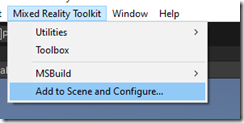
1. When the refresh is done, the Mixed Reality Toolkit item will appear your Unity menu bar.
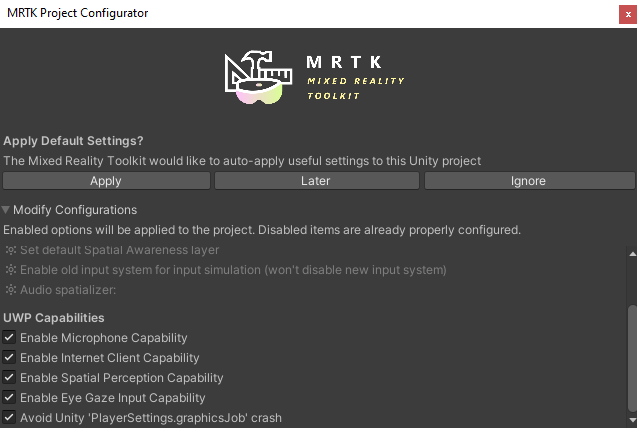
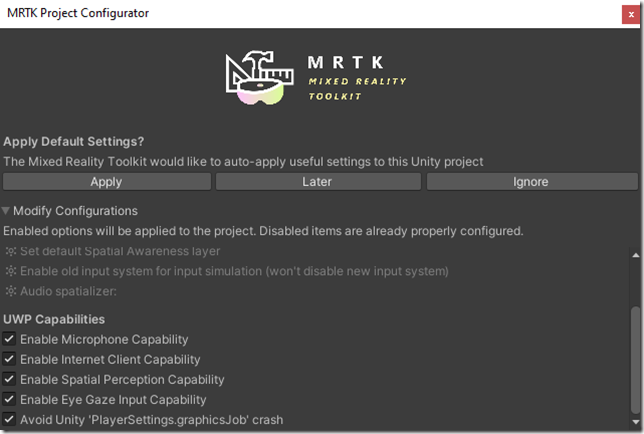
apply

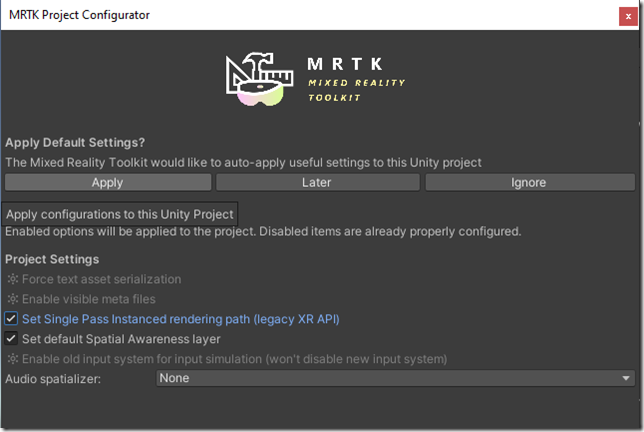
2. At the same time, an MRTK configuration window will also pop up in the Unity IDE. Accept the suggested project setting changes by selecting Apply.
switch_settings

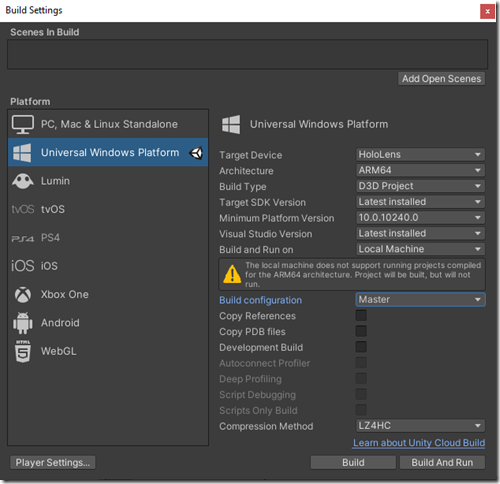
3. Click on File | Build Settings… to open the Build Settings window. Select Universal Windows Platform in the left pane.

switch

4. Upon selecting Universal Windows Platform as your build target, you will be prompted to switch platforms. Click on the Switch Platform button to confirm that you will be building an application for the UWP platform. This will initiate a series of updates to the project that may freeze the IDE as the project is refreshed.
switch_uwp

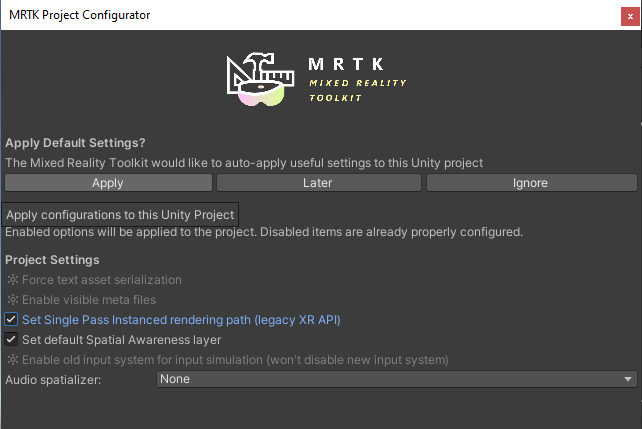
5. After your switch to the Universal Windows Platform, MRTK may prompt you to make additional changes to your project. Apply the recommended changes.
switch_settings

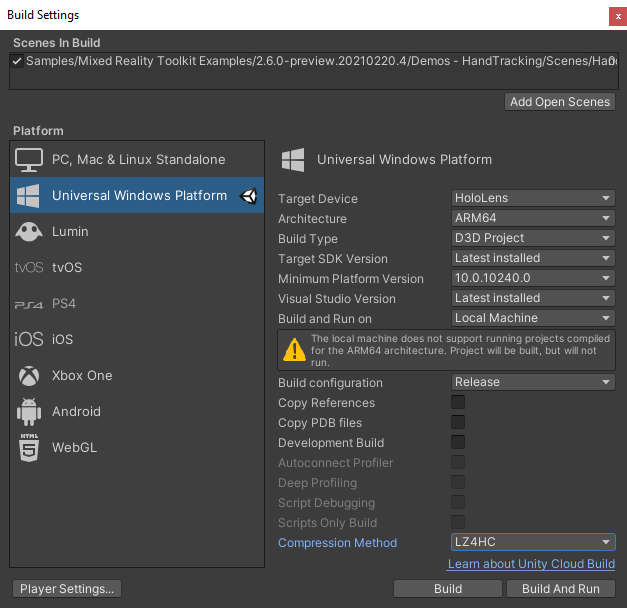
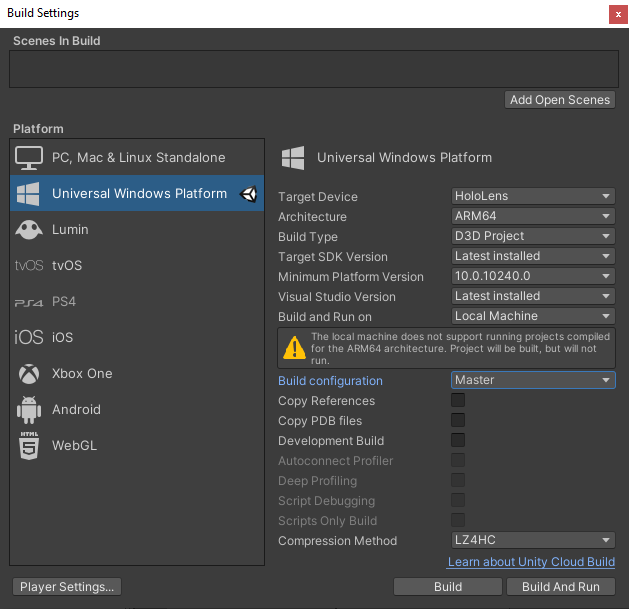
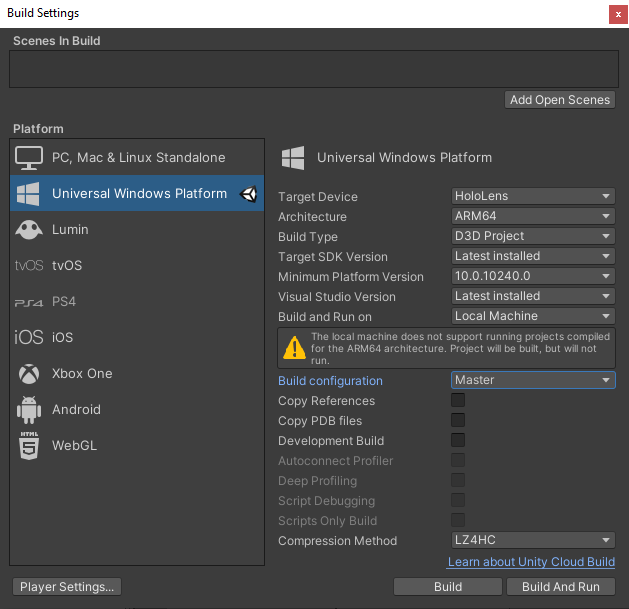
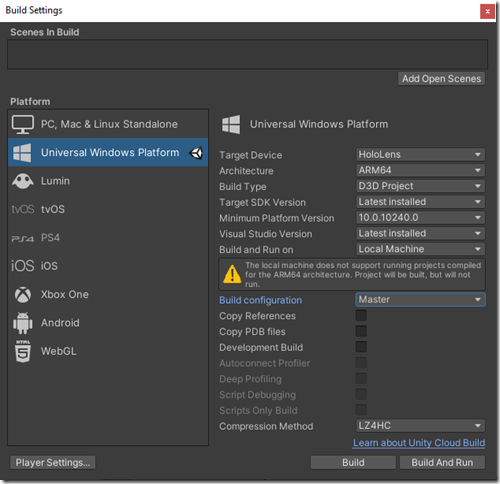
6. For a release deployment, you will want the following build settings:

    • Target Device should be HoloLens.
    • Architecture is ARM64. This is the processor used in the HoloLens 2.
    • Build Type is D3D Project. Any other build type will project a standard 2D UWP window into the HoloLens.
    • Build configuration is Master for a release build, rather than a Release, as odd as that seems. This is the most lightweight build you can deploy to your device, and consequently the best performing.
    • Compression Method should be LZ4HC for release builds. This takes a lot longer to compile, but is the most efficient in a deployed application.

You can close the Build Settings window.

Summary

This walkthrough is intended to get you through the initial steps for integrating the new Unity XR SDK pipeline with the Mixed Reality Toolkit. For completeness, I will walk you through setting up and deploying a HoloLens scene in the next post.


When GameStop Killed XBox One Kinect

producers

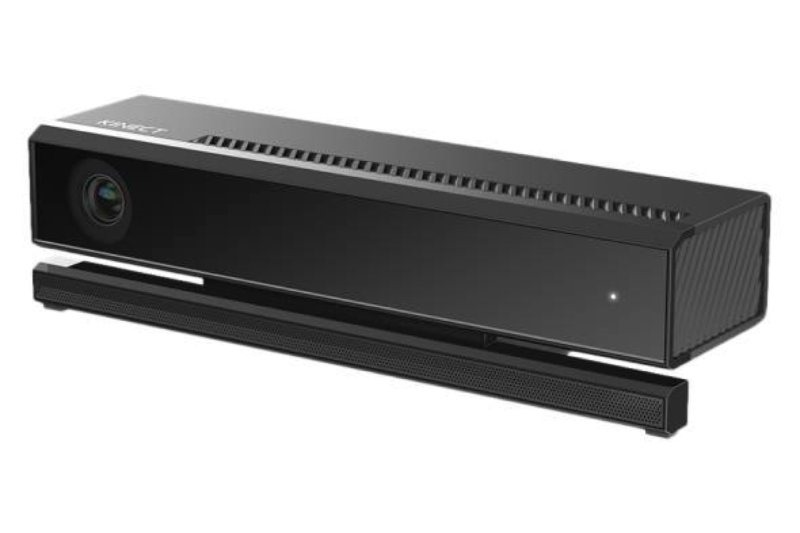
If you look up the Xbox One Kinect (informally known as the Kinect 2) on the GameStop website, you’ll read in the product description that “[t]he best Xbox One experience is with Kinect.”

Over the course of the Xbox One’s life, there were approximately 38 games that supported Kinect body tracking. None of them were triple-A games. This is out of 2682 games for the Xbox One. While Microsoft initially planned to require that the Kinect be always on, by the time of the Xbox One’s release on November 2013, this requirement was removed.  By the summer of 2014, Microsoft unbundled the Kinect from their game console, allowing people to purchase the Xbox One at a lower price point that was more competitive with PlayStation 4. The final blow came in late 2015, when Microsoft removed their Kinect support for navigating the Xbox dashboard.

Before going into some theories on what happened to the Kinect, I wanted to give my “they’re all dirty” metaphor for the recent rise and fall of the GameStop stock price. The weak GameStop business was being shorted by hedge funds. Small investors gathered on Reddit decided to fight this by pumping money into GameStop stocks in order to inflate the price artificially. They typically used the app Robinhood, which doesn’t charge trading fees, to do this. In the end, the hedge funds appear to have hedged their best, because even as they lost money on their shorts, they made money by fulfilling the trades coming through Robinhood from these reddit investors.

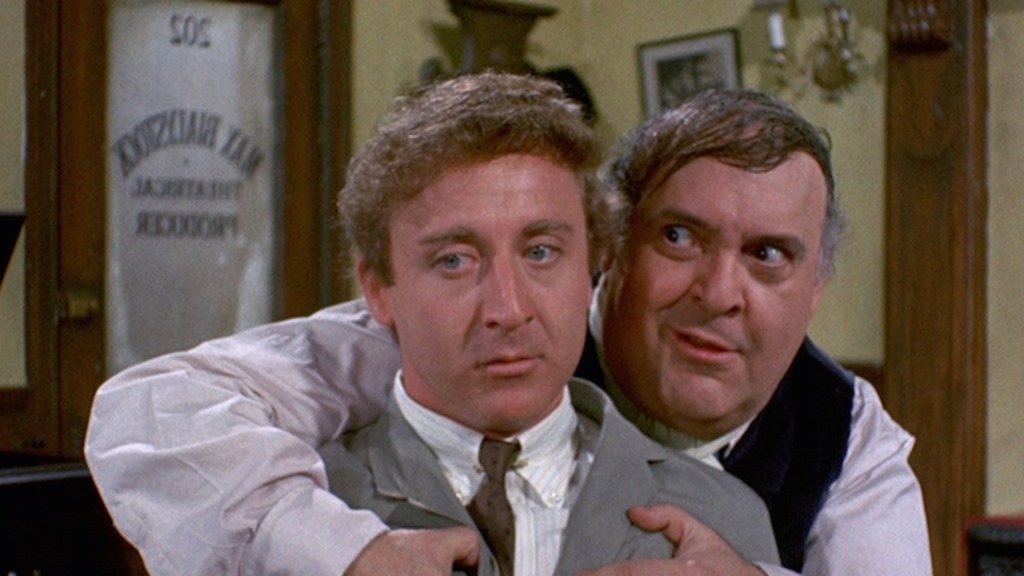
Isn’t this the plot of Mel Brooks’ The Producers?  While the purpose of the stock market is supposed to be efficiently moving investor money into the hands of companies in order to create value, short-selling is a speculative financial instrument to allow people to bet that certain companies will fail.  Like Leo Bloom, hedge funds like Melvin Capital and Citadel recognized that sometimes you can make more money with a failed venture than with a successful one.

In order to improve the odds of failure, Leo Bloom and Max Bialystock stack the deck by finding the worst script, the worst director and the worst cast for their Broadway show. Similarly, in order to improve the odds of driving down the price of GameStop stock, Citadel let people know that they were shorting the stock. Who would invest in a company that Wall Street big guns were trying to destroy?

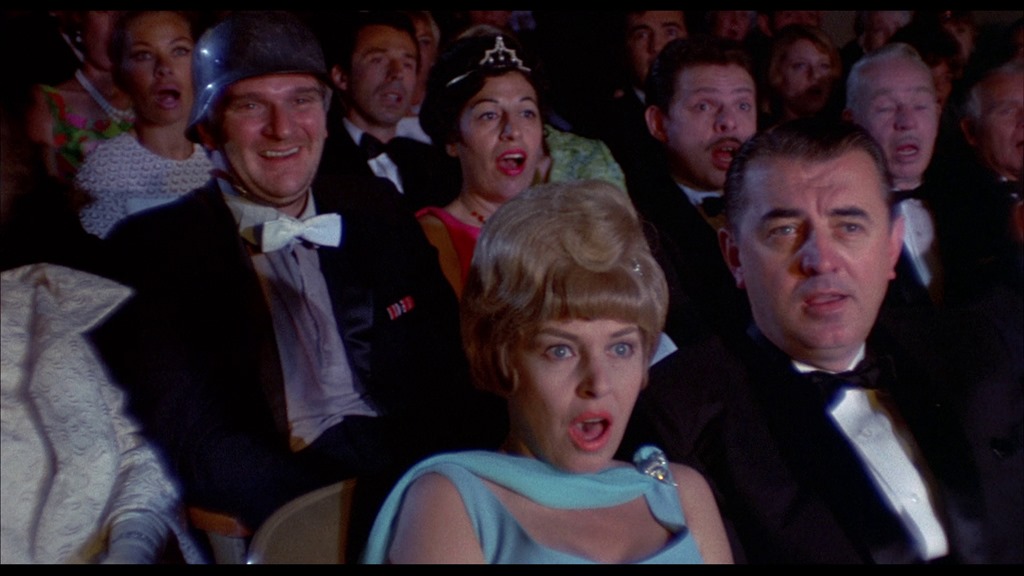
The problem for The Producers is that the worst play, Springtime for Hitler, the worst director (who turned it into a Busby Berkeley style musical), and the worst cast (drugged addled hippies), come together to create something that people can enjoy ironically. The play is so bad, it is good.

producers_aud

The worst director and worst cast in the GameStop saga are the Robinhood app and the reddit community /wallstreetbets. Robinhood allows (and encourages) inexperienced investors to bet against Wall Street professionals, which is about as successful as betting against the house in Las Vegas. /wallstreetbets, in turn, allows users to try out betting systems. The latest one depends on treating the stock market ironically, assuming that investment is primarily about manipulating markets rather than finding good companies to invest in. The only difference between /wallstreetbets and the hedge funds, is that one is made up of market outsiders and the other by insiders. Late capitalism. Post-truth investment.

There was a time when GameStop wasn’t just a carcass being fought over by carrion feeders looking for a quick meal. In 2013, GameSpot was a quickly growing company that made its money reselling second-hand console game disks.

In the lead up to the release of the XBox One, it turns out that Microsoft was attempting to kill this aftermarket. Even into the middle of 2013, Microsoft was considering dropping the optical drive from its hardware altogether and making the purchase of games completely cloud-based, like Steam.

ps4vid

It is clear from the confusion around the May, 2013 Xbox One reveal that this idea had lingering ramifications for the strategy around connectivity. Two requirements for a digital only game distribution system are a need for all consoles to be online, at least part of the time, and complex digital licensing verification systems. It turned out that the aftermarket in video games, brokered through third-parties like GameStop, was a much bigger deal than Microsoft realized and their inability to explain how people would be able to exchange and sell used games inspired one of the great marketing trolls of all time, when Sony created a commercial demonstrating how to exchange PlayStation games.

Today any teenager can explain to you the market forces that are destroying GameStop’s business model. There is no need for a company to provide an aftermarket for video games when no one uses disks anymore. Everything is digital in 2021 and everything is online. Almost like an act of revenge for 2013, Microsoft is even strong arming its Microsoft Gold subscribers to upgrade to the Xbox Game Pass by raising prices for the former. Xbox Game Pass allows users to have access to a broad range of games without having to buy those games individually, including the top games from the past two to three years.

Microsoft was ahead of its time in 2013. But what made it want to get rid of disks? One theory is that without a disk drive, Microsoft would have been able to drop the launch price of its console by $50. As it turned out, the Xbox with a disk drive and bundled with an Xbox Kinect, brought the initial price of an Xbox One to $499. The Sony PlayStation 4 launched at a $399 price point.

kinect-for-windows

This one hundred dollar difference turned out to be nearly fatal for the Xbox, which was forced to unbundle the Kinect 2 from its Xbox One by the middle of 2014, finally making their console competitive on price with the PlayStation. It was even able to undercut the price of the PlayStation by selling an unbundled Xbox One for $349 shortly after. This suggests that without an optical drive, the Xbox might have sold for only $50 more than the PlayStation 4, or even for the same price, at launch, while including a key differentiator with the Kinect.

Why did Microsoft insist on bundling the Kinect with the Xbox One in the first place? The problem for Microsoft was that in order to make the Kinect successful, it needed triple-A game companies to create games that used it. But this entails extra design and development costs for game companies. There is no way they would take on this additional cost without a guarantee of a user base that owned Kinect devices. There was a virtuous circle – or perhaps a vicious one – in which game makers need players with Kinects before they will create games for the Kinect, while console buyers need to be shown games that highlight the Kinect before they will buy a console that requires them to buy a Kinect.  In the end, neither of these things happened.

There was an underlying reason that Microsoft wanted to get Kinects into consumer living rooms. While the Kinect’s primary feature is its body tracking, which could be used as a controller for playing games and navigating screens, it’s secondary feature is a directional microphone plugged into Microsoft’s cutting edge speech recognition. It could have become an essential interface between consumers and the commercial internet, with Microsoft as the essential broker for these transactions and interactions.

Echo

As usual Microsoft was ahead of its time, and even as it quickly killed the Kinect in 2014, Amazon was releasing its own natural language devices built around Alexa, which soon expanded into a tool for not only accessing data on the internet, but also for integrating with services and controlling home devices.

But alas, GameStop created an aftermarket for game disks, that prevented Microsoft from getting rid of its Xbox One optical drive, that caused the Xbox One to lose on price to the PlayStation 4, that caused the XBox to drop the Kinect, that caused Microsoft to cede the living room device market to Amazon.

TL;DR 2/n

“So, in the next century there will be no more books. It takes too long to read, when success comes from gaining time. What will be called a book will be a printed object whose “message” (its information content) and name and title will first have been broadcast by the media, a film, a newspaper interview, a television program, and a cassette recording. It will be an object from whose sales the publisher (who will also have produced the film the interview, the program, etc.) will obtain a certain profit margin, because people will think that they must “have” it (and therefore buy it) so as not to be taken for idiots or to break (my goodness) the social bond! The book will be distributed at a premium, yielding a financial profit for the publisher and a symbolic one for the reader.” – Jean-François Lyotard, The Differend: Phrases in Dispute, 1981

rate2

rate3

rate6

room9

rate9

rate4

rate8

rate5

rate7

ratex

Unmasking, Optics, and Surveillance 1/n

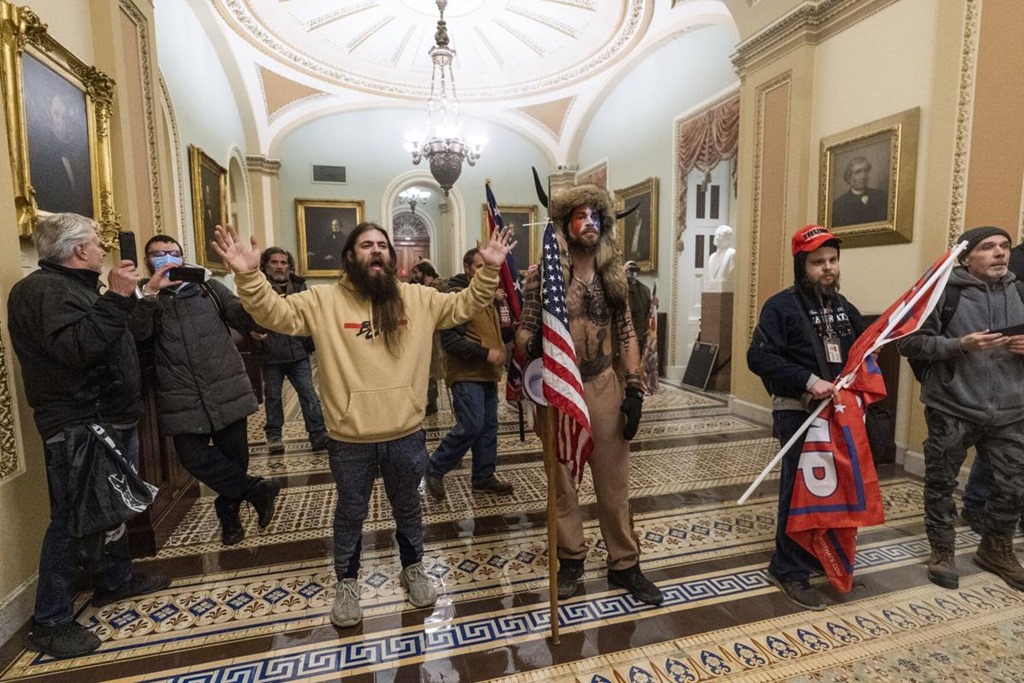
rioters

How do you deal with people who refuse to wear masks?

According to fedscoop, tracking down rioters from the January 6th Capitol invasion will be easy due to three reason:

  1. rioters typically didn’t wear masks
  2. rioters photographed, videoed, and streamed their insurrection
  3. surveillance software is extremely good at analyzing photographs and videos for facial matches
  4. (as an aside, facial recognition software is better with white faces than with minority faces. the overwhelming majority of the rioters were white – and men.)

One way to make sense of this is to realize that masking has taken on mythic overtones in America’s culture wars and the Trump supporters who came to attend rallies in the capital, before they became rioters in the Capitol, are anti-mask. Then when they became a mob and invaded the home of the legislative branch of government, they simply didn’t have masks on them.

On the other hand, the rioters seemed anxious to be seen, livestreaming what they perceived as a revolution as it was occurring. If there was no COVID, it seems likely the rioters would have done the same thing and, potentially, there was more masking than there would have otherwise been because of the pandemic.

There are then two plausible reasons rioters didn’t wear masks. First, the rioting was a surprise to most of them and most of them hadn’t known that they would end up breaking the law. Second, they didn’t see themselves as breaking the law, but thought they were on the same side as the police, the president, and other lawful authorities.

At some point, not wearing COVID masks overlaps with not wearing criminal masks, the first from the belief that COVID is not real and the second out of the belief that breaking into the Capitol is not a crime. But surely, deep inside, there is the suspicion for these people that both the disease and the crime are real.

This inherent conflict between wanting to hide our true selves while also wanting to reveal ourselves online is at the heart of the societal changes driven by social media like Twitter and Facebook. We know that these companies make their money by surveilling our online behavior and selling our information. Yet we see this as a fair trade because they give us the ability to be heard and connect with other people who think like us.

The structural artifact created is that unwanted surveillance is inextricable from the opportunity for identitarian expression.

For Capitol rioters, being observed is the natural corollary to being observed.

Due to the bad optics of the rioting of the U.S. Capitol, some Trump supporters are now disavowing the rioters and attempting to unmask them as Antifa agents pretending to be militia/3 percenters/bougaloo bois/ proud bois/ white supremacists.

In this final turn, the ideology critique tradition that runs through Nietzsche, Freud, Marx, critical theory and eventually critical race theory,  reaches an apex of sorts – unmasking as a tactic for erasing one’s tracks, even when everything has been caught on film.

In 1983 David Copperfield made the Statue of Liberty disappear on live television. It was similar to many other disappearing tricks he had performed over the years, but the scale and the fact that it was being filmed made it seem all the more inexplicable. According to some debunkers, however, the fact that it was filmed, and that we all have a bias toward believing what we see with our own eyes, made it actually easier for Copperfield to create his illusion.

As a software developer working with virtual reality, computer vision and artificial intelligence, and also as a former philosophy student, the intersection of these three themes, unmasking, optics and surveillance, are a rich mine for me. In the next few days I want to take each of these concepts apart philosophically and historically, in isolation and in relation to each other, and destrukt them to see what falls out. I want to address Kant’s distinction between the private and public spheres in What Is Enlightenment?  while also covering the role of the unmasking motif in Scooby-Doo, naturlich. I want to dig into why magicians never reveal their tricks and why politicians never admit they are wrong. Along the way, if I am feeling particularly self-destructive, I want to touch on Critical Race Theory, cancel culture, right wing safe spaces, the politics of personal destruction, nuclear options and redemption through art vs salvation through politics.

Patrick Leahy Cannot Preside Over a Presidential Impeachment

I’m not a lawyer, much less a Constitutional scholar, so I really have little weight to throw toward resolving the question of who should preside over the second impeachment trial of President Donald Trump. This is the second time of late that I’ve opined on matters for which I am fairly unqualified to opine. I’m even starting to worry that I’m becoming a bit of a habitual self-investigator rather than merely an easily distracted autodidact.

At the same time, I have been trained as a post-grad philosophy student to deal with some fairly difficult texts, many of which contradict each other, all dealing with extremely abstruse ideas and involving dense argumentation. Which is to say, I really find it difficult to resist.

It was recently reported that Senator Patrick Leahy will be presiding over the upcoming impeachment trial of Donald Trump rather than Supreme Court Chief Justice Roberts. The reasons for this are twofold.

First, Justice Roberts appears to have demurred when approached by Senator Chuck Schumer concerning the matter. 

Second, Article I, Section 3, Clause 6 states that “When the President of the United States is tried, the Chief Justice shall preside.” In other cases, such as impeachment of a Vice President or other civil officers, the President Pro Tempore of the Senate presides over impeachments. This case seems to fall somewhere in-between as Trump is no longer a sitting President of the United States.

The complication here is that how we read Article I, Section 3, Clause 6 on this matter is tied to our interpretation of Article II, Section 4 of the Constitution says this about the President of the United States: “The President, Vice President and all civil Officers of the United States, shall be removed from Office on Impeachment for, and Conviction of, Treason, Bribery, or other high Crimes and Misdemeanors.”

A minority of Constitutional experts who have weighed in on the matter interpret this section to mean that an ex-President of the United States cannot be impeached and tried, since the plain text of the Constitution says only Presidents, i.e. sitting Presidents, can be impeached and tried.

Against this argument opposing late impeachment, Brian C. Kalt, the foremost expert on late impeachments, makes it clear in a 2002 law journal article, The Constitutional Case for the Impeachability of Former Federal Officials,  that this is not a correct interpretation of the Constitution’s plain text, which is much more ambiguous.

The plain text arguments tend to take the form that if non-sitting Presidents are impeachable, then the Constitution should have said “The President, Vice President or other civil officers [or former Presidents, former Vice Presidents or other former civil officers]…” Because it doesn’t then they are not.
An even less tenable argument being thrown around is that Donald Trump is now a private citizen and if the Constitution wanted to allow impeachment and trial of private citizens like you or me, then it would have said so. This is a fairly weak argument, though, since a private citizen being impeached for high crimes while in civil office is clearly different from trying a private citizen who has never held federal office (or even trying a former official for offenses committed out of office, for that matter).
The right way to look at Article II, Section 4 is that it serves to limit Congressional power regarding who can be impeached and tried, but sets no rules regarding the timing of the impeachment and trial. This interpretation brings it in line with precedent, both in English Common Law and the contemporary understanding of impeachment as articulated in the state constitutions, as well as structural arguments for late impeachment (Presidents should be discouraged from doing impeachable things late in their presidencies).

But if the timing of the impeachment trial is not constrained when the Constitution says “President of the United States” in the context of impeachment, then this would seem to apply to Article I, Section 3, Clause 6, also. If presidential impeachment trials in the Senate must be presided over by the Chief Justice of the Supreme Court, then this would be true whether an incumbent President or a former President is being tried.

Moreover, the Chief Justice does not appear to have a say in the matter. The power to try an impeached President  is vested in the Senate and not the Supreme Court. The Senate makes its own rules about how it interprets the Constitution with regard to impeachment powers.

But I’m not a Constitutional expert and I’m not a lawyer. At the very least, though, it strikes this layman as odd that the Senate should choose to interpret “President” as including ex-Presidents in one part of the Constitution while deciding that it excludes ex-Presidents in another.

And if I’m noticing that, as a layman, it is not only probable but certain that the Republican defenders of President Trump in the Senate and dependable if flexible conservatives at the Wall Street Journal, National Review, and other publications will do so as well, arguing that while it may be the case that Donald Trump committed convictable acts, the process is so flawed that he must be exonerated.

Patrick Leahy cannot be allowed to preside over President Donald Trump’s second impeachment trial. Chief Justice Roberts needs to do his job.

Mitch McConnell’s Impeachment Canard

Mitch_McConnell_portrait_2016

While prominent voices like those of David Frum of The Atlantic , Jim Geraghty of National Review and Peggy Noonan of the Wall Street Journal have all called for a swift second impeachment of President Trump for instigating the mob that sacked the U. S. Capitol building in their attempt to stop the Constitutionally mandated counting of the electoral vote, this process appears to have been slowed down by Mitch McConnell’s January 8 memo stating that the Senate cannot begin to act on any impeachment articles from the House until January 19th at the soonest, one day before Joe Biden’s inauguration.

McConnell is misleading and pulling a combination of what he did to Merrick Garland by using parliamentary procedure to not act with Bill Barr’s traducing of his friend Robert Mueller by misrepresenting the actual case before him.

McConnell has a reputation as a master of Senate parliamentary procedure, and has used this reputation to hoodwink the public and his fellow Senators. There are in fact multiple ways to begin Senate impeachment hearings before January 19th.

The Senate is currently adjourned for three day increments and holding pro forma sessions in between.  According to Mitch McConnell’s memo,

“It would require the consent of all 100 senators to conduct any business of any kind during the scheduled pro forma sessions prior to January 19, and therefore the consent of all 100 senators to begin acting on any articles of impeachment during those sessions.”

According to a report Mitch McConnell had drawn up by the Congressional Research Service in 2012 about pro forma sessions, however, the correct language is not the consent of all 100 senators but rather unanimous consent, which is a very different thing that pretends to be the same thing. In fact the House just tried to pass a resolution by unanimous consent earlier today to request that Vice President Mike Pence invoke the 25th Amendment, and it basically means that unless anyone voices an objection we’ll all just pretend that all members agreed. (Someone did object, by the way, and the vote will be tabled for tomorrow.)

The CRS also, in this report, identifies two pro forma sessions of the Senate in which legislative business occurred through unanimous consent, on December 23, 2011 and August 5, 2011.

The report also states that there two ways to conduct business during a pro forma session and not just the one that McConnell claims in his recent memo:

“While, as noted above, the Senate has customarily agreed not to conduct business during pro forma sessions, no rule or constitutional provision imposes this restriction. Should the Senate choose to conduct legislative or executive business at a pro forma session, it could, providing it could assemble the necessary quorum or gain the consent of all Senators to act.”

So what are pro forma sessions and why is a) unanimous consent different from the b) consent of 100 senators. Also, why does McConnell think he can get away with conflating these two things?

Pro forma sessions are effectively sessions that last under five minutes in the Senate during which nothing is accomplished but which must be held in order to be in compliance with Article 1, Section 5, Clause 4 of the Constitution.

Neither House, during the Session of Congress, shall, without the Consent of the other, adjourn for more than three days, nor to any other Place than that in which the two Houses shall be sitting.

By holding a pro forma only meeting every three or so Congressional business days, either chamber can take an extended adjournment, allowing members the time to visit constituents, raise money, and so on, without technically violating the Constitution or requiring the consent of the other chamber.

In 2012, President Obama challenged the status of the pro forma session when it was being used by Mitch McConnell to block the President’s recess appointments. His administration claimed that these were not real sessions and that therefore the Congress was effectively in recess.

The Supreme Court disagreed in their decision in National Labor Relations Board v. Noel Canning, stating that pro forma sessions are not just for show because 1) the Senate says they aren’t and also because 2) legislative action can occur  by unanimous consent because a quorum, required for unanimous consent, is presumed, even if it doesn’t exist actually.

Confusing, isn’t it? I’ll quote extensively from this analysis from the Tom Goldstein of SCOTUSblog, which elucidates the matter further:

The interesting point is that (b) is rests on a fiction:  there actually is no Senate quorum during a pro forma session.  As Mitch McConnell’s brief in the Supreme Court explains, “The Senate, in other words, has provided that a quorum is presumed until proven otherwise.”  And it is a fiction the Court definitively accepts:  “[W]hen the Journal of the Senate indicates that a quorum was present, under a valid Senate rule, . . . we will not consider an argument that a quorum was not, in fact, present.”

Yet that critical presumption that a quorum exists is easily burst:  any member of the Senate can suggest the absence of a quorum.  “During any pro forma session, the Senate could have conducted business simply by passing a unanimous consent agreement. . . .  Senate rules presume that quorum is present unless a present Senator questions it.”  As Noel Canning’s brief in the Supreme Court explains, “whenever the Senate lacks quorum . . . , a single Senator can prevent the Senate from conducting business by making a quorum call.”

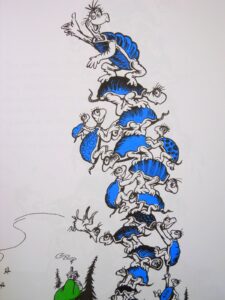
It’s turtles all the way down. To recapitulate:

  1. A pro forma session counts as a real session, for Constitutional purposes, if legislative action can occur during this session.
  2. Legislative action can occur during a pro forma session through unanimous consent.
  3. Unanimous consent requires a quorum comprised of a simple majority of all senators (51).
  4. Even if a quorum is not actually present, the rules of the Senate maintain the fiction that one is unless a senator calls for a quorum count.

So what would happen if a senator entered the senate chamber and requested a quorum count? Presumably something like this:

  1. It would be discovered that there is not a quorum.
  2. Without a quorum, no business can be done.
  3. If no business can be done, the the Senate is in violation of the Constitution Article 1, Section 5, Clause 4.
  4. The Senate must call on the Sergeant-at-arms to wrangle up 51 senators, so there is a quorum, so legislative action can occur in compliance with the Supreme Court’s decision in National Labor Relations Board v. Noel Canning.

Supposing there are 48 Democratic senators and at least 3 Republican senators willing to be in the Capitol Building to receive and act on Impeachment Articles from the House, this can happen as early as tomorrow. The next opportunity will be on January 15th at the next pro forma session of the United States Senate.

And thus Mitch McConnell’s attempt to obstruct congress can be toppled, by the numbers. Turtles all the way down.

Philosophical Classics for Nerds

eternal_sunshine

It is 60 days after the day I thought the U.S. presidential election would have been settled … and yet. Intellectually, I recognize the outrageousness of the situation, based on the Constitution, based on my high school civics lessons, and based on my memories of the 2000 presidential election between Bush and Gore when everyone felt that any wrong move or overreach back then would have threatened the stability of the republic and the rule of law.

At the same time I have become inured to the cray-cray and as I listen today to recordings of President Trump’s corrupt, self-serving call to Georgia Secretary of State Raffensperger, I find that my intellectual recognition that norms are being broken (the norm that we trust the democratic system, the norm that we should all abide by the rules as they are written , the norm that we should assiduously avoid tampering with ‘the process’ in any way) is not accompanied by the familiar gut uneasiness that signals to humans that norms have been disturbed. That thing that makes up “common sense”, a unanimity between thought and feeling, is missing for me due to four and more years of gaslighting.

gaslight

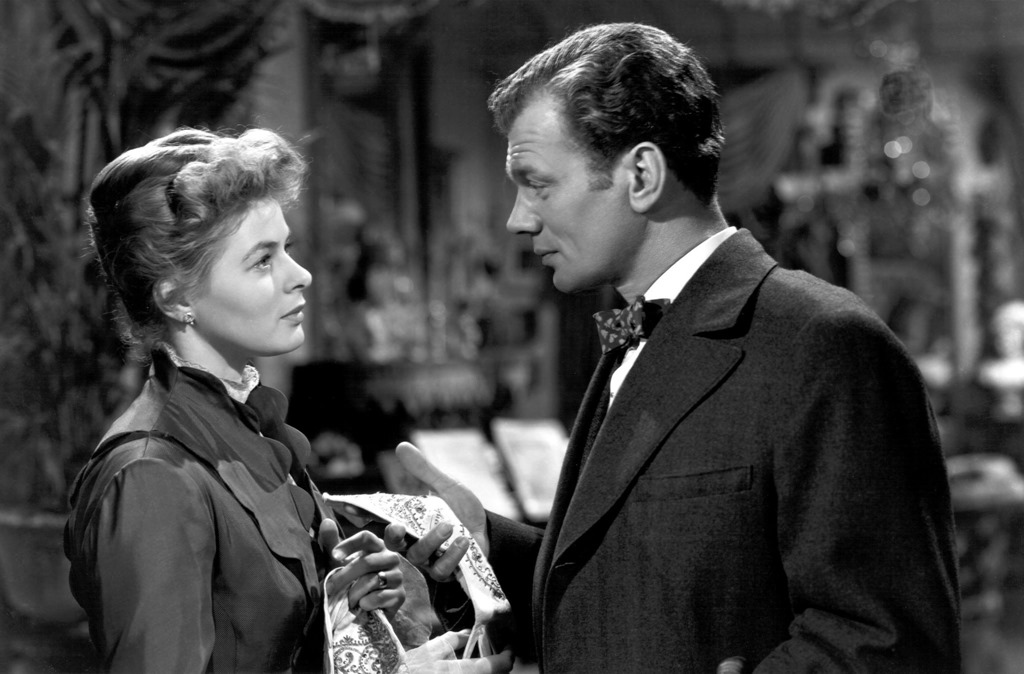
When common sense breaks down in this way, there are generally two possible causes. Either you have gone crazy or everyone else has. Like Ingrid Bergman in that George Cukor film, our first instinct is to look for a Joseph Cotton to reassure us that we are right and Charles Boyer is wrong. What always causes me dread about that movie, though, is the notion that things wouldn’t have gone so well had Ingrid Bergman not been gorgeous and drawn Cotton’s gaze and concern.

In another film from a parallel universe, Cotton might have ignored Bergman, and she would have withdrawn from the world, into herself, and pursued a hobby she had full control over, like crochet, or woodworking, or cosplaying. Many do.

Over the past two decades, nerdiness has shifted from being a character flaw into a virtue, from something tacitly acknowledged into a lifestyle to be pursued. The key characteristic of “nerdiness” is the willingness to allow a passion to bloom into an obsession to the point of wanting to know every trivial and quadrivial  aspect of a subject. True nerdiness is achieved when we take a matter just that bit too far, when friendships are broken over opinions concerning the Star Wars prequels, or when marriages are split over the classification of a print font.

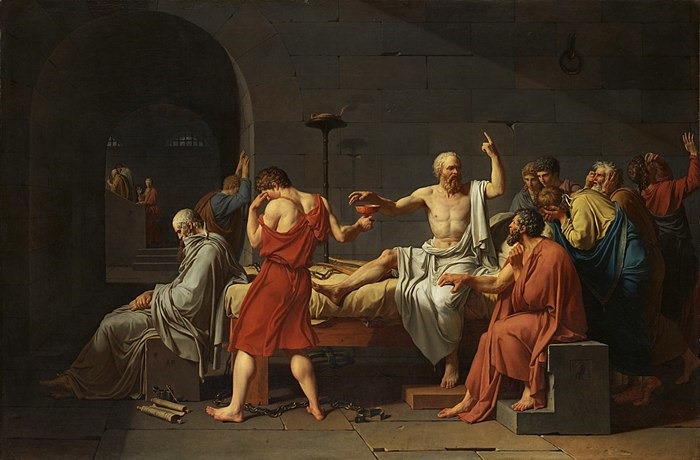
The loss of the sensus communis  can also mark the point where mere thought becomes philosophical. The hallmark of philosophical reflection is that moment when the familiar suddenly becomes unfamiliar and then demands our gaze with new fascination, like Ingrid Bergman suddenly drawing Joseph Cotton’s attention. For Heidegger this was the uncanniness of the world. For Husserl it was the epoche in which we bring into question the givenness of the world. And for Plato it is the desire for one’s lover, which one transfers to beauty in general, and finally to Truth itself.

http://www.metmuseum.org/art/collection/search/436105

Philosophers as a rule take things too far. They say forbidden things. They draw unexpected conclusions. They examine all the nooks and crannies of thought, exhaustively, to reach the conclusions they reach, often to the boredom of their audience. They were nerds before we knew what nerds were.

Even in the world of philosophy, however, there are books and ideas that used to be considered too important to overlook but too nerdy to be made central to the discipline. Instead, they have existed on the margins of philosophy waiting for a moment when the Zeitgeist was ready to receive them.

Here are five works of speculative philosophy whose time, I believe has come.

desert_real

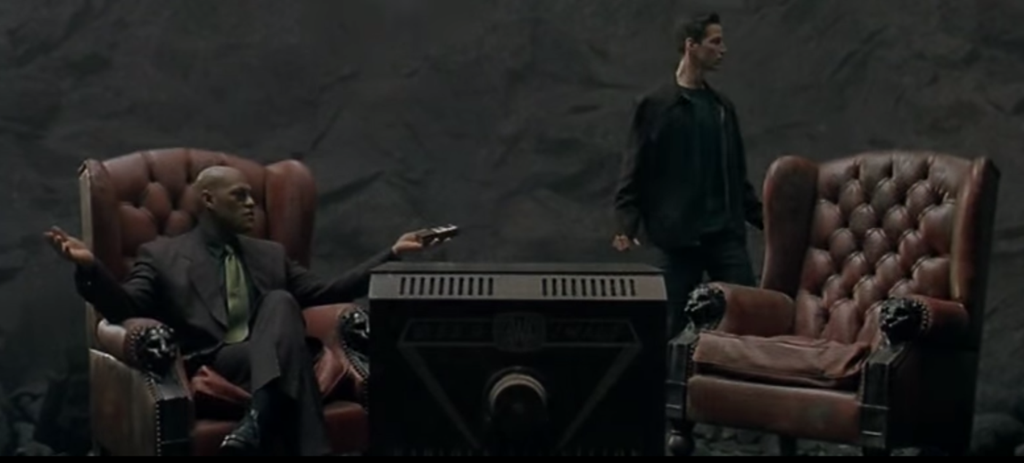
Simulacra and Simulations by Jean Baudrillard – This book describes virtual reality, a bit like William Gibson did with Neuromancer, before it was really a thing. The Wachowskis cite it as an inspiration for The Matrix and even put phrases from this work in one of Morpheus’s monologues. It is blessedly a short work that captures the essence of our virtual world today from a distance of almost half a century (it was written in 1983). No one should be working in tech today without understanding what Baudrillard meant by “the desert of the real.”

transporter

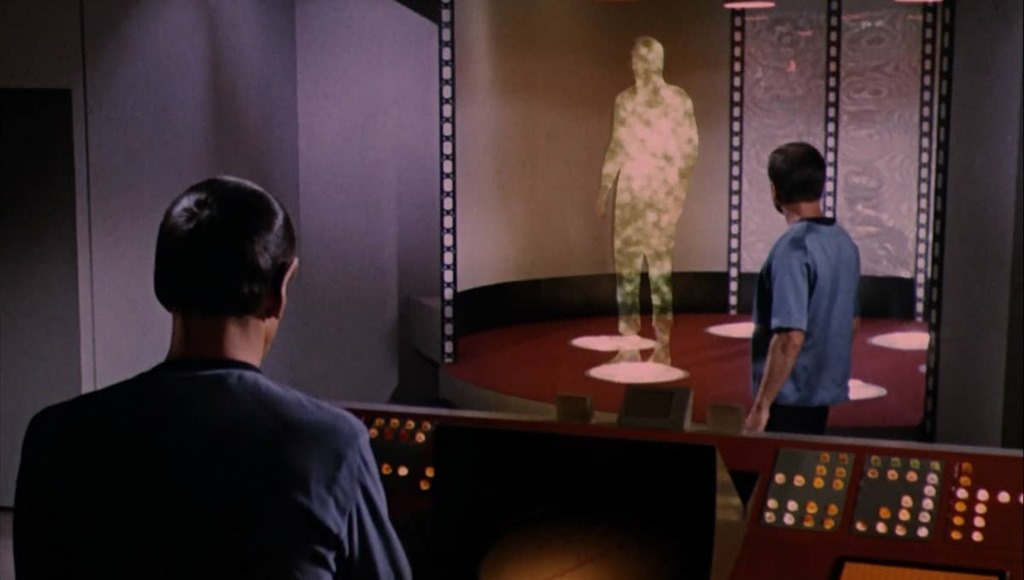
Reasons and Persons by Derek Parfit – Parfit took apart the notion of identity using thought experiments drawn from science fiction. One of his most striking arguments, introduced in Part Three of his work, in a section called Simple Teletransportation and the Branch-Line Case, Parfit posits a machine that allows speed-of-light travel by scanning a person into data, sending that data to another planet, and then reconstituting that data as matter to recreate the original person. Of course, we have to destroy the original copy during this process of teletransportation. Parfit toys with our intuitions of what it means to be a person in order to arrive at philosophical gold. If the reader is troubled by this scenario of murder and cloning cum teleportation, Parfit is able to point out that this is what we go through in our lives. How much of the matter we were born with is still a part of our physical bodies? Little to none?

For the coup de gras, one can apply the lessons of teletransportation to address our pointless fear of death. What is death, after all, but a journey through the teleporter without a known terminus?

third_eye

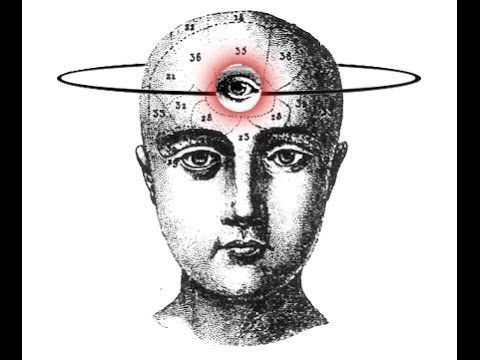
The Conscious Mind by  David J Chalmers – Just as the 4th century BCE saw a flourishing of philosophy and science in Greece, or the 16th century saw an explosion of literary invention in England, in the 1990’s Australia become the home of the most innovative works on the Philosophy of Mind in the world. Out of that period of wild genius David J Chalmers came out against the general trend driven by Daniel Dennett and Paul Churchland that denied the reality of consciousness. Chalmers, on the other hand, made the case through exacting arguments that consciousness is not only real, but is a fundamental property of the universe, alongside spatiality and temporality.

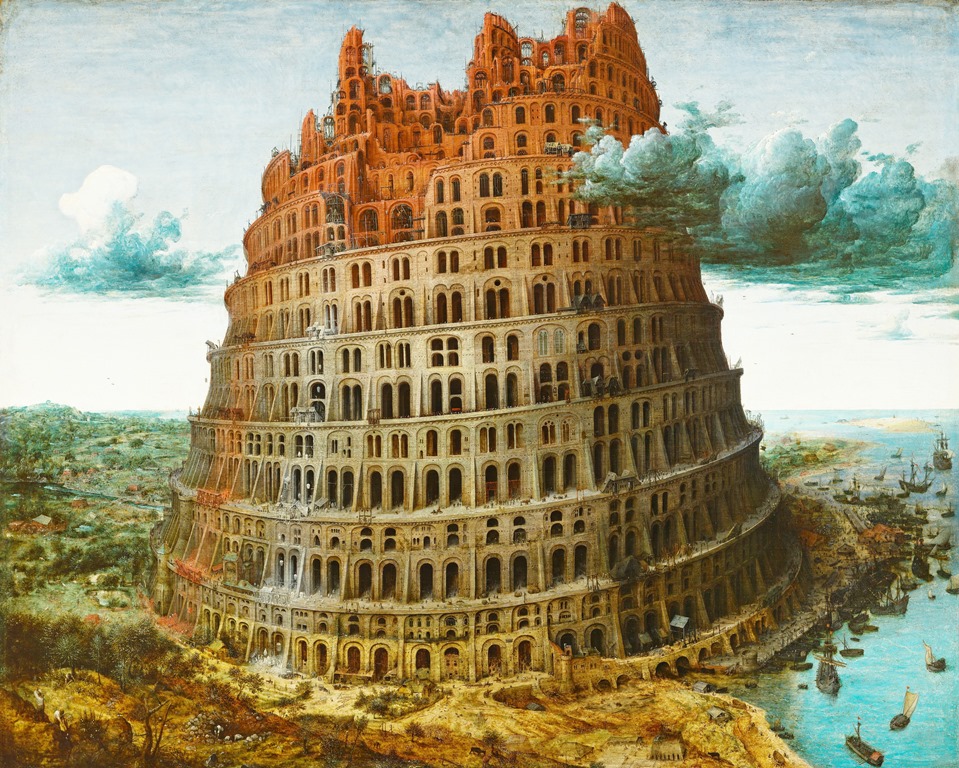
babel

Hegel and the Metaphysics of Absolute Negativity by Brady Bowman – Since Dale Carnegie’s important work reforming the habits of white collar labor, positive thinking has been the ethos of professional life. The Marxian threat of alienated labor is eliminated by refusing to acknowledge the possibility of alienation in the corporate managerial class. Just as movie Galadriel tells us that “history became legend, legend became myth”, the power of positive thinking became a tenet of faith, then a method of prosperous Biblical exegesis, and finally a secret.

Do you ever get tired of mindless positivism? What if the underlying engine of the universe turns out not to be positive thinking but absolute negativity? And what if this can be proven through Hegel’s advanced dialectical logic? How much would you pay for a secret like that?

154932300

The Emperor’s New Mind by Roger Penrose – Penrose was a brilliant mathematical physicist who unleashed his learned background to the problem of human consciousness. Do physics and quantum physics in particular confirm or reject our theories about the human soul? I’ve always loved this book because Penrose comes up with a solution to human consciousness in a  somewhat unphilosophical way – which made many philosophers nervous. The crux of his argument for the place of mind in a quantum universe is the size horizon of some features of the human brain. Ultimately, I think, Penrose provides a way to reconcile Kantian metaphysics with modern cutting edge physics and biology in a way that works – or that at least is consistent and the ground for the possibility of Kantianism.

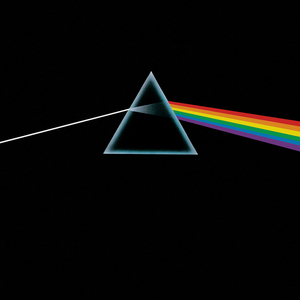
Dark_Side_of_the_Moon

Honorable mention: Darkside by Tom Stoppard – if you have been watching The Good Place then you should be familiar with The Trolley Problem, a thought experiment used to tease our ethical intuitions and commitments. What could make The Trolley Problem even better? What if it is incorporated into  a radio play by one of our greatest living English dramatists, performed to the tracks of Pink Floyd’s Dark Side of the Moon, and acted out by Bill Nighy (The Hitchhiker’s Guide to the Galaxy), Rufus Sewell (Dark City) and Iwan Rheon (Game of Thrones).

One Day Till Election Day

IMG_1416

The most important thing about making a Moscow Mule is getting the cup right. It needs to be copper, which does good things with the lime juice. Don’t use a silver cup, which is used a a container for the Mint Julep. To make a Moscow Mule my way, pour ice into a copper cup. Over the ice add:

  • 2 oz not too expensive vodka
  • 4 oz Moscow Mule mix
  • enough sparkling water to fill your copper cup to the rim

Garnish with a lime slice and mint sprig.

A few years ago I found myself with Dennis Vroegop at a LinkedIn Learning party in Redmond, Washington. It was there that we began negotiations on what eventually became our App Development for HoloLens video course. It was November 3rd, 2016  during the week of the Microsoft MVP summit and the free bar had an excellent mixologist who was able to make me a Rusty Nail as well as a Moscow Mule. I was thrilled.

As the night wore on, we went from party to party with a great sense of freedom and the feeling that we were on top of the world and that we were on the cusp of great things. Another friend, Tamas Deme, ended up at a dour affair for the local Republican Party where depressed representatives waited patiently for bad news.

But that isn’t how things turned out. As we moved from party to party, people started getting panicked phone calls from spouses at home and their faces turned from bemusement to chagrin. At one point we ran into Tim Huckaby, a legend in the Microsoft RD world, who told us Trump was winning the election. We thought he was joking.

Finally my wife called me in tears barely able to contain herself. The country had elected (another) rapist and she couldn’t understand how. I couldn’t get my head around it and ended up walking around Redmond for the next few hours.

Instead of the best year, 2016 became the start of a set of strange, difficult to understand events. Everything feels like it has slowly been dissipating ever since. Friendships have become strained. Relationships have frayed. The extended, non-nuclear family is maintained by avoiding each other. I constantly have to tell my children that this isn’t how things used to be and politicians as well as people in general traditionally are afraid of being caught in lies. But I can tell from their tone that they doubt me. After all, isn’t my generation partly responsible for what has happened?