HoloLens and The Plight of Men in Tech

The Golan Levin led Art && Code conference on VR and AR has just ended at Carnegie Mellon. It’s an amazing conference that reminds me of the days of MIX in terms of creativity and seriousness.  I have always secretly felt that there’s a strong correlation between gender parity at conferences and the quality of the conference — something MIX had to some degree and Art && Code has strongly.

rinseandrepeat

From Rinse and Repeat by Robert Yang

I don’t mean to be political or controversial, though. I just find this more enjoyable than //build or Ignite, which are valuable in other ways.

jchlaura

Brain by Laura Juo-Hsin Chen

A serious concern that bubbled up to my consciousness at Art && Code, however, is the plight of men in tech. Something has happened to us, I think, that in our gender isolation, we’ve become dull and less playful. Our very notions of what is fun in tech is limited and diminished and we don’t even realize it. We all go about doing our best Steve Wozniak pretending to be Steve Jobs impressions and talk about passion in a way that makes it sound like a wet rag we found in an alley, perpetuating the nerd on nerd self-violence that is choking the nascent mixed reality industry. And I think this is unfair.

memory Place

Memory Space by Sarah Rothberg

Part of the reason for this is probably the high cost of the tech we work with. When the gear is expensive, we feel a responsibility to appear more serious. We worry that appearing to be having fun doing what we do requires justification. A great example is Rene Schulte’s justification of wig caps for his company’s HoloLens demo when the only explanation needed should have been that the hololens is gangsta and our only legitimate response should have been that he needed more bling.

Nail Art Museum by Jeremy Bailey

My favorite talk at this conference was about political games by Robert Yang. The more I think about it the more profound it seems. He explores gender roles and race relations with a first person adventure that takes place in a gay spa. Mostly due to misunderstandings about what he is trying to do, his games are banned from twitch and he gets a lot of hateemails. His oeuvre of games is accused of having found rock bottom in the uncanny valley (though this is more a description of his aesthetic, I feel, rather than the success of his experiments).

I talked to him for a bit in the buffet line and he said he’s considered putting a contextual/researchy explanation in front of his games but also thinks it ruins the integrity of his bathhouse game and I agreed strongly.
And maybe sex games are still a step too far for us — but we should at least be able to be more playful and fun and willing to create apps that are exploratory rather than just cookie-cutter commercial translations of existing web apps.

Fun with Hyperbolic Space by Vi Hart

I think the cause of our predicament is the homogeneity of the people currently doing More Personal Computing development. The symptom and effect is the small number of women in this field. Hololens is, if anything, even more narrow in this way than windows development in general despite being more inherently innovative and transformative.

But what’s the point of transformation if we create a NUI world that has all the problems institutionalized in our current one?

As developers we have a limited ability to affect this — mostly because of lack of time and the other usual but legit reasons.


Shining 360 by Claire Hentschker

Where we can have an influence though is by by creating diversity in our own thinking. I can make this even easier — we create diversity by having more fun in what we do. If what we do looks more fun and has more joy, it will attract more diverse people who will want to use it for artistic and even subversive purposes and, in turn, make what we do even more fun. It’s a virtuous circle that gives back a hundred fold.

And while secretly my criteria for when we’ve succeeded with diversity is when we get a Robert Yang gay sex game on the HoloLens, a more modest one — just getting a non-zero number of women developers into the hololens dev community and making sure they have a voice — would also be great.

For what it’s worth, VR has the same institutional problem. But this is a fresh start and we can do better.

My modest proposal to accomplish this starts with a plea to Microsoft and other MR vendors like Meta and Magic Leap. You have plans or already have implemented plans to provide devices and developers to major large enterprises like NASA in order to build mixed reality experiences. Why not divert a portion of these resources to some of the new media artists linked in this post so we can see the true potential of Holographic Computing to change, challenge and improve our social world rather than simply find new ways to channel capital?

I understand that to some extent it’s a matter of which comes first, the chicken or the portrait of the chicken. I would simply plead with you, the mighty corporate curators of mixed reality, to this time choose the portrait of the chicken first. It’s the truer vision.

MIXED REALITY ESSENTIALS: A CONCISE COURSE

On Saturday, October 29th, Dennis Vroegop and I will be running a Mixed Reality Workshop as part of the DEVintersection conference in Las Vegas. Dennis is both a promoter and trainer in Mixed Reality and has made frequent appearances on European TV talking about this emerging technology as well as consulting on and leading several high-profile mixed reality projects. I’ve worked as a developer on several commercial mixed reality experiences while also studying and writing about the various implications and scenarios for using mixed reality in entertainment and productivity apps.

Our workshop will cover the fundamentals of building for mixed reality through the first half of the day. Through the rest of the day, we will work with you to build your own mixed reality application of your choice—so come with ideas of what you’d like to make. And if you aren’t sure what you want to create in mixed reality, we’ll help you with that, too.

Here’s an outline of what we plan to cover in the workshop:

  1. Hardware: an overview of the leading mixed reality devices and how they work.
  2. Tools: an introduction to the toolchain used for mixed reality development emphasizing Unity and Visual Studio.
  3. Hello Unity: hands-on development of an MR app using gestures and voice commands.
  4. SDK: we’ll go over the libraries used in MR development, what they provide and how to use them.
  5. Raycasting – covering some things you never have to worry about in 2D programming.
  6. Spatial Mapping and Spatial Understanding – how MR devices recognize the world around them.
  7. World Anchors – fixing virtual objects in the real world.

Break for lunch

    8.  Dennis and I will help you realize your mixed reality project. At the end of the workshop, we’ll do a show and tell to share what you’ve built and go over next steps if you want to publish your work.

We are extremely excited to be doing this workshop at DEVintersection. Mixed Reality is forecasted to be a multi-billion dollar industry by 2020. This is your opportunity to get in at the ground floor with some real hands-on experience.

(Be sure to use the promo code ASHLEY for a discount on your registration.)

Pokémon Go as An Illustration of AR Belief Circles

venn

Recent rumors circling around Pokémon Go suggest that they will delay their next major update until next year. It was previously believed that they would be including additional game elements, creatures and levels beyond level 40 sometime in December.

A large gap between releases like this would seem to leave the door open to other copy cat games to move into the opening that Niantec is providing them. And maybe this wouldn’t be such a bad thing. While World of Warcraft is the most successful MMORPG, for instance, it certainly wasn’t the first. Dark Age of Camelot, Everquest, Asheron’s Call and Ultima Online all preceded it. What WoW did was perhaps to collect the best features of all these games while also ride the right graphics card cycle to success.

A similar student-becomes-the-master trope can play out for other franchise owners, since the only thing that seems to be required to get a game similar to Pokemon going is a pre-existing storyline (like WoW had) and 3D assets either available or easily created to go into the game. With Azure and AWS cloud computing easily available, even infrastructure isn’t such a challenge as it was when the early MMORPGs were starting. Possible franchise holders that could make the leap into geographically-aware augmented reality games include Disney, Wow itself, Yu-Gi-Oh!, Magic the Gathering, and Star Wars.

Imagine going to the park one day and asking someone else face down staring at their phone if they know where the bulbasaur showing up on the nearby is and having them not knowing what you are talking about because they are looking for Captain Hook or a jawa on their nearby?

This sort of experience is exemplary of what Vernor Vinge calls belief circles in his book about augmented reality, Rainbow’s End. Belief circles describe groups of people who share a collaborative AR experience. Because they also share a common real life world with others, their belief circles may conflict with other people’s belief circles. What’s even more peculiar is that members of different belief circles do not have access to each other’s augmented worlds – a peculiar twist on the problem of other minds. So while a person in H.P. Lovecraft’s belief circle can encounter someone in Terry Pratchett’s Discworld belief circle at a Starbuck’s, it isn’t at all clear how they will ultimately interact with one another. Starbuck’s itself may provide virtual assets that can be incorporated into either belief circle in order to attract customers from different worlds and backgrounds – basically multi-tier marketing of the future. Will different things be emphasized in the store based on our self-selected belief circles? Will our drinks have different names and ingredients? How will trademark and copyright laws impact the ability to incorporate franchises into the muti-aspect branding of coffee houses, restaurants and other mall stores?

But most of all, how will people talk to each other? One of the great pleasures of playing Pokemon today is encountering and chatting with people I otherwise wouldn’t meet and having a common set of interests that trump our political and social differences. Belief circles in the AR future of five to ten years may simply encourage the opposite trend of community Balkanization in interest zones. Will high concept belief circles based on art, literature and genre fiction simply devolve into Democrat and Republican belief circles at some point?

Pokemonography

Pokémon Go is the first big augmented reality hit. It also challenges our understanding of what augmented reality means. While it has AR modes for catching as well as battling pokémon, it feels like an augmentation of reality even when these modes are disabled.

krabby

Pokémon Go in large part is a game overlaid on top of a maps application. Maps apps, in turn, are an augmentation overlaid on top of our physical world that track our position inside of the digital representation of streets and roads. More than anything else, it is the fully successful cartography referred to George Luis Borges’s story On Exactitude in Science, prominently referred to in Baudrillard’s monograph Simulacra and Simulation.

Pokémon Go’s digital world is also the world’s largest game world. Games like Fallout 4 and Grand Theft Auto V boast of worlds that encompass 40 sq miles and 50 sq miles, respectively. Pokémon Go’s world, on the other hand, is co-extensive with the mapped world (or the known world, as we once called it).  It has a scale of one kilometer to one kilometer.

dragonaire

Pokémon Go is an augmented reality game even when we have AR turned off. Players share the same geographic space we do but live, simultaneously, in a different world revealed to them through their portable devices. It makes the real world more interesting – so much so that the sedentary will participate in exercise while the normally cautious will risk sunburn and heatstroke in post-climate change summers around the world in order to participate in an alternative reality. In other words, it shapes behavior by creating new goals. It creates new fiscal economies in the process.

electabuzz

Which is all a way of saying that Pokémon Go does what marketing has always wanted to do. It generates a desire for things that, up to a month ago, did not exist.

magikarp

A desire for things which, literally, do not exist today.

What more fitting moniker to describe a desire for something that does not exist than Pokémonography. Here are some pics from my personal collection.

porygon

snorlax

warturturtle

raichu

dratini

lapras

dragonite

gyrados

The ReadRe Project: Ready Player One

This is the first of a multipart blog series covering re-reads of popular media about Virtual and Augmented Reality. In future installments, I plan to cover classics like William Gibson’s Neuromancer, Vernor Vinge’s Rainbow’s End, Ridley Scott’s Blade Runner and the anime series Ghost in the Shell. The worn premise of the series is that our collective vision of the future was formed long ago in the past and we are, in many ways, simply walking the path others have set for us in their imaginations. That being the case, the best way to navigate our own futures is by raiding popular fringe culture in order to find the blueprints. In other words, this is an excuse to revisit some of my favorite books, movies and anime.  Each entry in the series will provide a summary of the work, an overview of the AR or VR technology represented, and an analysis of the impact of the work on contemporary virtual world technology – in other words, what lessons can be drawn from the work.

rpo

Non-spoilerish summary of the work

Ernst Cline’s novel takes place in a dystopic 2044 where the world economy has collapsed, corporations have taken over, and the hacker hero, 17 year old Wade Watts, spends most of his life plugged into a virtual reality world called the OASIS while waiting to graduate from high school. He has also spent the past five years of his life as a Gunter – someone on a quest to find the video game easter egg left behind by the creator of the OASIS, James Halliday, somewhere inside his massive online virtual universe. To whomever discovers his easter egg,  James Halliday has bequeathed his vast fortune of hundreds of billions of dollars.

The secret to solving Halliday’s puzzles turns out to be an understanding of Halliday’s love for the 80’s, the decade in which he grew up, and an encyclopedic understanding of the popular movies, music, and video games of the 80’s as well as a decent familiarity with D&D. Wade, along with a motley band of friends, fights an evil mega-corporation for control of Halliday’s inheritance as well as control of his online world.

adventure

How it works

The VR hardware consists of a hi-rez virtual reality stereoscopic headset and haptic gloves connected to a custom game console. Basically the Oculus Rift or HTC Vive with much higher resolution. An internet connection is required. Instead of servers, the shared simulation runs using some sort of peer-to-peer networked computing system that borrows compute time from all the machines of all the players. The virtual world itself is a single shared world rather than a series of shards. Everyone who plays, which turns out to be almost everyone in the world, is in the OASIS at the same time.

Monetization turns out to be a major aspect of the plot. The OASIS is not subscription based and does not have ads. Instead, Halliday’s company makes its income through in-app purchases and transportation fees for teleportation from one part of the OASIS universe to another.

This is because the OASIS universe is huge and consists of thousands of planets filled mostly with user created content. To get from one planet to another requires an in-game spaceship or travel through a transporter. Different worlds, and even sectors of OASIS space, are governed by different themes. This is perhaps the most interesting part of Ernst Cline’s VR universe. The OASIS is ultimately a pastiche of imaginary worlds from science fiction and fantasy. The Star Wars sector is just next door to the Star Trek sector of space. Firefly has it’s own area. The Lord of the Rings, Dragonriders of Pern and World of Warcraft each have at least one planet devoted to them. Different sectors of VR space even work under different physical laws, so magic will not work in some while technology will not work in others.

Cline’s VR universe doesn’t involve world-building, as such, but rather a huge mash-up project to recover and preserve all past efforts at world-building.

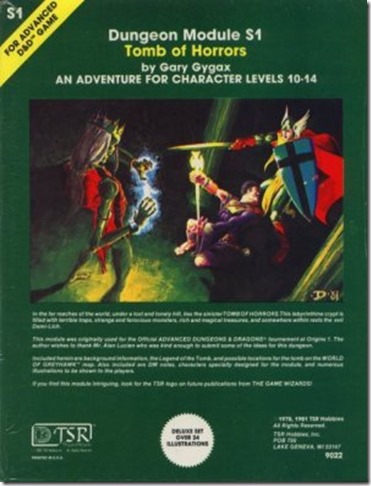
S1ModuleCover

Ponder the lessons to be learned at your own risk!!!!

The eighties were my decade and a book devoted to recovering obscure details about it is inherently fun for me. In fact, it feels like it is written for me.

That said, the notion of a future overwhelmed by nostalgia is troubling. Not only is the OASIS effectively a museum for retro-futurism, but the quest at the center of the book is an attempt by a Howard Hughes figure to make others obsess over his teenage years as much as he does.

What if virtual reality is an old man’s game? We all hope that future technology will create new worlds and open up new possibilities, but what if all the potential for VR and AR is ultimately overwhelmed by the obsessions of the past and guided by what we have wanted VR to be since Star Wars movie first appeared on movie house screens?

What if this is the ultimately paradox of emerging technologies: that new technology is always created to solve the problems and fill the appetites of yesterday? We can make our first lesson from the history of VR a paraphrase of George Santayana’s famous saying.

Maxim 1 – In the virtual world, those who can’t let go of the past are doomed to repeat it.

HoloLens Surface Reconstruction XEF File Format

[Update 4/23 – this turns out to be just a re-appropriation of an extension name. Kinect studio doesn’t recognize the HoloLens XEF format and vice-versa.]

The HoloLens documentation reveals interesting connections with the Kinect sensor. As most people by now know, the man behind the HoloLens, Alex Kipman, was also behind the Kinect v1 and Kinect v2 sensors.

kinect_studio_xef

One of the more interesting features of the Kinect was its ability to perform a scan and then play that scan back later like a 3D movie. The Kinect v2 even came with a recording and playback tool for this called Kinect Studio. Kinect Studio v2 serialized recordings in a file format known as the eXtended Event File format. This basically recorded depth point information over time – along with audio and color video if specified.

Now a few years later we have HoloLens. Just as the Kinect included a depth camera, the HoloLens also has a depth camera that it uses to perform spatial mapping of the area in front of the user. These spatmaps are turned into simulations that are then combined with code so that in the final visualization, 2D apps appear to be pinned to globally fixed positions while 3D objects and characters seem to be aware of physical objects in the room and interact with them appropriately.

xef

Deep in the documentation on the HoloLens emulator is fascinating information about the ability to play back previously scanned rooms in the emulator. If you have a physical headset, it turns out you can also record surface reconstructions using the windows device portal.

The serialization format, it turns out, is the same one that is used in Kinect Studio v2: *.xef .

An interesting fact about the XEF format is that Microsoft never released any documentation about what the xef format looked like. When I open up a saved xef file in Notepad++, this is what it looks like:

xef_np 

Microsoft also never released a library to deserialize depth data from the xef format, which forced many people trying to make recordings to come up with their own, idiosyncratic formats for saving depth information.

Hopefully, now that the same format is being used across devices, Microsoft will be able to finally release a lib for general use – and if not that, then at least a spec of how xef is formed.

Rethinking VR/AR Launch Dates

The HTC Vive, Oculus Rift and Microsoft HoloLens all opened for pre-orders in 2016 with plans to ship in early April (or late March in the case of the Oculus). All have run into fulfillment problems creating general confusion for their most ardent fans.

I won’t try to go into all the details of what each company originally promised and then what each company has done to explain their delays. I honestly barely understand it. Oculus says there were component shortages and is contacting people through email to update them. Oculus also refunded some shipping costs for some purchasers as compensation. HTC had issues with their day one ordering process and is using its blog for updates. Microsoft hasn’t acknowledged a problem but is using its developer forum to clarify the shipping timeline.

Maybe it’s time to acknowledge that spinning up production for expensive devices in relatively small batches is really, really hard. Early promises from 2015 followed by CES in January 2016 and then GDC in March probably created an artificial timeline that was difficult to hit.

On top of this, internal corporate pressure has probably also driven each product group to hype to the point that it is difficult to meet production goals. HTC probably has the most experience with international production lines for high tech gear and even they stumbled a bit.

Maybe it’s also time to stop blaming each of these companies as they reach out for the future. All that’s happened is that some early adopters aren’t getting to be as early as they want to be (including me, admittedly).

As William Gibson said, “The future is already here — it’s just not very evenly distributed.”

Sketching Holographic Experiences

augmented reality D&D

These experiences sketches are an initial concept exploration for a pen and paper role playing game like Dungeons & Dragons augmented by mixed reality devices. The first inklings for this were worked out on the HoloLens forums and I want to thank everyone who was kind enough to offer their creative suggestions there.

I’ve always felt that the very game mechanics that make D&D playable are also one of the major barriers to getting a game going. The D&D mechanics were eventually translated into a variety of video games that made progressing through an adventure much easier. Instead of spending half an hour or more working out all the math for a battle, a computer can do it in a fraction of the time and also throw in nice particle effects to boot.

What gets lost in the process is the story telling element as well as the social aspect of playing. So how to we reintroduce the dungeon master and socialization elements of role playing without having to deal with all the bookkeeping?

2 

With augmented reality, we can do much of the math and bookkeeping in the background, allowing players to spend more time talking to each other, making bad puns and getting into their characters. Instead of physical playing pieces, I think we could use flat player bases instead imprinted with QR codes that identify the characters. 3D animated models can be virtually projected onto the bases. Players can then move their bases on the underlying (virtual) hex maps and the holograms will continue to be oriented on their bases correctly.

3

All viewpoints are calibrated for the different players so everyone seems the same things happening – just from different POVs. The experience can also be enhanced with voice commands so when your magic user says “magic missile” everyone gets to see appropriate particle effects on the game table shooting from the magic user character’s hands at a target.

4

I feel that the dice should be physical objects. The feel of the various dice and the sound of the dice are an essential component of pen and paper role playing. Instead, I want to use computer vision to calculate the outcomes, present digital visualizations of successful and unsuccessful rolls over the physical dice, and then perform automatic calculations in the background based on the outcome.

5

The player character’s stats and relevant info should over over him on the game table. As rolls are made, the health points and stats should update automatically.

6

While some of the holograms on the table are shared between all players, some are only for the dungeon master. As players move from area to area, opening them up through a visual fog of war, the dungeon master will be able to see secret content like the location of traps and the stats for NPCs. It may also be cool to enable remote DMs who appear virtually to host a game. The thought here is that a good DM is hard to find and in high demand. It would be interesting to use AR technology to invite celebrity DMs or paid DMs to help get a regular game going.

7 

When I started planning out how a holographic D&D game would work, there was still some confusion over the visible range of holograms with HoloLens. I was concerned that digital D&D pieces would fade or blur at close ranges – but this turns out not to be true. The main concern seems to be that looking at a hologram less than a meter away for extended periods of time will trigger vergence-accomodation mismatch for some people. In a typical D&D game, however, this shouldn’t be a problem since players can lean forward to move their pieces and then recline again to talk through the game.

8

AR can also be used to help with calorie control for that other important aspect of D&D – snack foods and sodas.

Please add your suggestions, criticisms and observations in the comments section. The next step for me is creating some prototypes  in Unity of gameplay. I’ll post these as they become ready.

And just in case it’s been a long time and you don’t remember what’s so fun about role playing games, here’s an episode of the web series Table Top with Will Wheaton, Chris Hardwick and Sam Witwer playing the Dragon Age role playing game.

Understanding HoloLens Spatial Mapping and Hologram Ranges

There seems to be some confusion over what the HoloLens’s depth sensor does, on the one hand, and what the HoloLens’s waveguides do, on the other. Ultimately the HoloLens HPU fuses these two two streams into a single image, but understanding the component pieces separately are essential for creating good holographic UX.

spatmap

From what I can gather (though I could be wrong), HoloLens uses a single depth camera similar to the Kinect  to perform spatial mapping of the surfaces around a HoloLens user. If you are coming from Kinect development, this is the same thing as surface reconstruction with that device. Different surfaces in the room are scanned by the depth cameras. Multiple passes of the scan are stitched together and merged over time (even as you walk through the room) to create a 3D mesh of the many planes in the room.

things

These surfaces can then be used to provide collision detection information for 3D models (holograms) in your HoloLens application. The range of the depth spatial mapping cameras is 0.85 meters to 3.1 meters. This means that if a user wants to include a surface that is closer than 0.85 M in their HoloLens experience, they will need to lean back.

The functioning of the depth camera shouldn’t be  confused with the functioning of the HoloLens’s four “environment aware” cameras. These cameras are used to help in nailing down the orientation of the HoloLens headset in what is known as  inside-out positional tracking. You can read more about that in How HoloLens Sensors Work. It is probably the case that the depth camera is used for finger tracking while the 4 environment aware cameras are devoted to spatial mapping.

The depth camera spatial mapping in effect creates a background context for the virtual objects created by your application. These holograms are the foreground elements.

Another way to make the distinction based on technical functionality rather than on the user experience is to think of the depth camera surface reconstruction data as input , and holograms as output. The camera is a highly evolved version of the keyboard while the waveguide displays are modern CRT monitors.

It has been misreported that the minimum distance for virtual objects in HoloLens is also 0.85 Meters. This is not so.

The minimum range for hologram placement is more like 10 centimeters. The optimal range for hologram placement, however, is 1.25 m to 5 m. In UWP, the ideal range for placing a 2D app in 3D holographic space is 2 m.

Microsoft also discusses another range they call the comfort zone for holograms. This is the range where vergence-accommodation mismatch doesn’t occur (one of the causes of VR sickness for some people). The comfort zone extends from 1 m to infinity.

Range Name Minimum Distance Maximum Distance
Depth Camera 0.85 m (2.8 ft) 3.1 m (10 ft)
Hologram Placement 0.1 m (4 inches) infinity
Optimal Zone 1.25 m (4 ft) 5 m (16 ft)
Comfort Zone 1.0 m (3 ft) infinity

The most interesting zone, right now, is of course that short range inside of 1 meter. That 1 meter min comfort distance basically prevents any direct interactions between the user’s arms and holograms. The current documentation even says:

Assume that a user will not be able to touch your holograms and consider ways of gracefully clipping or fading out your content when it gets too close so as not to jar the user into an unexpected experience.

When a user sees a hologram, they will naturally want to get a closer look and inspect the details. When a human being looks at something up close, he typically wants to reach out and touch it.

sistine_chapel

Tactile reassurance is hardwired into our brains and is a major tool for human beings to interact with the world. Punting on this interaction, as the HoloLens documentation does, is a great way to avoid this basic psychological need in the early days of designing for augmented reality.

We can pretend for now that AR interactions are going to be analogs to mouse click (air-tap) and touch-less display interactions. Eventually, though, that 1 meter range will become a major UX problem for everyone.

[Updated 4/6 after realizing I probably have the functioning of the environment aware cameras and the depth camera reversed.]

[Updated 4/21 – nope. Had it right the first time.]