Free Windows Phone 7 Devices

startscreen_print

According to the twitter rumor mill, certificates for free Windows Phone 7 devices are being handed out to select attendees at this year’s Tech-Ed North America in New Orleans (to be accurate 50 of them, according to Brandon Watson).

Looking past some of the grumbling from a few MIX10 attendees who feel they should have gotten a shot at the phones (we all got free Azure t-shirts left in our hotel rooms, didn’t we?), this is very exciting news.  It suggests that a large number of Windows Phone devices are ready and will soon become available to WP7 developers.

<hypothetical>WP7 DEVICES for Phone application developers will soon be generally – more or less — AVAILABLE!  Woohoo!</hypothetical>

For the past month or so I’ve been peering at these devices over the shoulders of Microsoft evangelists.  At MIX I surreptitiously saw one hanging out of the pocket of a project manager on the Phone team.  I don’t think I even saw one at the MVP Summit in February.

So how does one get one’s hands on the upcoming series of phones for developers?  I have no hard information, but a good bet is to sign up for the Windows Phone Marketplace.

It’s $99 for a year – a very good price if you plan to develop Windows Phone applications in time for the Holiday launch later this year.  And if, by chance, that registration puts you on a list to potentially get a WP7 device – well that’s just gravy, isn’t it?

The big message I’m hearing, though, is that you should really come up with a great idea for a phone app before asking for a phone.  Microsoft isn’t looking to hand out phones so you can, only at that point, start thinking about what you might want to build.  That would be putting the cart before the handheld device.

How To Launch A Cat

gatto

In his wonderful book, Sketching User Experiences, Bill Buxton identifies the 15th century notebooks of Mariano di Jacobi detto Taccola on military technology as some of the earliest examples of “sketching".  Buxton continues by explaining what he means by “sketching”: suggestive, unfinished illustrations of concepts that are provocative rather than didactic.

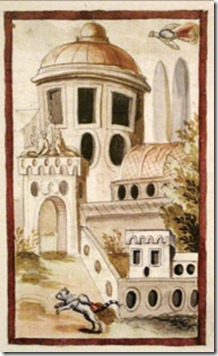
The illustration above comes from a 16th century Bavarian work called the Buechsenmeisterei or Artillery Master’s Manual.  The anonymous ink and watercolor illustration is labeled “How to Launch a Cat” and is part of the Getty Museum’s collection in Los Angeles. The drawing depicts a cat with a rocket strapped to its back. It appears to be a sketch demonstrating the possible military application of felines in siege warfare.  It may just as well, of course, be a sketch of novel ways to dispose of cats.

“There is more than one way to skin a cat” turns out to be an incorrect translation of an old German proverb.  The correct saying is, of course, “there is more than one way to launch a cat.”  Placed in its proper context, this saying makes much more sense.

There are also many ways to launch a new business – perhaps as many ways as there are to launch a cat.  I am in the process of doing so now.  The business does not involve cats – though it does involve friends.

I am aware of the common adage that one should never go into business with relatives or cats, no matter how cool they may be.  Nevertheless, I find the prospect of launching a cat with my friends to be infinitely appealing.  It is an opportunity to turn work into play.

And all we need do is wait until the cat is up, up and away.

Danger of Drowning

tybee 002

Habit is often considered a bad thing these days.  It is associated with “bad” things such as smoking cigarettes, chewing nails and eating too much candy.  There are also “good” habits, of course, such as flossing and rebooting your computer regularly.

Aristotle based his ethical system on the notion of forming good habits.  In order to achieve something difficult like “virtue”, he felt, we have to train ourselves to have “good” habits.  This is best achieved by having good mentors and good friends (and it doesn’t hurt to belong to a good city-state) who reinforce the habits we ought to have.

Perhaps too much is made of the distinction, but we currently live in a zeitgeist dominated by Kantian rather than Aristotelian ethics.  In a Kantian system (ours) we judge not good people but rather good deeds.  Moreover a deed is good based not on its results (baby saved from drowning, people can fish for themselves) but rather by the attitude in which it was done.  If an action is done out of a sense of obligation to do good in general, then it is truly good.  If it is done out of a sense of accomplishment – then not so good.

I am making these broad-brush statements about ethics mainly because I am breaking some habits.  I recently moved from my trusted web-host of 5+ years, discountasp.net, to orcsweb.  I have also switched my blog engine from dasBlog to BlogEngine.NET. 

While I firmly believe in the importance of cultivating good habits and am a fervent admirer of the Nichomachean Ethics, I nevertheless sometimes feel the need for a change.

Discountasp.net is great (especially for developers) but I couldn’t beat free hosting orcsweb was offering for Microsoft MVPs.  Similarly, dasBlog has been very nice over the years (though I’m certain I had it configured incorrectly) but it hasn’t been developed on for a while.  Perhaps everything is perfect with dasBlog the way it is.  All the same, I like the idea of a blog engine that is still being worked on and still has room for improvement.  The last update to BlogEngine.NET was three months ago.  We might say that BlogEngine.net is still trying to inculcate good habits into its code-base. 

One of my personal habits is an occasional desire to jump into the abyss.  I call this a habit because, when the notion hits me to try out something new, I immediately get a sick feeling in my stomach.  This is when the habit comes into play.  When this vertiginous feeling overcomes me, long-established habit tells me to leap forward rather than fall back.

It is a small thing and reveals itself in small ways.  Nevertheless, I feel it is a good habit and one worth cultivating.

ReMIX Atlanta 2010 Postscript

4597438858_d617a1dd2f

It’s taken a few weeks to catch my breath after ReMIX Atlanta.  Most people have been asking if it was stressful to organize an event like this.  The truth is it was exhilarating.

Glen Gordon, Senior Developer Evangelist for Microsoft (pictured above imbibing the fruits of his labor after the event) has a good wrap-up here.  You can see the full set of ReMIX photos here.

4607279310_d90b380efe

In the past, ReMIX events have also been held in Boston and Chicago.  This year ReMIX Atlanta was the only ReMIX (an event based on MIX content and following MIX) in the US, so we have taken to calling it ReMIX USA.  Worldwide, there are also ReMIX events being hosted in Moscow, Paris, Seoul, Melbourne and London.

Our sponsors were amazing.  I can’t tell you how important an early response from sponsors means to the health of an event – as well as their willingness to set aside their typical invoice+60 policies in order to make money available. This early money is the life-blood of a conference – it establishes the scope of the event as well as morale for an event.

4616291144_9f7b6acd32

The vast majority of our sponsors contributed at the Platinum level – which means they gave us the maximum amount of money we were asking for.  Above and beyond that many also contributed software licenses, swag, and their time at the event.  Intellinet provided volunteers to check badges at the doors. Slalom flew out Nikki Chau to speak.  Microsoft flew out Brandon Watson to be our keynote speaker (Celia Dyer posted her video interview with Brandon for techdrawl here). DevExpress flew out Mehul Harry who is an amazing guy. 

Here is our full list of sponsors: Matrix, Veredus, Dunn Training, Agilitrain, EventVolt, Wintellect, Slalom, Intellinet, Magenic, Microsoft, DevExpress, Telerik, First Floor, Infragistics, Sagepath, AWDG, IxDA.

4606833186_bbde700131

Special mention should be made of EventVolt.  This is the brainchild of Patrick Nickles, an entrepreneur new to the Atlanta area.  He contacted us just a few days before the event and offered to wire up power for the audience so they could plug in their laptops.   He has his own rig to do this.  He even had a rig for hooking us up with WIFI. His business idea is simply to help out with conferences by doing a lot of this technical plumbing work that hotels and other venues are not set up to do.  His initial email was basically – “I don’t expect anything back.  Just let me set up something cool for you and I’ll stay out of your way.”  Needless to say, this is an event organizer’s dream.

Thanks also go out to the speakers.  Many travelled to get to us – Brandon, Jonathan, Wally, Todd and Nikki.  All were amazing. 

4615910101_49d3808f42

Our full list of speakers is: Brandon Watson, Virginia Cagwin, Rob Cameron, Nikki Chau, James Chittenden, Dennis Estanislao, Sean Gerety, Jonathan Marbutt, Wallace McClure, Todd Miranda, Zachary Pousman, Corey Schuman and Shawn Wildermuth.  We had a scary moment when Steve Porter called us early on Saturday morning and turned out to be incredibly sick.  Corey Schuman was able to fill in at the last minute to do his talk on Windows Phone 7 and Expression Blend.

Thanks should also go out to the organizers.  For what it is worth, organizing an event ultimately comes down to bringing the right people together and letting then run with their ideas.  One assumes that by maintaining a high energy level and firing on all pistons, everyone will be at their best.  One then crosses one’s fingers and hopes that the right people have been brought in.  At ReMIX USA, this was the case.  Everyone pitched in when they saw a gap.  Everyone excelled at whatever became their responsibilities.

4607307232_3da6b1c677

The main organizers of ReMIX were James Ashley, Dan Attis, Dennis Estanislao, Sean Gerety, Cliff Jacobson, Corey Schuman and David Steyer.

4597852879_a23e1e6ec9

And then there are all the people who, like Patrick Nickles, simply pitched in and asked for no thanks.  I will do a great disservice at this point by not remembering everyone who helped out in this way.  However, at the risk of ignoring many contributors by naming the few, I’d like to thank Linda Gerety, Sergey Barskiy, Jessie and Jason Rainwater, Jay Cornelius and Farhan Rabbi.

ReMIX Atlanta: Soup to Nuts and Bolts

ReMIXAtlanta 

If you have ever wondered how a major technical event gets thrown together, I’ll tell you.

ReMIX Atlanta started with a conversation in which Corey Schuman suggested that it would be a good idea to do a ReMIX event like they do in Boston and Chicago every year.  The appeal for us was that MIX is totally unlike every other Microsoft sponsored event.  In turn, every community event in Atlanta tends to model itself on MS conferences like the PDC.  Wouldn’t it be fun, we thought to ourselves, to do something different.

Meanwhile in another part of the world, Richard Campbell and Carl Franklin, the hosts of the .NET Rocks! Podcast (and producers of Hanselminutes, I believe) were planning to bring their roadshow to Atlanta on May 7th.

Glen Gordon and Murray Gordon, Microsoft Evangelists in Atlanta, suggested that we associate the two events and do some cross-promoting.  So an invitation went out and on March 25th, a bunch of guys got together at a Fuddrucker’s and started laying out plans.

The first thing was trying to scope the event.  Should we go small or go big?  Corey and I wanted to do something really new and different and ambitious for the Atlanta area so we pushed for something big – 400 attendees big – and we got our way.

Having pushed for the idea, we were now on the line for making it happen, of course.  We next had to find a venue for both the .NET Rocks roadshow as well as the ReMIX that could accommodate 400 people.  Cliff Jacobson (Cliff helps to run the MS Pros user group and helps out lots of other user groups in innumerable ways) got on the phone that following Monday and just started making calls.  It turned out to be a bad time of year to plan an event.  We were competing against proms and weddings.  We had used colleges and universities for events in the past, but the main problem there is that they either do not have the space or have weekend classes or are on the edges of Atlanta making them hard to get to.  Besides, we wanted to use the same space for both the .NET Rocks! roadshow as well as the ReMIX event.  Finally the Marriott at the Perimeter came through for us (and have continued to work with us every step of the way to get us what we needed for a fantastic conference).

So the next question was: how do we pay for this?  We decided to charge $25 dollars initially as a way to cover our costs for a bare minimum conference.  This doesn’t even cover lunch, but at least the Perimeter is a nice area and there are lots of excellent restaurants within walking distance.  (If you’ve ever wondered, getting conference space with catering is expensive, yes it is.)

Now we needed to promote the event.  I contacted my favorite web designer, Dennis Estanislao, part of our Minus Five team from MIX (there’s an embarrassing picture out there somewhere of our Minus Five outing), and he put together a design concept and website for the event in three days.

So next – what were we going to present at the conference?  You may think that this should have been our first concern – we did have a few MIX inspired ideas – but the truth is we weren’t ready to start recruiting speakers until we knew we could actually have an event.  Silverlight 4 and Blend 4 were just about to come out, so we knew we wanted to do that.  Then there’s Windows Phone 7 – we decided that we needed to do a whole track on Windows Phone 7.  So for the third track?  Believe it or not, the first suggestion was to do a catchall track for RIA Services, Sharepoint 2010, SQL Server Reporting Services and so on.

But that wouldn’t be MIX-like, would it?  We were sitting around with Sean Gerety and Dennis who began describing an Abbott and Costello routine they had developed around common misunderstandings between developers and designers.  We were on the floor laughing and knew immediately that that should be in the conference.  Very quickly we realized that we wanted to do an entire track on the sorts of issues they were pointing out.  It’s a Kumbaya kindof idea, but developers really need designers to make their applications shine, while designers need developers to make their applications functional.  And yet these are two fields that simply don’t talk to each other and even have a bit of a chip on their shoulders about it.  We knew we wanted to break down those boundaries with the ReMIX conference.

And so the User Experience track was born.

Now we needed speakers.  We wanted the best and we wanted to include excellent speakers that the Atlanta community hasn’t seen before.  Back on the phone we all went and before we knew it we had speakers from Alabama and Tennessee committed to speaking at ReMIX.

We then got a lucky break.  Richard Campbell was talking to Brandon Watson, the new Director of Developer Experience for the Windows Phone 7 team, about being our keynote speaker.  In the process, Brandon offered to provide us with hand-picked speakers for the entire Windows Phone track.

We put out the registration site http://remixatlanta.eventbrite.com (Eventbrite turns out to be amazing – Brendon Schwartz recommended that we use it and he was right!), asked all the leaders of the user groups in Atlanta to promote the event to their members, and within a few days had a hundred people register.  We were excited.

Now we really had a big event on our hands.  We needed money to make it better.  With only three weeks before the event, everyone started hitting their contacts and we reached out for sponsors.  We were worried that no one would even respond to our emails.

Instead, lots of companies have come through at the Platinum level (we honestly thought only one or two would offer to sponsor us at the Platinum level).  Richard Campbell hooked us up with the great people at DevExpress; Doug Ware reached out to Matrix; Veredus Staffing even added a comment to our website asking if we needed sponsors.  Very quickly Dunn Training, Agilitrain, the wonderful Bethany Jones Vananda of Wintellect, my own company Sagepath, Stacy Koehn at Slalom and Emily Parker and Telerik all offered to help sponsor the ReMIX – on very short notice, let’s remember.

Dan Attis set up a non-profit bank account to put all these pledged funds into.  I can’t thank him enough for that.  We’d been talking about setting up an account like this for well over a year, and Dan finally got it done just in time for ReMIX.

The Atlanta Web Developers Group: http://www.awdg.org/ and the Atlanta’s Interaction Design and User Experience Community: http://ixdaatlanta.ning.com/ are going to help us with the event (yay designers!) and be present in The Commons to talk about design issues.  J. Cornelius, leader of the AWDG, will even stick around to give tips on improving your apps – so bring your laptops with your current web, windows or Silverlight project and get a free appraisal from an expert.

What is The Commons, you ask?  The Commons is a concept a bunch of us first encountered at MIX.  While learning new information at conference sessions is valuable, the greatest value one can get out of a conference is a chance to make new contacts and expanding your network.  The Commons is a place that facilitates that.  We’re going to make it extremely comfortable and inviting.  It is where you will want to be when you want to take a break – and really, who can sit through five talks in one day – you need to pace yourself.  So we are setting up The Commons as your personal retreat.  Here developers will get a chance to talk to designers (I know developers who have never even met designers before).  Designers will get a chance to reevaluate their opinion of Microsoft products.  People who are job hunting, or just thinking about job hunting, will get some casual time with recruiters to find out what the market is really like now.  We’ll have an XBOX 360 there for a little bit of RockBand action.  Software vendors will demonstrate their products (which Silverlight charting control should you use? – you’ll get a chance to compare them side-by-side from the vendors themselves).

Sean Gerety has been the biggest proponent of The Commons concept and is doing the majority of the concept work.  It is going to be fantastic.  He has also been putting together the UX track and has the most amazing soft skills I have ever encountered.

If you haven’t picked up your ticket to ReMIX Atlanta and the .NET Rocks roadshow, yet, please do so at: http://remixatlanta.eventbrite.com

The Roadshow is a free event on Friday night.  Richard and Carl are giving out lots of software licenses and books, and anyone who has ever listened to their podcast will know how fun these guys are.  Think Prairie Home Companion for geeks and without so many jokes about Minnesota.  There will be food and refreshments.

And that, as Paul Harvey would say, is the rest of the story. 

War of the Wing-Men

war of the wingmen

Recently, a reader wrote to ask about the image used as a header for this blog.

It is a scanned and photoshopped cover from a 1958 ACE pulp science fiction paperback.  The paperback includes two short novels by Poul Anderson.  The side above shows an illustration for War of the Wing-Men.  The verso has an inverted illustration for Anderson’s The Snows of Ganymede.  The text of the two novels meet somewhere in the middle of the book and then flip upside-down (or right-side up, depending on whether you are reading from front-to-back or back-to-front).

Here is a short summary of the plot from the insert to War of the Wing-Men:

Only three humans survived the wreck of that space-ship on the little known planet of Diomedes.  One was the beautiful ruler of a distant colonial world; another was the fat, slovenly owner of a great Solar trading company; the third was a handsome, blue-eyed engineer.

The survivors had food for only six weeks, for the native food was one hundred percent poisonous to people.  So in that limited amount of time they had to gain the trust of the winged barbarians who held them prisoners, end the terrible war that these Diomedians were engaged in, and persuade the wing-men to carry the three across the thousands of miles of unmapped territory to the single Earth spaceport.

Their desperate efforts to beat that fatal deadline makes WAR OF THE WING-MEN one of Poul Anderson’s most exciting novels.

My wife inherited this pulp novel – along with a hundred more like it – when Walter G. Steblez, her father, passed away a few years ago.  Walter had collected sci-fi, mystery and horror pulp novels from his childhood and later became a collector as an adult.  His tastes were eclectic, and ranged from books of poetry in Latin (he was a classics major in college) to the complete series of The Saint novels by Leslie Charteris (though he was also a keen advocate of the mystery writings of S. S. Van Dine).  Walter’s book collection also included the books belonging to Nikolai Elenev, a distant relative and Russia scholar who was part of the Russian émigré community in Prague during the 20’s and belonged to a circle of friends which included Marina Tsvetaeva and Sergei Efron.  We also have correspondences between Nikolai and Walter, though the majority of Nikolai Elenev’s correspondences are archived at Amherst College.

Walter George Steblez was born in Germany in 1945 on the road between an Auschwitz labor camp for Osterlanders and Hanau, where his family was able to make contact with Allied Forces and eventually arranged passage to America – having escaped both Stalin and Hitler.  His family was originally from Mariupol, a city on the Azov Sea, but left for Germany during the Nazi occupation of Ukraine in the hopes of a better life.  This may seem strange, but it should be remembered that they had lived through the revolution, the famine in the Ukraine, and had watched Avraam, Walter’s grandfather, be dragged away to the Gulag with no expectation of ever seeing him again. 

Walter grew up a bilingual speaker of Russian and English and was fluent in French.  He later picked up classical Greek and Latin in college.  He worked for the State Department in the 70’s and was well known for hosting soirees in Washington, D.C.  He later moved to the US Geological Survey and ultimately to the U.S. Bureau of Mines where he was an expert in Central and Eastern European minerals.  A Bing search will bring up his publications for the USGS.

Richard Levine, one of Walter’s longest friends, wrote this about the childhood collector of War of the Wing-Men:

I knew Walt Steblez as a best friend and colleague with whom I spent either the entire day at work or talked with after working hours almost every day for 30 years.  I could go on and on with stories about Walt’s humor, philosophical insights, and varied interests, but the one overriding thing which informed everything he did was his sense of righteousness and the courage he displayed in acting according to his beliefs. If a person was ever being treated unjustly and needed a defender to stand up for them despite any personal consequences there was no better person than Walter Steblez.

I should also add that Walt was the Union Steward where we worked so he did this not only for his friends but for everybody in need that he was in a position to help and he would even go against his politics if he felt it was necessary to help people. For example, although Walt often sided with Republicans in their fiscal views, he voted for Walter Mondale over Ronald Reagan in 1984 because he told me he thought that Reagan’s policies were adversely affecting the homeless and disabled.

On a personal level I think that one of the ways that he helped exemplifies how he lived his life and what he did for others.

We were in a work situation where we had an unstable supervisor whose many problems I won’t go into, but the supervisor had decided that he could advance himself further if he could get rid of me and promote Walter to my position who he thought would be a loyal minion. He proposed this plot to Walter, even lamenting that because I did a good job it would be more difficult.

This would have meant for Walter a promotion and a chance to do a job which may have given him more personal satisfaction and fully employed his unique bilingual abilities in Russian and English.  Rather than being tempted, Walter found the person despicable, and without any authorization physically moved his office so that he would not have to look at this person.

Nevertheless, the supervisor thought that Walter would still be in on the scheme and began to carry it out. He laid the groundwork by giving me a lousy performance rating although I had the best year of my career and by giving Walter a superlative performance rating. I of course was infuriated and launched a grievance about receiving too low an evaluation. 

Walter, who knew his game, also launched a grievance procedure, claiming that he gave him too high an evaluation by listing false accomplishments. Walter just as doggedly pursued his grievance for too high an evaluation as I did for too low of one.  Not only that, but Walter went with me personally to the head of our agency to describe what was going on with the supervisor. 

So the result was I kept my job, the supervisor, who had harmed many others, was moved, and Walter stayed doing what he was doing and only much later was he promoted. 

Until Walter’s last day he maintained this blazing sense of justice and would have pursued any just cause as vehemently at whatever cost to himself. If all people, were like Walter, then the Biblical prophesy would come true of let justice roll down like waters. I am not only personally appreciative to Walt for saving my career, but live in awe of his example which I forever hold before me as a standard to which I must always try to live up to. 

Speaking at DevLink

Our far-flung correspondent from self-promotion land writes:

I received an invitation this past week to speak at DevLink.  I will be presenting on two topics:

The C# 4 Dynamic Objects session will be a longer version of the talk I gave at the MVP Summit in February.  The Advanced Windows Phone 7 talk is one I find I am updating every few weeks as more tools and information about the platform become available.

DevLink is a three day conference being held in Nashville, August 5-7.

My Dance Card is Full

dancecard

I’m overcommitted.  I recently changed jobs, moving from Magenic Technologies, a software consulting firm, to Sagepath, a creative agency.  I knew the new job would be great when they paid my way to MIX10 my second week at work.

On top of that I submitted talks to several regional conferences and the voting has begun to select speakers.

For CodeStock I have submitted the following three presentations:

For the DEVLINK conference I also have three talks which are currently doing well in community voting.  This is a blind vote, though, so I won’t list the sessions I have submitted.

With Ambrose Little and Brady Bowman, I have started a reading group on Umberto Eco’s A Theory of Semiotics called ‘Semiotics and Technology’ and hosted on google groups.  We have just finished the first chapter and are beginning our discussion of the Introduction.

In addition, I have been working with several members of the Atlanta developer community to organize ReMIX Atlanta.  The goal of ReMIX is to have a different kind of conference – one that caters to both the developer community and the design-UX community.  These are traditionally two communities that do not necessarily get along – and yet they must if we are ever to get beyond the current proliferation of unusable applications and non-functional websites.  To quote Immanuel Kant:

“Thoughts without content are empty, intuitions without concepts are blind.”

I also need to stain the deck and build a website for my wife – and in the time left over I plan to build the next killer application for the Windows Phone 7 Series app store.  This time next year I will be blogging to you from a beach in Tahiti while reclining on a chair made from my Windows Phone app riches.

In the meantime, however, my dance card is full.

Open Spaces and the Public Sphere

office

While watching C-SPAN’s coverage of the public Congressional debate over healthcare (very entertaining if not instructive), I found that a friend has been writing about Habermas’s concept of the ‘public sphere’: Slawkenbergius’s Tales.

To be more precise, he elucidates on the mistranslation of ‘Öffentlichkeit’ in the 1962 work Habilitationsschrift, Strukturwandel der Öffentlichkeit into English as ‘public sphere’.  The term, as used by Heidegger, was often translated into English as ‘publicity’ or ‘publicness’.

“The actually important text was Thomas Burger’s 1989 translation of the book, The Structural Transformation of the Public Sphere. (As my advisor pointed out to me, the highly misleading rendering of the abstract noun Öffentlichkeit as the slightly less abstract but more "spatialized" public sphere may have been the source of all the present trouble.) Because the translation arrived at a point in time when issues of space, popular culture, material culture, and print media were at the forefront of historiographical innovation, the spatialized rendering fit very nicely with just about everyone’s research project. That’s when the hegemony of the "public sphere" began. ”

The mention of ‘space’ in Slawkenbergius’s discourse (he’ll wince at that word – read his blog entry to find out why) reminded me of the origins of the Open Space movement.

For those unfamiliar with it, open spaces are a way of loosely organizing meetings that is currently popular at software conferences and user groups.  The tenets of an open space follows, vis-a-vis Wikipedia:

  • Whoever comes is the right people [sic]: this alerts the participants that attendees of a session class as "right" simply because they care to attend
  • Whatever happens is the only thing that could have: this tells the attendees to pay attention to events of the moment, instead of worrying about what could possibly happen
  • Whenever it starts is the right time: clarifies the lack of any given schedule or structure and emphasizes creativity and innovation
  • When it’s over, it’s over: encourages the participants not to waste time, but to move on to something else when the fruitful discussion ends
  • The Law of Two Feet: If at any time during our time together you find yourself in any situation where you are neither learning nor contributing, use your two feet. Go to some other place where you may learn and contribute.
  • The open spaces I’ve encountered at software conferences have tended to be one man on a soapbox or several men staring at their navels.  But I digress.

    The notion of an Open Space was formulated by Harrison Owen in the early 1980’s (about the same time Habermas was achieving recognition in America) as a way to recreate the water-cooler conversation.  It is intended to be a space where people come without agendas simply to talk.  The goal of an open space, in its barest form, is to create an atmosphere where ‘talk’, of whatever sort, is generated.

    For me, this has an affinity with Jürgen Habermas’s notion of an ‘Ideal Speech Situation’, which is an idealized community where everyone comes together in a democratic manner and simply talks in order to come to agreement by consensus about the ‘Truth’ – with the postmodern correction that ‘Truth’ is not a metaphysical concept but merely this – a consensus.

    This should come with a warning, however, since in Heidegger’s use of Öffentlichkeit, public sphere | open space | publicness is not a good thing.  Publicness is characteristic of a false way of being that turns each of us (Dasein) into a sort of ‘they’ (Das Man) – the ‘they’ we talk about when we say “they say x” or “they are doing it this way this year.”  According to Heidegger – and take this with a grain of salt since he was a Nazi for a time, after all, and was himself rather untrustworthy – in Being and Time:

    The ‘they’ has its own ways in which to be …

    Thus the particular Dasein in its everydayness is disburdened by the ‘they’.  Not only that; by thus disburdening it of its Being, the ‘they’ accommodates Dasein … if Dasein has any tendency to take things easily and make them easy.  And because the ‘they’ constantly accommodates the particular Dasein by disburdening it of its Being, the ‘they’ retains and enhances its stubborn dominion.

    Everyone is the other, and no one is himself.

    Your First Windows Phone Development Book

    WinPhone_v3_18432D37

    Shortly after the announcement at MIX that the Windows Phone Developer Tools were available for download, a free e-book by Charles Petzold on developing for Windows Phone showed up on the Internet.  You can download it from his site here.  It includes six chapters from the book and, from what I’ve read so far, is great.  The XPS I downloaded is 156 pages – so it is quite a bit more than a tease.

    The book begins in Petzold’s characteristically off-center and brilliant style:

    “This is a short draft preview of a much longer ebook that will be completed and published later this year. That later edition will be brilliantly conceived, exquisitely structured, elegantly written, delightfully witty, and refreshingly free of bugs, but this draft preview is none of that. It is very obviously a work-in-progress that was created under an impossible timeframe while targeting quickly evolving software.”