The Open Office and Panopticism

open office plan

The magazine Fast Company has recently been on a tear critiquing the modern “open office” design ubiquitous in white collar businesses.  Several studies have found that marginal improvements in communication are offset by stress and productivity loss due to noise and lack of privacy.  Satisfaction levels for people who work in offices with doors that close are significantly higher.

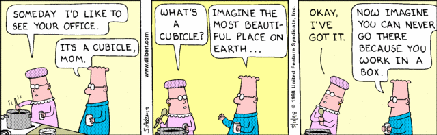
How did we get to this place?  Open office plans arose sometime in the late 90’s as a response to the jokes about cubicle culture and densification which dehumanized the office worker while squeezing every  square footage out of usable office space. Open plans were intended to be more humanizing and to encourage social interactions, bringing the serendipity of water cooler conversation to the worker’s desk simply by lowering the height of cubicle walls and introducing a few plants.

Cubicles, in their turn, were also once seen as a humanizing and egalitarian effort.  Instead of low-valued employees being doubled or tripled up in fluorescent-lighted rooms while high-valued employees got more desirable windowed private offices, cubicles broke down the divide and gave more or less the same amount of space to middle managers as well as the people under them (corner offices still go to executives).  Moreover, to the extent that metaphors make up the furniture of our minds, we collectively moved away from the notion of smoky closed rooms as the space where decisions were made and generally redesigned our workspaces to emphasize transparency and equality.

This general trend towards greater and greater openness is captured in the name: “open office”.  Like some dystopic novel or Orwellian word game, we have somehow been placed in a position of seeking out and realizing our own discontent.  With only a little exaggeration, it resembles Michel Foucault’s notion of fascism as a force the leads us “to desire the very thing that dominates and exploits us.”  Fortunately for us, we’re only talking here about furniture fascism and it’s only middle- and upper middle-class white collar workers who are standing in for the exploited masses.

Even office workers have the right to have Foucault speak for them, however.  Were Foucault to perform a genealogical \ archeological analysis of the problematic of the contemporary open plan office, it might go something like this:

The initial move involved a misdirection concerned with repression.  Middle managers were seen as repressing their employees with a feudal style architecture that crowded office workers into shared spaces while they were allowed the luxury of having their own space.  Because of the preponderance of this repressive hypothesis, the ur-father from Freud’s Civilization and Its Discontents, now embodied in the middle-manager, could only be brought down by giving everyone her own version of the manager’s office: the modern cubicle.

There are two sides to these sorts of power dynamics, though.  On their side, managers were driven to the new office plans by their own bad conscience and desire not to be seen as authoritarian figures – they, as much as anyone else, bought into the repressive hypothesis.  On the other hand, bureaucratic movement requires expediency and expertise to justify change – this was provided by consultants more than happy to explain the cost-cutting that would be afforded by replacing office walls with removable cubicle walls.  On top of this, they touted the benefits of being able to put up new cubicles or remove old ones in response to fluctuations in the workforce.

Dilbert

The argument from economic necessity led to something Scott Adams, the creator of Dilbert, identified as “densification.”  Over time and as if by a natural law, cubicles became increasingly smaller.  Because the change was gradual it was difficult to notice.  Nevertheless, the cost savings produced by “densification” – a cost savings eerily reminiscent of Marx’s analysis of surplus value – could be touted each quarter as middle managers and executives justified their own value to the company. 

When employees began to complain more regularly about densification as they stood around the water cooler, it was quickly observed that through a trompe l’oeil.  The gradual densification could no longer be plausibly denied once cubicle walls had reached the point where they were taller than they were wide.  This awareness of densification, it was discovered, could be resolved by simply making the walls shorter and consequently making the perspectival distortion caused by densification less obvious.  All one had to do then was bring in a few architects to pretty things up and provide an aesthetic explanation for the changes.

Hence was born the movement toward greater openness and collaboration – as well as the eventual removal of water coolers.  As by products of this transition, we also saw the introduction of headphones into the workplace, the rise of music players, the increase in the fortunes of Apple, the proliferation of online music streaming services and eventually the necessity of workplace broadband, now considered in some circles a human right,  to pump all this music into our headphones to drown out the conversations of our neighbors in the open office.

What caused all this to happen?  Recall that for Foucault the repressive hypothesis is at best false and at worse a misdirection.  Management did not get together and plan out a way to decrease productivity in exchange for less expensive office space – all while convincing workers that the workers were getting one over on management by being allowed to spend more time talking and avoiding hearing other people talking rather than working.

orderly rows

Instead Foucault identifies a general trend toward scientific regularity and the privileging of visual metaphors he identifies as the “empire of the gaze” and, eventually, “panopticism”.  Let’s try to make this plausible and show how it is relevant to the rise of the open office.

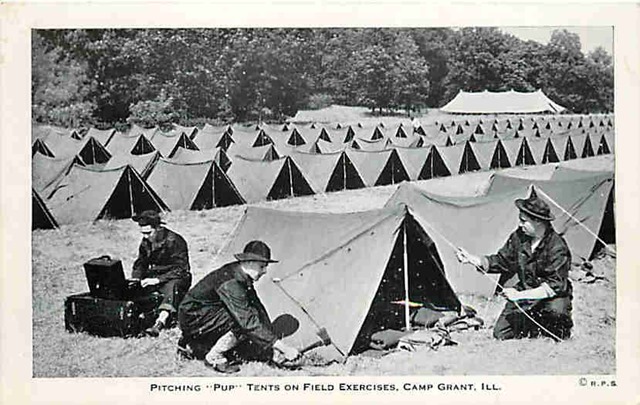
In his book Discipline and Punish, Foucault introduces the notion that modern civilization, built on firm scientific principles, has had regulation and observation built into it on a cultural level.  As an example, he cites the development of geometrical plans for the laying out of military camps starting in the 17th century.  Military manuals from that time spell out explicitly how camps were to be laid out, how far tents needed to be from one another, how high they must be, etc.  The goal of these standardized layouts was to make the entire camp visible and an easy object of surveillance from a given point of view.  More importantly, soldiers were made to know, by the layout of the camps that they themselves built, that their conduct was being observed by their superiors and that they needed to fall in line, so to speak.

“For a long time this model of the camp, or at least its underlying principle, was found in urban development, in the construction of working-class housing estates, hospitals, asylums, prisons, schools: the spatial ‘nesting’ of hierarchized surveillance … The camp was to the rather shameful art of surveillance what the dark room was to the great science of optics.

“A whole problematic then develops: that of an architecture that is no longer built simply to be seen (as with the ostentation of palaces), or to observe  the external space (cf. the geometry of fortresses), but to permit an internal, articulated and detailed control – to render visible those who are inside it; in more general terms, an architecture that would operate to transform individuals: to act on those it shelters, to provide a hold on their conduct, to carry the effects of power right to them, to make it possible to know them, to alter them.”

The fault in each of these geometries is the point of view required to perform surveillance.  It is a weakness in the system that constantly draws attention to itself as the observer.  When a soldier in the camp knows who is observing him – that is, whose opinion matters most – he can choose to be obsequious to his officer, to buddy up to his officer, to flatter him, to bribe him, and in other ways undermine the surveillance culture that is being developed.  In this sort of scenario, the soldier merely has to “act” as if he is behaving and only when he thinks someone is watching; whereas the true goal of a surveillance culture is to mold people to behave well all the time and to do this sincerely rather merely as an act.

panopticon

Foucault finds the architectural fulfillment of this managerial vision in something known as the Panopticon.  The Panopticon is a concept for a prison designed by Jeremy Bentham, the father of utilitarianism.  The idea behind it was to have a prison designed in a ring so that every prisoner was constantly being observed by other prisoners.  Additionally, there was a tower in the center of the ring that provided the only privacy available in the prison layout.  The tower housed guards, but inmates could never be sure how many were watching them at any time.  What is important in the design is that prisoners always feel as if they are being watched.  Under constant surveillance of this sort, it was hoped, would cause prisoners to behave morally and hence undergo rehabilitation through self-discipline as well as punishment.  The Panopticon would put them on their best behavior.

How does this apply to the open office?  Just as there are design patterns in architecture – patterns that repeat themselves to the point that technicians can use them as guides for architectural design – there are also patterns in civilization.  These patterns mark epochs in culture. Thomas Kuhn, when discussing scientific revolutions, called them “paradigms” – from which we get the overused term “paradigm shift” that, technically, describes the transitions between scientific epochs.

For Foucault, the cultural epoch we are currently living through is ultimately one guided by the notion of surveillance.  Surveillance patterns inform our managerial practices as well as our modes of self-governance as a nation, our architecture as well as how we do interior decorating, our city planning as well as how we raise our children.  Surveillance entertainment, more commonly known as “reality television”, is a media staple.  And of course, surveillance design patterns inform our office spaces.

In discussing living in a surveillance society, in this particular time and place, it feels overly heavy handed to even link to articles about Edward Snowden, WikiLeaks, NSA spying or project PRISM.   These are the design patterns of a world we have simply learned to accept as a matter of course.  It is worth reflecting, however, that Foucault worked through his insights on surveillance and panopticism in the 60’s and 70’s; Discipline and Punish, in which he laid out these observations, was published in 1975.

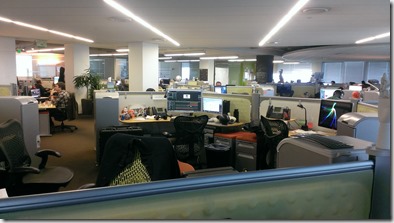
The picture at the top of this post is of the office I work in.  It is an open office plan.  There happen to be offices with doors for managers.  Their office walls, however, as well as their doors are made of glass.  This allows management to more easily observe us, just as it allows us to more easily watch management.  It is the fulfillment of panopticism because it has no area for guards whatsoever – everyone inhabits the empire of the gaze.

The greatest office design innovation here at work are the two tiny rooms designated for nursing mothers.  They are the most used spaces – not because we have that many nursing mothers but rather because they are the only places in the office where people can hide.  This requires correction.

Quick Reference: Kinect 1 vs Kinect 2


This information is preliminary as Kinect for Windows SDK 2.0 has not been released in final form and some of this may change.  Some things, such as no tilt motor and supported USB standards, are probably impossible to change.

Feature Kinect for Windows 1 Kinect for Windows 2
Color Camera 640 x 480 @30 fps 1920 x 1080 @30 fps
Depth Camera 320 x 240 512 x 424
Max Depth Distance ~4.5 M 8 M
Min Depth Distance 40 cm in near mode 50 cm
Depth Horizontal Field of View 57 degrees 70 degrees
Depth Vertical Field of View 43 degrees 60 degrees
Tilt Motor yes no
Skeleton Joints Defined 20 joints 25 joints
Full Skeletons Tracked 2 6
USB Standard 2.0 3.0
Supported OS Win 7, Win 8 Win 8
Price $249 $199

My daughter the sword swallower

sasha

My fifteen year old daughter, Sasha, publicly performed her sword swallowing act this past weekend at the Ripley’s Believe It or Not! museum in Gatlinburg, TN for Sword Swallowers Day and in the process officially became a member of the Sword Swallowers Association International.  She is currently one of about 25 female sword swallowers in the entire world.

There are three common questions that arise when people find out about my teenage daughter’s unusual hobby:

1. How did she tell you about it?

2. How did she learn to do it?

3. How do you feel about your daughter being a sword swallower?

1. How did she tell you about it?

My wife and I were watching TV in the living room when my daughter came down from her room and said “There’s something I want to show you.  Don’t freak out.”

2. How did she learn to do it?

Over the summer we sent Sasha to Los Angeles to spend time with some of her relatives on the west coast.  Her Vietnamese grandmother took her shopping in one of the more interesting areas of L.A. which included a small Chinese curiosity shop where she became fascinated by a dusty, aging volume simply called The Book of Swords.  Among other things, the book provides drawings and instructions on the ancient art of sword swallowing.  When she got back to Georgia, she practiced quietly and diligently in her room for weeks until she was ready to show us what she had learned to do.  Surprisingly, her younger brother and sister knew about it but managed to keep it a secret from me and my wife.

3. How do you feel about your daughter being a sword swallower?

At first I freaked out.  I didn’t want to see it when she wanted to show me what she could do and instead asked for a reprieve of a few days while my wife and I researched it.  I learned that sword swallowing is in fact dangerous – but it is also an art that, when practiced correctly, allows the practitioner to accomplish remarkable feats.  And then when I finally saw my daughter perform …

A father worries about his children harming themselves.  He worries that they will get involved in unsavory things or end up with unsavory friends.  He worries about his daughters more than his sons out of a perhaps chauvinistic belief that his daughters are more likely to be taken advantage of, will have more trouble standing up for themselves and saying no, are more susceptible to peer pressure, etc.  A father of teenage daughters lives half his life in fear and I am no exception.  Yet, when I finally saw my daughter perform …

I was amazed.  I learned that my daughter can accomplish anything she puts her mind to.  I learned that, unlike many people her age, my daughter has no body image issues whatsoever and in fact is in complete control over her own body and emotions in a way I find enviable.  I realized that my daughter will never have troubles saying no to anyone because she freakin’ swallows swords.  My daughter is fierce and wonderful, and I never have to worry about her being her own person and doing whatever she wants to do. 

I learned that I worry way too much.

A Tale from the Snowpocalypse

one-inch-of-snow

“Atlanta, we are ready for the snow.“ — @KasimReed via twitter

The Snowpocalypse of 2014 is strangely not a weather story so much as a traffic story.  One or two inches of snow, after all, is hardly a tsunami, a flood, or even a moderate earthquake.  It may, however, have the singular distinction of being the first time a governor of the great state of Georgia has declared a state of emergency due to a bad case of gridlock.

Which is not to say that road conditions were particularly good. They just weren’t the initial problem.  As first flurries and then larger flakes fell shortly before noon on Tuesday, January 28th, people started to realize it was time to abandon Atlanta.  The digital marketing agency where I work is located in midtown.  The email announcement went out at 12:36 that the office was closing at 1 pm. 

People had an inkling that traffic would be bad.  Even Atlanta’s mayor Kasim Reid has said that as it was happening, he thought it was a bad idea that everyone was leaving at once.  Of course, everyone thought this, which is why they all rushed out of work at the same time to beat everyone else headed toward the freeways and highways to go home to their families – most people who work in Atlanta, after all, live in the suburbs around the city.

As I peered down at the cars filling up the roads around my building like syrup overfilling a plate of pancakes, I decided to hunker down and wait a bit.  This choice was driven more by necessity than forethought as I had a meeting with a potential technology partner and then a performance management meeting.  True forethought was exercised by my friend Wells who simply called in and said he was working from home that day.  After all, we all knew there would be snow.  Our smartphone weather apps told us so.

It wasn’t until 5:30 that I finally left.  The immediate roads around the office had dried up a little.  Additionally the online traffic cameras colored all the routes out of town black so it was unlikely anything would get better in the near future.  I had no idea what a “black” road actually meant, however, so I wasn’t as rattled as I should have been.  I expected a simple three hour commute – which was about the worse I’d ever experienced on the 25 mile drive back home to the city of Lilburn – next to Snellville – northeast of Atlanta where I live.  Little did I know this was only the start of a fifteen hour odyssey through the Snowpocalypse that would give me nightmares for days and show me things about the true nature of my fellow man I’d just as soon never have known.  The performance review went relatively well, by the way – thanks for asking.

Muscle memory is an amazing metaphor for how the mind works.  Whatever the actual biological process, the story of muscle memory says that actions we perform repetitively are stored in a Lamarckian way in our bodies themselves – as if our minds, home to our memories, permeate through and suffuse our arms and legs.  In my experience, though, the notion of muscle memory ought to be extended into geographical space, for surely we leave impressions of ourselves in the places we abide and the routes we frequent much as a person leaves a depression in the easy chair when he gets up from it.

As I headed home, my car followed its own muscle memory around and around the parking deck, then right on Cypress Street, Left on 4th, crossed West Peachtree and finally made another left turn on Spring Street.  And then it was two hours to crawl south on Spring, past J.R. Crickets on my left (established 1980), then past The Varsity on my right (surprisingly good onion rings).  Two hours as the sun went down.  Two hours to struggle down three blocks at which point I reached a decision.  I could either make a right turn onto the I-85 headed north or continue on to the I-75 South, which would take me to the 20 West and eventually the Stone Mountain Highway toward Athens and Snellville. 

The odd thing is that after spending two hours despising the herd of cars around me, when it came time to make my choice North or South I followed the herd.  No one was getting onto the 85 (I discovered later it was totally blocked) so I didn’t either.  Instead I spent another hour crawling even more slowly along to get onto the 75 South.  As the Honda Accord in front of me let in one person after another in front of him (and, of course, in front of me) I slowly seethed.  Since it was taking ten minutes or so to move each car length, the Accord was adding time to my journey, taking time from my life, taking money from my pocket. 

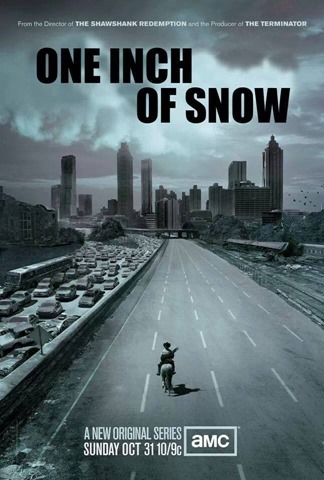
And as I seethed, the lizard part of my brain took over.  I imagined the zombies from The Walking Dead and felt that I was coming to understand them.  I slowly shuffled along, to the extent a car can shuffle along, and tried to stay close to the cars in front of me – even if this was probably an unsafe distance.  I no longer even saw the cars in front of me so much as patterns of tail lights.  When someone appeared to move faster than the standard shuffling pace, the entire herd became hungry and would look toward the sudden flash of movement – only to realize nothing was really happening, there was no fresh meat.

I shuffled forward for a half hour.  Then I shuffled another half hour.  I was now approaching a 270 degree turn on my right onto the 75.  The whole turn was perhaps 600 feet long.  And here we reached a sort of standstill. No motion for another half hour.  I had been texting my wife (at this speed, I couldn’t see the harm) but my phone finally gave out with a defeated beep.  The main excitement during this extended wait occurred when a Lexus pulled up along the right shoulder and sped past everyone making the 270 degree turn.  At first I was angry.  And then I was envious.  Why didn’t I do that too?  This dude was speeding along at almost fifteen miles an hour.  As he reached the 180 degree point, however, he was brought up short, too – and when it came down to it, just thinking of leaving the order of the herd made me anxious.  

Over the turn was a large digital sign.  It lit up the whole area and cycled through something about a new sitcom, then something about a new reality show, then a Coca-Cola spot, then the sitcom again.  All of midtown Atlanta is hooked up for communication, every pocket has a smartphone with a data plan streaming information, every car has a radio allowing our government to speak directly to us.  Despite all this, the massive sign positioned to communicate to hundreds of people in terrible trouble could only tell us was to tune into TBS for a few giggles.  The smartphone, that miraculous device which allows me to call anywhere anytime, dies in less than a day because that’s just the state of battery technology – especially when the GPS is turned on.  And finally the radio, which once a month or so starts bleating, then tells me that it’s only having a test and that if this were a real emergency it would tell me what to do next – the government, the governor, the mayor apparently had nothing to communicate to the stranded motorists, so there was not emergency bleating to be had.  Again, I thought of those zombie movies where lone survivors sit by their radios waiting for news from the army about safe zones and instead hear only static.

More time went by and I was finally on the 75, but now stuck behind a big rig truck.  It was spinning its wheels faster and faster and faster but couldn’t seem to make any progress forward.  At the same time it was freaking out everyone around the 18 wheeler as we imagined what would happen if it the tires actually caught and the truck went flying forward.  As I waited behind this truck, I noticed another rig pull up to its left and get stuck, then another beside that.  Eventually there were four tractor trailers side by side and stuck, blocking all movement on the 75.  For a time I thought they must be getting secret communications from the government and that this was a complex maneuver intended to shut down the Interstate because there were worse things ahead – government and truckers working together for the common weal. 

This was not true, of course, and I found out later that it was mainly the big rigs that were shutting down all the freeways and highways running around and through Atlanta.  They would either just freeze in place or, worse, slide until they were sideways and blocking all lanes.  Things would probably have turned out differently if the people who are in charge had simply called up all the truckers on their radios and told them to pull over.  Then we all might have gotten home, freeing up the big roads and as a by product all the capillaries blocked by people trying to get onto the big roads.

Something snapped in me.  Fresh vitality came back to my mind and warmth flowed into my fingers.  I pulled around the trucker, I weaved slowly around other cars that appeared stopped, and took the first exit onto Courtland Street.  I drove up to Peachtree Street and then took it all the way to Ponce de Leon Avenue where I turned right.  Ponce is basically two blocks from my office where I started out.  I was about four or five hours into the journey at this point.

Ponce was beautifully clear.  I had left the zombies behind and now felt as though I was on a different, more exciting adventure.  I glided down the beautifully tree-lined Ponce – driving / skating along its winding path.  As I approached intersections, the lights kept turning green for me.  One time I stopped for a red light but discovered it was hard to get moving again once I’d stopped.  I panicked and started pressing harder and harder on the gas.  Then I remembered the 18 wheeler on the 75 and got a grip on myself.  I reversed slowly, the moved slowly forward and was free again to glide.  I don’t know when it happened but I eventually fell behind a White Passat.  Whereas I’d previously secretly despised everyone driving around me, the White Passat became my special friend, and I like to think he felt the same way.  We were comrades traveling through a post-apocalyptic world and nothing could harm us.  Other travelers joined us and were welcomed gladly.  We few, we happy few.

There were whole stretches that felt like we were driving through the Christmas day scene from A Christmas Carol – not the ghost bits but the morning with Scrooge running around wishing people happy Christmas and carolers in scarves and big smiles.  Just like that except I’m driving through Dickensian London in a Toyota Scion.  I even have false memories of snow covered cobble streets lined with gas lamps decorated with ribbon.

And then we finally came to the 78 – Stone Mountain Highway – and my dear friend headed toward Decatur while I continued toward Snellville.  So much had been left unsaid between us.  Perhaps it was better this way.

I was able to go several miles on the 78 without seeing anyone.  And then I started to see cars slowly headed toward me the wrong way on the highway.  It was like a movie in which the protagonist is headed into a forest and suddenly all the birds burst out from the trees and head towards him and then overhead – a clear indication that the protagonist, rather than the birds, are headed in the wrong direction. 

Oddly, I was still hoping to get home before midnight.  The last message I’d sent my wife before the phone died was “Is there food?”  I knew she was worried and hated that I didn’t have a way to let her know I was safe.  And what if things got worse?  Who wants their last words to be “Is there food?” 

Perhaps the headlights coming toward me where a bit too uncanny.  It was at this point – the only point in the whole adventure — that my car started to spin.  I remembered that I was supposed to turn into the spin and looked down at my hands, which had all on their own turned completely in the opposite direction.  Stupid muscle memory.  Of all the stupid things I’ve picked up over the years – baseball stats, D&D rules, obsolete computer languages – knowledge of how to drive in the snow suddenly floated to the top like the submerged pyramid in a magic 8 ball.  Pump pump pump on the breaks, slow down, turn the wheel slightly into the spin – and suddenly I was back in control again.  I’m sure there was a metaphor buried somewhere in that experience that I could have pulled out in order to live my life better and be a better human being, but I was really too tired and hungry to care.

Up ahead I started to find cars turned around in the direction I was headed, sparse at first, but more and more dense as I headed further north until the traffic came to a standstill.  And for the most part that was how things were for the next nine to ten hours.  It was like being in a parking lot lit only by the headlights of the cars in it.  We would be stopped for an hour at a time and then get ten minutes or so of forward motion, then stop again.  No one had any idea what was happening ahead to allow for the forward motion, which by now had become the exception rather than the rule.  I never wondered why we were stopped – only how we ever progressed.

Occasionally during these forward movements I’d realized I was parked behind a completely stopped vehicle.  At first I was dumbfounded by the thought of someone not taking the opportunity to move forward when given the chance, but I got used to it.  People were just stopping in the middle of the highway and going to sleep in the snow like wanderers in a Jack London story.  Sometimes, I’d pass cars that were simply abandoned.  The lights and engines would just be off – surely if someone were sleeping they would leave the engine running to heat their car.  Mostly these cars were well situated.  Early on they’d be abandoned on the right and left shoulders of the road as if someone had taken care to park them carefully before abandoning them. 

Later – at the eleven and twelve hour mark, I’d pass cars that were simply left in the middle of traffic, correctly positioned in an appropriate lane.  Drivers had simply said screw this, turned off their engines and walked into the woods – at least I imagine they walked into the woods because there weren’t really any hotels or houses or stores around us on that patch of highway.  The drivers vanished into the cold.  Later still, as I began to pass the various cars that had created the original pile ups, I found abandoned cars facing a variety of different directions.  Sometimes I’d see one car oriented perpendicularly to another car and barely kissing each other, the result of a slow motion crash in which no one was injured, not even the body work on the cars, but which was no doubt frightening enough – and in slow motion at that – that both drivers just said fuckit and walked off into the snow.

As I passed these wrecks frozen in time – perhaps even still occurring so infinitesimally slowly that no one noticed – I came to realize that getting past a pileup like this was never the end, for just a mile ahead there would be another one, and a mile in front of that another one.  Like a series of dominos, each slow collision between two cars caused other cars to brake badly and slide further behind them and so on and so on.   This was simply the pattern of things and even had a beautiful cadence that I learned to appreciate.

I remember strange moments breaking up the interminable boredom.  The snow occurred during a new moon, so the light during the odd patches when there were no cars around was provided solely by stars and was beautiful.

I remember the people who got out of their cars to walk north along the side of the road, either to see what was going on or to find a discrete place to urinate.  I would wait for each of them to come back and worried when it seemed to take too long.

The stretch of highway going in the opposite direction was empty.  A hitchhiker walked south along that stretch with his hand out and I wondered who he was hoping to get a ride from.  I was also amazed at how fast he was moving compared to me, as if he had wings on his feet.

I was entertained for an hour by a small truck headed in the opposite direction that had gotten stuck.  The engine would rev and over rev and the wheels would whine at higher and higher pitches which I learned to recognize as the sound of futility.  Then the truck would stop for five or ten minutes, gather up courage, and proceed to do the exact same thing again with the exact same results.

For the most part, the massive trucks that are common to Atlanta had absolutely no advantage in the snow and were even more likely to get stuck, for some reason.  Chances are they got stuck due to overconfidence while the cautious tortoise-like commuter cars fared much better.  Those fantastic commercials of trucks driving over glaciers, it turns out, have been lying to us and planting false knowledge in our collective unconscious.  Even sadder, we probably all already knew this.

Occasionally black all-terrain vehicles with S.W.A.T. bumper stickers would pass by and national guardsmen would jump out.  They’d look around for a while and then get back into their trucks and drive on, pursuing their mysterious missions.  They never talked to anyone but each other.

One time a large truck with flashing police lights came along the left shoulder and told everyone over a megaphone to get out of the left two lanes.  We magically transformed a slowly crawling traffic jam over five lanes into a fully stopped traffic jam over three lanes.  According to the megaphone, we were clearing the way for a salt truck to come through and treat the roads.  He insisted that this was the only way to clear the traffic and that we had to stop traffic to unclog traffic.  Over the next two hours that open left lane was a great temptation but no one took advantage of it.  We believed in following rules and working together for the greater good.  We believed in foregoing immediate gratification in order to achieve a higher outcome.  Like a nasty scab, that open lane begged to be scratch, but we did not.

Until slowly we began to realize that there was no salt truck coming and we just picked and picked at that scab for about five minutes until all lanes were backed up again.  And it felt good.

I mostly entertained myself by listening to AM radio, hoping for some news about what was going on or signs that someone in authority was taking charge.  Apparently, though, no one in authority really had anything to pass on to the stranded motorists.  Home Depot, bless their hearts, were opening up fourteen stores for people to take shelter.  Sadly, though, this didn’t really help anyone out except the people stuck in traffic in front of a Home Depot.

The radio announcer was apparently going well beyond his appointed duration.  He acknowledged that since we were suffering, he wanted to be there right along with us.  He then talked about how nice it was to be at home drinking bourbon in front of a raging fire and wished we could be there with him.  It was actually pleasant listening to him take calls and listen to other people vent about the troubles.  They called in and complained about the poor preparation exhibited by the state of Georgia and the city of Atlanta.  This being AM radio, these calls were followed up by others extolling the virtue of personal responsibility and reminding people they had no one to blame but themselves.  I actually couldn’t follow the logic of these callers since I didn’t know what I was responsible for other than coming in to work that morning and going to a performance management meeting.

Speaking of performance management, the host of the show also passed on comments by the mayor of Atlanta explaining that contrary to popular opinion, the city was actually doing a fantastic job of managing road conditions.  I think I heard this at around the thirteen hour mark.  It occurred to me that people often lie to themselves and others when it comes to performance.  Which led me to dwell a bit on my own relatively good performance review and I realized that when I asked about the possibility of a promotion my boss said let’s wait and see how things go – and it suddenly dawned on me that this is what I say to my children when they ask me for something and I don’t want to say no but I also have no intention of ever giving it to them.

That’s the problem with long drives.  Too much time to think.

As I mentioned, I was curious why the AM radio host was staying on for so long and then I finally understood, as he understood, that he had a captive audience.  He started laying out a theory about James the brother of the Lord being the actual rather than half-brother of Jesus, and then something complicated about Jesus having had to be a historical person otherwise we’d be saying that Polycarp and Tertullian never existed or something.  And slowly it dawned on me that he was simply laying out a Da Vinci Code- liite theory of his own in which Jesus has nephews and nieces with their own nephews and nieces spread throughout in the world.  He never quite said it but this seemed to be where he was headed, and he had a captive audience to spin it out to like a drunk uncle at a family get-together.

He had almost gotten to his point when the thread of the argument was lost due to some real news.  The government (not sure which one) had decided not to do anything further until sunrise.  It was about four-thirty when I heard this and I realized that now I had two hours to go before anything more would happen.  I could actually plan … to do nothing … but having the ability to exercise forethought was exciting.  I looked at the cars around me.  The fellow in the lane to my right leaned back and closed his eyes.  I found this deeply offensive – he had an obligation to maintain the night watch with the rest of us.  He felt my critical gaze, opened his eyes, looked over at me and just shrugged.  Then he went back to sleep.  I looked at the car behind him and saw two people watching a movie on their phone.  Again, what amazing devices smartphones are, so potentially useful in an emergency, and it turns out best used to catch up on two-and-a-half men.  In the back seat of the Lexus in front of me I noticed a small child’s hand weaving back and forth hypnotically.

I snapped awake a little later, slid forward a few car lengths, and slipped back into my coma.  This went on several times over the next few hours.  The logic of waiting till dawn was that the sun would help melt the snow despite the freezing temperatures.  I think it was really an opportunity for a respite and permission for people in authority to finally admit that they were out of ideas.  The fault was with planning, after all, and no amount of frantic response after the fact would really make up for it.  There was also probably something mythological at work.  The dawn chases away evil.  It chases away vampires, werewolves, and even makes zombies less frightening.  Sometimes it even helps us forget bad choices.

Dawn was beautiful when it came.  With the dawn came hope.  A black truck with a S.W.A.T. bumper sticker sped by and moved out beyond the tiny circumferences of the world immediately around my car.  And then ten minutes later cars started moving, just as promised.  I looked at my speedometer and realized I was actually moving at five miles an hour.  I was worried that at those speeds, I would spin out of control – it just seemed so much faster than I was used to.

After passing the gates to Stone Mountain, I was happy to discover that none of these people I had been stuck with for hours were actually headed my way.  So why on earth had they blocked me for so long?  It was another skating drive like I’d had on Ponce de Leon, with familiar streets made unfamiliar by white powder.  I would occasionally pass gangs of curious children out playing, getting supplies, breaking into abandoned cars, whatever.  The rules had changed.  I didn’t even stop for red lights anymore, having shed all muscle memory of traffic regulations in the night.  I simply slowed down at intersections and enjoyed my newfound freedom of movement.

A left turn onto Hewitt road to get to my own street, carefully maneuvered.  I didn’t want to slide into the gutter a mile from home – that would just be embarrassing after all that.  On a tiny two lane street, I finally passed the last signs of the Snowmaggedon.  Seven cars, all turned in different directions, some half on the road, others on people’s lawns, all abandoned.  I’d seen scenes like this all night but in the light of day the abandoned cars were particularly striking and more like the panoramic scenes of a disaster movie.  People who leave their cars in the middle of the road must really think life sucks.

I navigated slowly around these cars, watching for zombies to jump out, pumping my breaks the whole way, and finally made a left turn onto Oak Road.  There had been a single car behind me, matching my speed and following my lead as we passed cars and avoided icy slicks.  I was happy to pass on the survival skills I’d learned in the night to this fellow traveler of the post-apocalyptic highways and byways.  My little buddy, however, went right when I’d gone left, and I was alone again.

I slid into my driveway, walked up to the door, found that my house key wasn’t working and banged on the door, desperately, until someone let me in.  Have you ever played the Xbox game Left for Dead?  At the end of each level you find a safe house and after everyone has freed themselves of their zombie pursuers, you can shut and bolt the door behind you.  That’s how it felt to finally be in my house again after that fifteen hour ordeal.  I was home again, I was warm, and I was loved.

And you know what?  There was even food.
Razzle Dazzle

kinect for XBox One

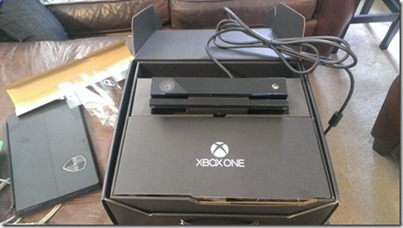
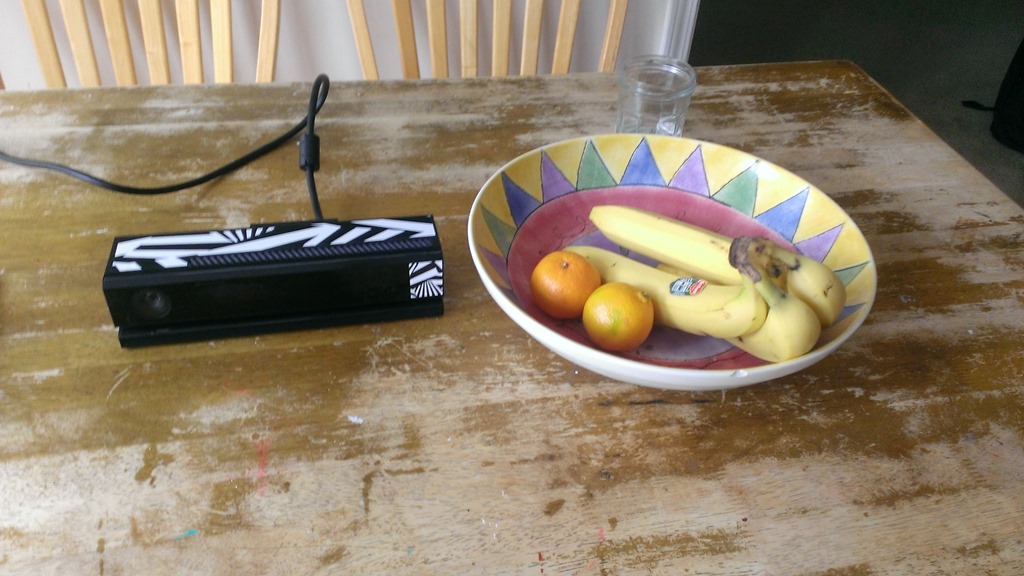
People continue to ask what the difference is between the Kinect for XBox One and the Kinect for Windows v2.  I had to wait to unveil the Thanksgiving miracle to my children, but now I have some pictures to illustrate the differences.

side by side

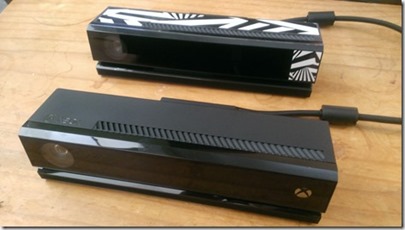
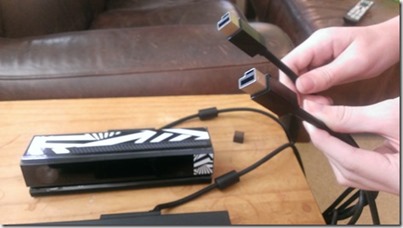
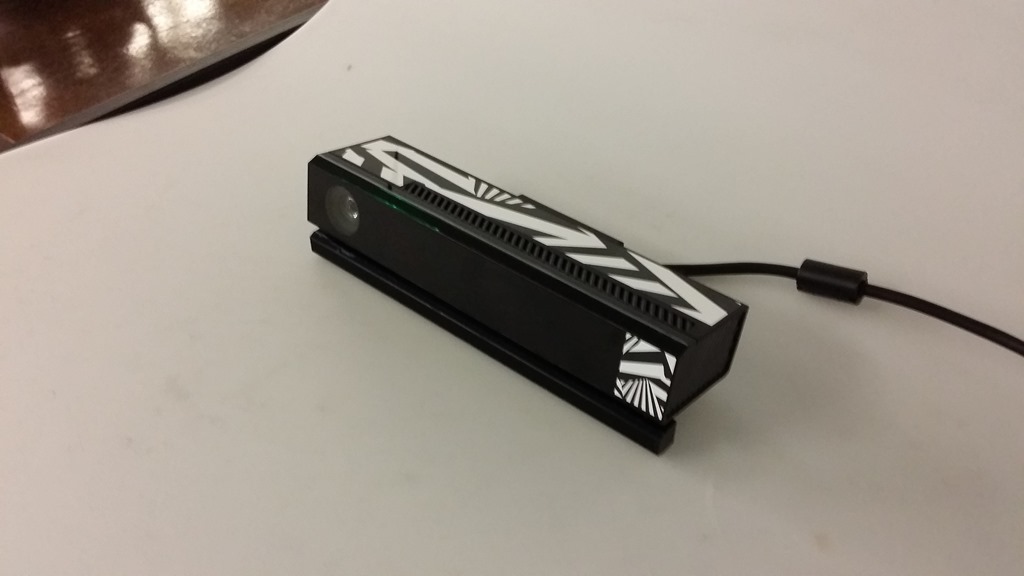
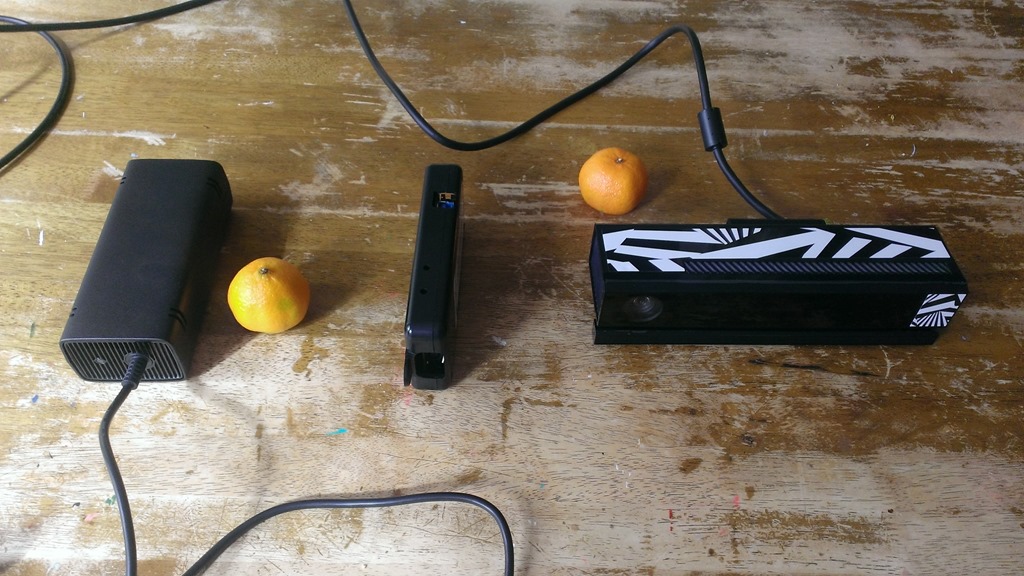
On the sensors distributed through the developer preview program (thank you Microsoft!) there is a sticker along the top covering up the XBox embossing on the left.  There is an additional sticker covering up the XBox logo on the front of the device.  The power/data cables that comes off of the two  sensors look a bit like tails.  Like the body of the sensors, the tails are also identical.  These sensors plug directly into the XBox One.  To plug them into a PC, you need an additional adapter that draws power from a power cord and sends data to a USB 3.0 cable and passes both of these through the special plugs shown in the picture below.

usb

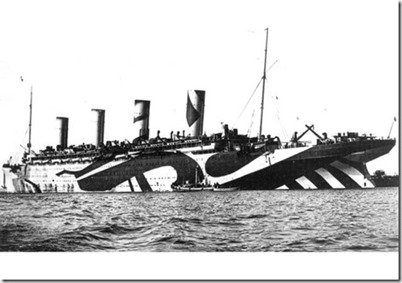
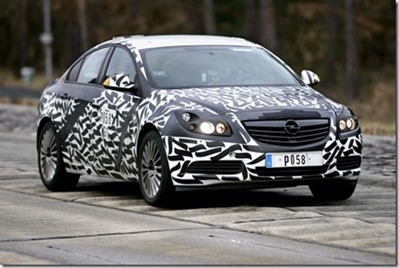
So what’s with those stickers?  It’s a pattern called razzle dazzle (and sometimes razzmatazz).  In World War I, it was used as a form of camouflage for war ships by the British navy.  It’s purpose is to confuse rather than conceal — to obfuscate rather than occlude.

war razzle dazzle

Microsoft has been using it not only for the Kinect for Windows devices but also in developer units of the XBox One and controllers that went out six months ago. 

This is a technique of obfuscation popular with auto manufacturers who need to test their vehicles but do not want competitors or media to know exactly what they are working on.  At the same time, automakers do use this peculiar pattern to let their competitors and the media know that they are, in fact, working on something.

car razzle dazzle

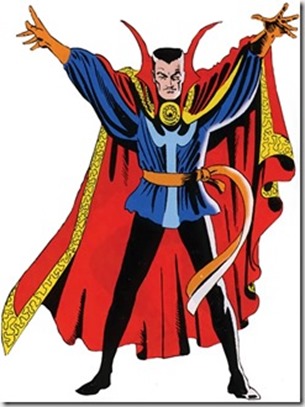
What we are here calling razzle dazzle was, in a more simple age, called the occult.  Umberto Eco demonstrates in his fascinating exploration of the occult, Foucault’s Pendulum, that the nature of hidden knowledge is to make sure other people know you have hidden knowledge.  In other words, having a secret is no good if people don’t know you have it.  Dr. Strangelove expressed it best in Stanley Kubrick’s classic film:

Of course, the whole point of a Doomsday Machine is lost if you keep it a secret!

A secret, however, loses its power if it is ever revealed.  This has always been the difficulty of maintaining mystery series like The X-Files and Lost.  An audience is put off if all you ever do is constantly tease them without telling them what’s really going on. 

magic

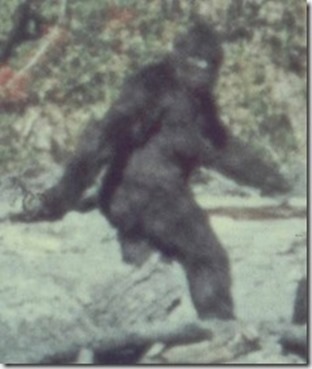
By the same token, the reveal is always a bit of a letdown.  Capturing bigfoot and finding out that it is some sort of hairy hominid would be terribly disappointing.  Catching the Loch Ness Monster – even discovering that it is in fact a plesiosaur that survived the extinction of the dinosaurs – would be deflating compared to the sweetness of having it exist as a pure potential we don’t even believe in.

This letdown even applies to the future and new technologies.  New technologies are like bigfoot in the way they disappoint when we finally get our hands on them.  The initial excitement is always short-lived and is followed by a peculiar depression.  Such was the case in an infamous blog post by Scott Hanselman called Leap Motion Amazing, Revolutionary, Useless – but known informally as his Dis-kinect post – which is an odd and ambivalent blend of snarky and sympathetic.  Or perhaps snarky and sympathetic is simply our constant stance regarding the always impending future.

bigfoot

The classic bad reveal – the one that traumatized millions of idealistic would-be Jedi – is the quasi-scientific explanation of midichlorians  in The Phantom Menace.   The offences are many – not least because the mystery of the force is simply shifted to magic bacteria that pervade the universe and live inside sentient beings – an explanation that explains nothing but does allow the force to be quantified in a midichlorian count. 

The midichlorian plot device highlights an important point.  Explanations, revelations and unmaskings do not always make things easier to understand, especially when it’s something like the force that, in some sense, is already understood intuitively.  Every child already knows that by being good, one ultimately gets what one wants and gets along with others.  This is essentially the lesson of that ancient Jedi religion – by following the tenets of the Jedi, one is able to move distant objects with one’s will, influence people, and be one with the universe.  An over-analysis of this premise of childhood virtue destroys rather than enlightens.

the force razzle dazzle

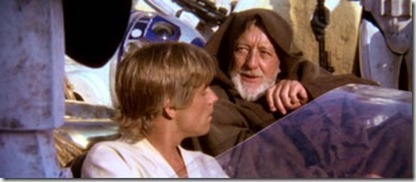
The force, like virtue itself, is a kind of razzle dazzle – by obfuscating it also brings something into existence – it creates a secret.  In attempts to explain the potential of the Kinect sensor, people often resort to images of Tom Cruise at the Desk of the Future or Picard on the holodeck.  The true emotional connection, however, is with that earlier (and adolescent) fantasy awakened by A New Hope of moving things by simply wanting them to move, or changing someone’s mind with a wave of the hand and a few words – these are not the droids you are looking for.  Ben Kenobi’s trick in turn has its primordial source in the infant’s crying and waving of the arms as a way to magically make food appear. 

It’s not coincidental, after all, that Kinect sensors have always had both a depth sensor to track hand movements as well as a virtual microphone array to detect speech.

Kinect for Windows v2 First Look

WP_20131123_001

I’ve had a little less than a week to play with the new Kinect for Windows v2 so far, thanks to the developer preview program and the Kinect MVP program.  The original unboxing video is on Vimeo.  So far it is everything Kinect developers and designers have been hoping for – full HD through the color camera and a much improved depth camera as well as USB 3.0 data throughput. 

Additionally, much of the processing is now occurring on the GPU rather than the onboard chip or your computer’s CPU.  While amazing things were possible with the first Kinect for Windows sensor, most developers found themselves pushing the performance envelope at times and wishing they could get just a little more resolution or just a little more data speed.  Now they will have both.

20131126_110049

At this point the programming model has changed a bit between Kinect for Windows v1 and Kinect for Windows v2.  While knowing the original SDK will definitely give you a leg up, a bit of work will still need to be done to port Kinect v1 apps to the new Kinect v2 SDK when it is eventually released.

What I find actually confusing is the naming.  With the first round of devices that came out in 2010-11, we had the Kinect for XBox and Kinect for Windows.  It makes sense that the follow up to Kinect for XBox is the “Kinect for XBox One”.  But the follow up to Kinect for Windows is “Kinect for Windows v2” so we end up with the Kinect for XBox One as the correlate to K4W2. Furthermore,  by “Windows” we mean Windows 8 (now 8.1) so to be truly accurate, we really should be calling the newest Windows sensor K4W8.1v2.  For convenience, I’ll just be calling it the “new Kinect” for a while.

WP_20131123_004

What’s different between the new Kinect for XBox One and the Kinect for Windows v2?  It turns out not a lot.  The Kinect for XBox has a special USB 3.0 adapter that draws both lots of power as well as data from the XBox One.  Because it is a non-standard connector, it can’t be plugged straight into a PC (unlike with the original Kinect which had a standard USB 2.0 plug).

To make the new Kinect work with a PC, then, requires a special breakout board.  This board serves as an adapter with three ports – one for the Kinect, one for a power source, finally one for a standard USB 3.0 cable. 

We can also probably expect the firmware on the two versions of the new Kinect sensor to also diverge over time as occurred with the original Kinect.

kinec2_skel

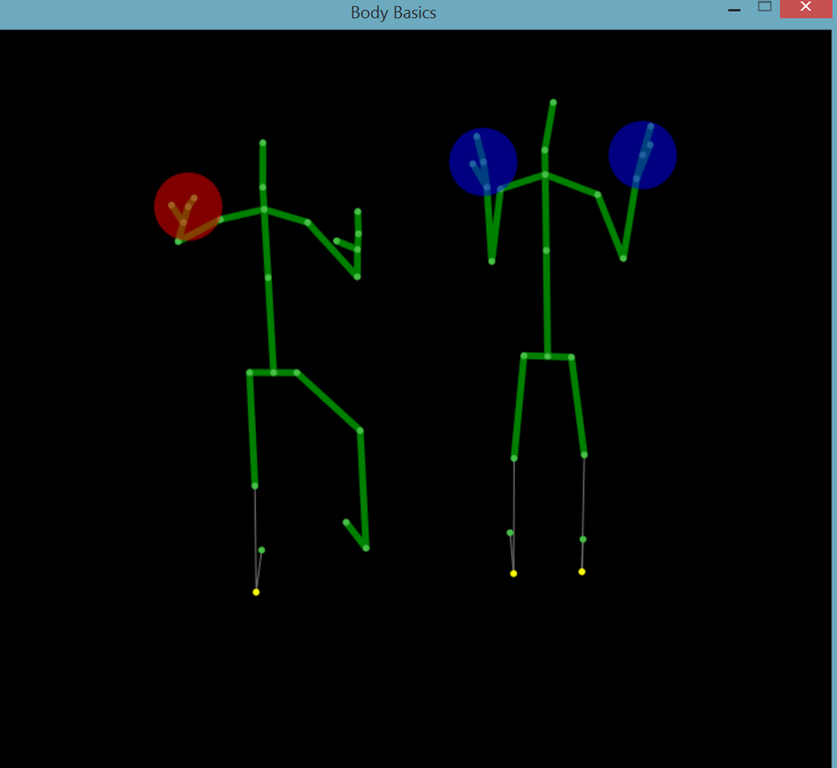
Skeleton detection is greatly improved with the new Kinect.  Not only are more joints now detected, but many of the jitters developers became used to working around are now gone.  The new SDK recognizes up to 6 skeletons rather than just two.  Finally, because of the improved Time-of-Flight depth camera, which replaces the Primesense technology used in the previous hardware, the accuracy of the skeleton detection is much better and includes excellent hand detection.  Grip recognition as well as Lasso recognition (two fingers used to draw) are now available out of the box – even in this early alpha version of the SDK.

WP_20131123_005

I won’t hesitate to say – even this early in the game – that the new hardware is amazing and is leaps and bounds better than the original sensor.  The big question, though, is whether it will take off the way the original hardware did.

If you recall, when Microsoft released the first Kinect sensor they didn’t have immediate plans to use it for anything other than a game controller – no SDK, no motor controller, not a single luxury.  Instead, creative developers, artists, researchers and hackers figured out ways to read the raw USB data and started manipulating it to create amazingly original applications that took advantage of the depth sensor – and they posted them to the Internet.

Will this happen the second time around?  Microsoft is endeavoring to do better this time by getting an SDK out much earlier.  As I mentioned above, the alpha SDK for Kinect v2 is already available to people in the developer preview program.  The trick will be in attracting the types of creative people that were drawn to the Kinect three years ago – the kind of creative technologists Microsoft has always had trouble attracting toward other products like Windows Phone and Windows tablets.

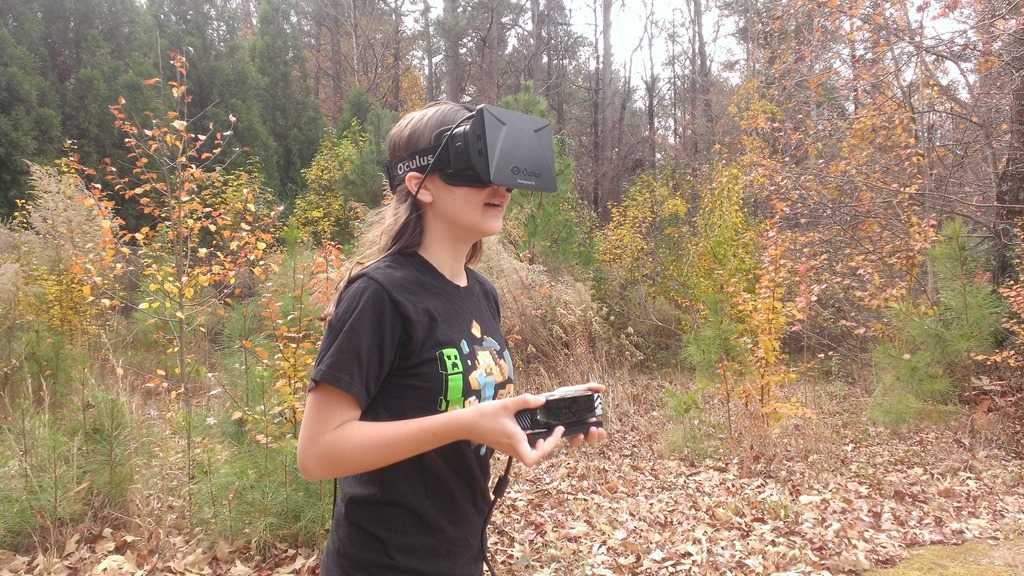
My colleagues and I at Razorfish Emerging Experiences are currently working on combining the new Kinect with other technologies such as Oculus Rift, Google Glass, Unity 3D, Cinder, Leap Motion and 4K video.  Like a modern day scrying device (or simply a mad scientist’s experiment) we hope that by simply mixing all these gadgets together we’ll get a glimpse at what the future looks like and, perhaps, even help to create that future.

I Just Inceptioned Visual Studio 2013

inception_sim

Building Windows Store apps in Visual Studio 2013 has gotten a lot more fun with the Simulator.  At first, this seemed to be the same thing as the Emulator for Windows Phone development, but there are some interesting differences.

First, the Simulator actually seems to be closer to the simulator used for Pixel Sense (nee Microsoft Surface 2) development since it allows us to use a mouse to simulate finger touches as well as two finger gestures.  In general, we should all be using touch screens for development – but in the field or on unusual environments like Parallels running on a Mac, this isn’t always doable.  Being able to use the simulator gives us an out.  Additionally, because it allows us to simulate alternative aspect ratios and resolutions, it can be handy even when a touch display is readily available.

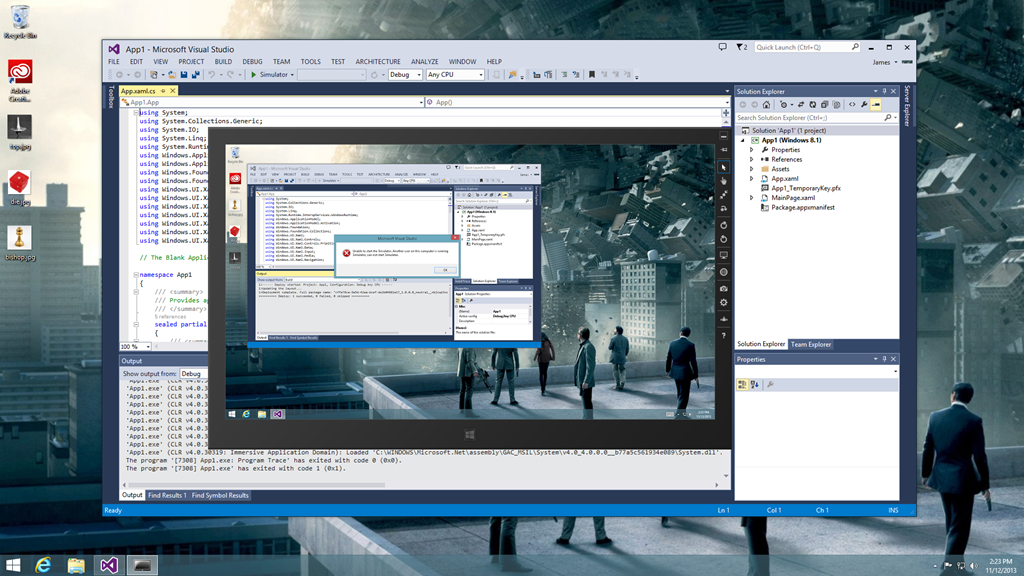
The really cool thing about the Simulator, though, is that when it fires up, it seems to create a VM of my current system.  I start a new project, set the debug target to “Simulator” and punch F5. 

My desktop background image shows up inside the Simulator and all my apps show up in the Tiles screen. 

I can even search for Visual Studio 2013 with the Search charm and find VS13. 

Then I can fire it up. 

Then I can look at the bottom of the file menu and, under recent project, find the project I am currently running inside the Simulator! 

The next step is obvious, right?  I set the target of the instance of visual studio running inside my Simulator, set that to “Simulator” and hit F5 to get a neat message:

“Unable to start the Simulator.  Another user on this computer is running Simulator, can not start Simulator.”

This is not standard English, so it’s especially fascinating. As everyone knows, the worthwhile Microsoft error messages are the ones that have never been spellchecked.

Does anyone know if I can log into the simulator as a different user at this point?  This is a rabbit hole I really want to go down.

Ghost Hunting with Kinect

Paranormal Activity 4

I don’t usually try to undersell the capabilities of the Kinect.  Being a Microsoft Kinect for Windows MVP, I actually tend to promote all the things that Kinect currently does and one day will do.  In fact, I have a pretty big vision of how Kinect, Kinect 2, Leap Motion, Intel’s Perceptual Computing camera and related gestural technologies will change the way we interact with our environment.

Having said that, let me just add that Kinect cannot find ghosts.  It might reveal bugs in the underlying Kinect software – but it cannot find ghosts.

Nevertheless, “experts” are apparently using Kinect sensors to reveal the presence of ghosts.  Here’s a clip from Travel Channel’s Ghost Adventures.  It’s an episode called Cripple Creek and you’ll want to skip ahead to about 3:50 (ht to friend Josh Blake for finding this).

The logic of this is based on some very sophisticated algorithms the Kinect uses to identify “skeletons” – or outlines of the human form.  The current Kinect can spot two skeletons at a time including up to 20 joints on each skeleton.  Additionally, it has a “seated mode” that allows it to identify partial skeletons from about the waist up – this tends to be a little more dodgy though.  All of this skeleton information is provided primarily to allow developers to create games that track the human body and, typically, animate an onscreen avatar that emulates the player’s movements.

The underlying theory behind using it for ghost hunting is that, since when someone passes in front of the Kinect sensor the Kinect will typically register a skeleton, it follows that if the Kinect registers a skeleton someone must have passed in front of it.

skeleton

Unfortunately, this is not really the case.  There are lots of forum posts from developers asking how to work around peculiarities with the Kinect skeletons while anyone who has played a Kinect game on XBox has probably noticed that the sensor will occasionally provide false positives (which for gaming, is ultimately better than false negatives).  In fact, even my dog would sometimes register as a skeleton when he ran in front of me while I was playing. 

Perhaps you’ve also noticed that in an oddly shaped room, Kinect is prone to register false speech commands.  This happens to me especially when I’m trying to watch my favorite ghost hunting show on Netflix – probably because of the feedback from the television itself (which the Kinect tends to be very good at cancelling out if you take the trouble to configure it according to instructions – but I don’t).  I know this isn’t a ghost pausing my TV show, though, because the Kinect isn’t set up to hear anything I don’t hear.  Just because the Kinect emulates some human features – like following simple voice commands like “Play” and “Pause” – doesn’t mean it’s something from The Terminator, The Matrix or Minority Report.  It is no more psychic than I am and it doesn’t have super hearing.

Kinect 2 IR

Similarly, skeleton tracking on Kinect isn’t specially fitted to see invisible things.  It uses a combination of an infrared camera and a color camera to collect data which it interprets as a human structure.  But these cameras don’t see anything the human eye can’t see with the lights on.  Those light photons that are being collected by the sensors still have to bounce off of something visible, even if you can’t see the light beams themselves.  Perhaps part of the illusion is that, because we can’t see the infrared light being emitted and collected by the Kinect, people assume that what it detects also can’t be seen?

Here’s another episode of Ghost Adventures on location at the haunted Talumne Hospital.  It’s especially remarkable because the Kinect here is doing exactly what it is expected to do.  As the subject lifts himself off the bed, he separates his outline from the background and Kinect for Windows’ “seated mode” identifies his partial skeleton from approximately the waist up.  The intrepid ghost hunters then scream out “It was in your gut!”  Television gold.

Apparently the use of unfamiliar (and misunderstood) technology provides a veneer of seriousness to what these people do on their shows.  Another piece of weird technology all these shows use is something called EVP – electronic voice phenomena.  Here the idea is that you put out a tape recorder or digital recorder and let it run for a while – often with a white noise machine in the background.  Then you play it back later and you start hearing things you didn’t hear at the time.  The trick is that if you run these recordings through software intended to clean up audio in order to discover voices, they remarkably discover voices that you never heard but which must be the voice of ghosts.

I can’t help feeling, however, that it isn’t the world of extrasensory phenomena that is mysterious and baffling to us.  It’s all the crazy new technologies that appear every day that is truly supernatural and overwhelming.  Perhaps tying all of these frightening technologies to our traditional myths and collective superstitions is just a way of making sense of it all and normalizing it.

Book Review: Augmented Reality with Kinect

4384OT_Mini

Rui Wang’s Augmented Reality with Kinect from Pakt Publishing is my new favorite book about the Kinect sensor.  It’s a solid 5 out of 5 for me and if you want to learn how to use the Kinect 4W SDK 1.5 and above with C++, then this is the book for you.  That said, however, it is also an incredibly frustrating software programming book.

The first issue I have with it is that it isn’t really about Augmented Reality, as such.  The way AR fits in is simply that the central project created in the course of the book is a Fruit Ninja-style game using Kinect and with a player overlay.  AR seems very much incidental to the book.

What it actually is is an intro book to C++ and the Kinect for Windows SDK.  This is actually a much needed resource in the Kinect community and one I have been on the lookout for for a long time.  I’m not sure why the publisher decided to add this “AR” twist to the concept for the book.  It really wasn’t necessary.

Second, the book’s tool chain is Visual Studio 2012, C++, Kinect for Windows SDK 1.5 and OpenGL.  One of these is not like the others!  In the second chapter, we are then told that the book covers OpenGL rather than DirectX because “…it is only used under Windows currently, and can hardly support languages except C/C++ and C#.”  Hmmm.

With those reservations out of the way, this is a really fine book about programming for the Kinect sensor.  C++ is the right way to do vision processing and this is a great introduction to the topic.  Along the way, it even includes a nice overview of face tracking.

Kinect PowerPoint Mapper

I just published a Kinect mapping tool for PowerPoint allowing users to navigate through a PowerPoint slide deck using gestures.  It’s here on CodePlex: https://k4wppt.codeplex.com/ .  There are already a lot of these out there, by the way – one of my favorites is the one Josh Blake published.

So why did I think the world needed one more? 

kinect_for_windows_fig1

The main thing is that, prior to the release of the Kinect SDK 1.7, controlling a slide deck with a Kinect was prone to error and absurdity.  Because they are almost universally written for the swipe gesture, prior PowerPoint controllers using Kinect had a tendency to recognize any sort of hand waving gesture as an event.  Consequently, as a speaker innocently gesticulated through his point the slides would begin to wander on their own.

The Kinect for Windows team added the grip gesture as well as the push gesture in the SDK 1.7.  This required several months of computer learning work to get these recognizers to work effectively in a wide variety of circumstances.  They are extremely solid at this point.

The Kinect PowerPoint Mapper I just uploaded to CodePlex takes advantage of the grip gesture to implement a grab-and-throw for PowerPoint navigation.  This effectively disambiguates navigation gestures from other symbolic gestures a presenter might use during the course of a talk.

I see the Kinect PowerPoint Mapper serving several audiences:

1. It’s for people who just want a more usable Kinect-navigation tool for PowerPoint.

2. It’s a reference application for developers who want to learn how they can pull the grip and the push recognizers out of the Microsoft Kinect controls and use them in combination with other gestures.  (A word of warning, tho – while double grip is working really well in this project, double push seems a little flakey.)  One of the peculiarities of the underlying interfaces is that the push notification is a state, when for most purposes it needs to be an event.  The grip, on the other hand, is basically a pair of events (grip and ungrip) which need to be transposed into states.  The source code for the Mapper demonstrates how these translations can be implemented.

3. The Mapper is configuration based, so users can actually use it with PC apps other than PowerPoint simply by remapping gestures to keystrokes.  The current mappings in KinectKeyMapper.exe.config look like this:

    <add key="DoubleGraspAction" value="{F5}" />
    <add key="DoublePushAction" value="{Esc}" />
    <add key="RightSwipeWithGraspAction" value="{Right}" />
    <add key="LeftSwipeWithGraspAction" value="{Left}" />
    <add key="RightSwipeNoGraspAction" value="" />
    <add key="LeftSwipeNoGraspAction" value="" />
    <add key="RightPush" value="" />
    <add key="LeftPush" value="" />
    <add key="TargetApplicationProcessName" value="POWERPNT"/>

Behind the scenes, this is basically translating gesture recognition algorithms (some complex, some not so much) to keystrokes.  To have a gesture mapped to a different keystroke, just change the value associated with the gesture – making sure to include the squiggly brackets.  If the value is left blank, the gesture will not be read.  Finally, the TargetApplicationProcessName tells the application which process to send the keystroke to if there are multiple applications open at the same time.  To find a process name in Windows, just go into the Task Manager and look under the process tab.  The process name for all currently running applications can be found there – just remove the dot-E-X-E at the end of the name. 

4. The project ought to be extended as more gesture recognizers become available from Microsoft or as people just find good algorithms for gesture recognizers over time.  Ideally, there will ultimately be enough gestures to map onto your favorite MMO.  A key mapper created by the media lab at USC was actually one of the first Kinect apps I started following back in 2010.  It seemed like a cool idea then and it still seems cool to me today.