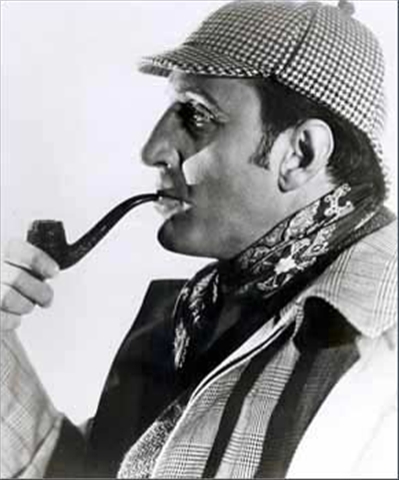
In the early chapters of A Study In Scarlet, John H. Watson observes of his friend Sherlock Holmes:
His ignorance was as remarkable as his knowledge. Of contemporary literature, philosophy and politics he appeared to know next to nothing. Upon my quoting Thomas Carlyle, he inquired in the naivest way who he might be and what he had done. My surprise reached a climax, however, when I found incidentally that he was ignorant of the Copernican Theory and of the composition of the Solar System. That any civilized human being in this nineteenth century should not be aware that the earth travelled round the sun appeared to be to me such an extraordinary fact that I could harldly realize it.
There is a similar strain of incredulity, both within the United States as well as without, when it is observed that a vast number of Americans claim they do not believe in Evolution. It is a source of such consternation that the beliefs of presidential candidates on this matter are speculated upon and discussed as a sort of key that will reveal the secret heart of these men and women. Are people who do not believe in Evolution simply of lower intellectual abilities than the rest of us? Or is it rather that the decision not to believe is an indication of other values, tied together in a web of beliefs, that hinge on certain characteristics which make these people ultimately alien in their thought patterns, radically other in their perception of reality? Do these people pose a threat to the homogeneity of world view that we take for granted in public discourse?
“You appear to be astonished,” he said, smiling at my expression of surprise. “Now that I do know it I shall do my best to forget it.”
“To forget it!”
“You see,” he explained, “I consider that a man’s brain originally is like alittle empty attic, and you have to stock it with such furniture as you choose. A fool takes in all the lumber of every sort that he comes across, so that the knowledge which might be ueful to him gets crowded out, or at best is jumbled up with a lot of other tings, so that he has a difficulty in laying his hands upon it…. Depend upon it there comes a time when for every addition of knowledge you forget something that you knew before. It is of the highest importance, therefore, not to have useless facts elbowing out the useful ones.”
If they deny one fact, what else might they deny? If they hold this set of beliefs, what else might they cleave to? As a Scientific American article put it,
“Embarrassingly, in the 21st century, in the most scientifically advanced nation the world has ever known, creationists can still persuade politicians, judges and ordinary citizens that evolution is a flawed, poorly supported fantasy. They lobby for creationist ideas such as “intelligent design” to be taught as alternatives to evolution in science classrooms.
…
“In addition to the theory of evolution, meaning the idea of descent with modification, one may also speak of the fact of evolution. The NAS defines a fact as “an observation that has been repeatedly confirmed and for all practical purposes is accepted as true …. All sciences frequently rely on indirect evidence. Physicists cannot see subatomic particles directly, for instance, so they verify their existence by watching for telltale tracks that the particles leave in cloud chambers. The absence of direct observation does not make physicists’ conclusions less certain.”
The atheism entry on About.com puts it more baldly:
“Evolutionary theory is the organizing principle for all modern biology – denial of it is like denying relativity in modern physics. The fact of evolution — the fact that allele frequencies change in populations over time — is as undeniable as are the actions of gravity or continental shifts. Despite this, only a third of Americans actually think that evolution is supported by the evidence…. People who don’t “accept” evolution are guilty of very unfortunate ignorance, but it’s probably an understandable ignorance. I wouldn’t be surprised if people were similarly ignorant of other aspects of science. It’s a sign of the great scientific illiteracy of American culture.”
“But the Solar System!” I protested.
“What the deuce is it to me?” he interrupted impatiently: “you say that we go round the sun. If we went round the moon it would not make a pennyworth of difference to me or to my work.”
Alasdair MacIntyre in After Virtue marks this conflation of theory and facts (evolution is a fact, but it is also a theory) as a product of the 17th and 18th centuries. Empiricism is based on the notion that what we see is what there actually is. It depends on the belief (or is it fact?) that our experiences are reliable. Natural science, on the other hand, depends on tools of measurement as the arbiter of what is real. The telescope tells us more than our unreliable eyes can.
“…[I]n the measurement of temperature the effect of heat on spirits of alcohol or mercury is given priority over the effect of heat on sunburnt skin or parched throats.”
Just as theory is dependent upon measurement to verify it, so measurement is dependent on theory to justify it. We require a theory of how heat affects mercury in order to be able to rely on our thermometer. Yet this is so far from the notions of common sense and perception which undergird empiricism.
“There is indeed therefore something extraordinary in the coexistence of empiricism and natural science in the same culture, for they represent radically different and incompatible ways of approaching the world. But in the eighteenth century both could be incorporated and expressed within one and the same world-view. It follows that that world-view is at its best radically incoherent….”
Out of this notion of the fact, as something both self-evident and obscure at the same time, Max Weber formulated the opposition central to his theorizing, and still central to the modern world view: the fact-value distinction. Just as a fact has a dual nature, a value also has an inherent ambiguity. It is both a choice as well as something imposed upon us by society. In its second form, it is something that can be studied by the social sciences, and consequently can be analyzed to some degree as a fact. In the first form, it is radically subjective, and as indeterminate as the swerve of Lucretius.
The matter can be framed as something even stranger than that. In existentialist terms, the choice is something we are always obliged to make, so that the notion of a “factual” value is ultimately false, or worse, inauthentic. From a scientific view point, on the other hand, choice is illusory, and merely a stand-in for facts we do not yet know.
It is these two terms, as vague as they are, that inform our public discourse. On the one hand, facts are something we should all agree upon; the replacement of values for facts is considered an act of civil disobedience. If we can’t agree on the facts, then what can we agree on? On the other hand, we should not be driven by facts alone. Is it enough to say that a market economy in the long run is the most efficient way to distribute goods? What about social justice? What about idealism? What about values?
It is the state-of-mind of Evolution-deniers I find most fascinating. The more I think about them, the more I long to be one. They hold a strange position that while they want to leave room in public science education for the creationism — hence the insistence on the public avowal that evolution is “only a theory” — they appear to have no desire to actually displace the teaching of evolutionary biology. Perhaps this is merely strategic, a camel’s nose under the tent.
But what if we take them at their word? In that case, they want to find a way to make the fact of evolution and the value of creationism exist side-by-side. They want to take nothing away from evolution to the extent that it is a practical tool that provides technology for them and extends their lives, but they also want to take nothing away from faith to the extent that it provides a reason to live and a way to go about it. It is a world-view only possible with the construction of the fact-value distinction. It is a beautiful attempt to reconcile the irreconcilable, and to make possible a plurality of beliefs that should not co-exist. Still, it is a world-view that is at its best radically incoherent.
“I don’t like to talk much with people who always agree with me. It is amusing to coquette with an echo for a little while, but one soon tires of it.”
— Thomas Carlyle
It might be beautiful if it were that sophisticated. I doubt most of the evolution-deniers (let’s call them EDs) understand the difference between a fact and a value. Isn’t that what Colbert lampooned for? I also don’t think they understand what ‘theory’ means. "Oh, that’s just your <em>theory</em>"–the word is used in an evaluative (pejorative) sense, as akin to "pure speculation". I doubt they have any conception of sophisticated scientific method, eg. that of Popper, who provided the most eloquent statement of "Just as theory is dependent upon measurement to verify it, so measurement is dependent on theory to justify it."
More beautiful is the way that highly intelligent mediaevals reconciled the Bible to factual contradiction (or Aristotle)–by the means of allegory.
> evolution is a fact, but it is also a theory
Wouldn’t it be more accurate to say that evolution <em>consists of</em> facts, as well as theories?
> In its second form, it is something that can be studied by the social sciences, and consequently can be analyzed to some degree as a fact.
Can’t we just say that it is a fact that people <em>hold</em> beliefs?
Finally, existentialism is all well and good for those who think—but how much of the world is governed by choices <em>not</em> made? I suspect religious beliefs largely fall into this category.
— that should be "lampooned Bush for"
Conrad,
I think the fact-value distinction permeates all of modern thinking, including that of evangelicals. It plays a special role in evangelical thinking when you distinguish it from that other brand of American Christian-right thought, fundamentalism. As I understand it, evangelicals are more or less comfortable with treating faith as an "as-if" metaphysics, whereas the really hard-core fundamentalists have a gnostic tendency to see the world around them as an illusion, while faith reveals reality. Evangelicals are compatibilists, who want to reconcile daily-life with the Biblical world. Fundies reject daily-life.
1. I think you are right about the rhetorical use of "theory" as in "that is just a theory", but this sort of view isn’t unique to the Christian right, and it may be for the inherent instability of the notion of theory/fact that MacIntyre points out.
Consider this headline by the head of the Royal Society of Chemistry: ‘Teach children evolution as fact not theory’ (http://www.rsc.org/AboutUs/News/PressReleases/2006/Evolution.asp).
2. A good clarification to explain what is meant by saying that Evolution is both a theory and a fact follows Stephen J. Gould’s lead. He says the ambiguous term "Evolution" refers to two different things: first, the fact of evolution, by which is understood an observed Hariclitean transformation of species over time. Second, theories, such as natural selection, which are used to explain these phenomena. Thus theories are not imperfect facts, and facts are not reified theories.
Historically, however, I’m not sure this ad-hoc explanation works. In the Origin of Species, it seems to me, Darwin intertwined and put forth both notions as a new way to describe reality. Both the generation of species and natural selection where "theories" for him (or perhaps both "facts" for him) and it is difficult to say after the fact that his problem was that he simply didn’t have the proper intellectual apparatus to explain the difference.
In addition, many lay defenders of Evolution (and even some specialists, as in the link above) end up affirming the epistemic framework that Gould rejects: that facts are indeed just theories that have been confirmed to a greater degree. This goes back to the notion, I think, that facts are somehow immediately evident, as the Empiricists argued. The generation of species, of course, is not of this kind, but rather is something that has to be deduced based on actual empirical evidence — a hip bone here, a jaw bone there.
A common anology is made between the fact of the generation of species and the fact that the earth revolves around the sun. For Copernicus, clearly, this was not the fact it is today. It hadn’t achieved the status of common sense, or common knowledge. It hadn’t become a fact, yet, but instead was still something that had to be argued for.
A historical interpretation of this would affirm that a side-effect of scientific progress is the generation of facts from earlier theories.
3. I hadn’t realized that Popper had discussed the interdependency of theories and tools of measurement — and I feel especially ignorant here, since I’ve read The Logic of Scientific Discovery (apparently not closely enough).
What I did recall, while writing this, is that Horkheimer and Adorno emphasize the point in their book on the Enlightnment. I believe they in turn culled it from their reading of late Heidegger.